
By Michael Kozlowski | Edited for Good e-Reader
Published: October 2026
Executive Overview
The landscape of electronic paper technology is undergoing a quiet yet relentless evolution, and Onyx BOOX remains at the vanguard of this movement. In a sweeping late-2026 product launch, the company has officially introduced a robust, highly anticipated wave of new E Ink devices. This latest hardware generation establishes a decisive transition across the brand’s entire ecosystem, migrating its portfolio to the cutting-edge Android 16 operating system while pairing it with heavily upgraded, energy-efficient processors.
Spanning an ultra-compact pocket companion, a redesigned smartphone-format reader, a mid-sized professional color notebook, and a full-scale digital canvas, this multi-tiered rollout caters to nearly every conceivable user demographic. From casual readers looking for distraction-free micro-devices to enterprise professionals and digital artists requiring precision color palettes, Onyx BOOX is pushing the boundaries of what electronic paper can achieve.
Read Also
Yet, beneath the polished aluminum chassis and advanced refresh algorithms lies a deeper industry question: Are these iterative spec bumps and software leaps enough to justify upgrades in an already saturated market? This comprehensive report investigates the four new flagships—the Picco, the Palma 3, the Note Air6 C, and the Note Mini C—dissecting their hardware specifications, design philosophies, and overall market implications.
Detailed Chronology & Device Breakdown
The September and October 2026 hardware announcements reflect a carefully staged product strategy. Rather than dropping a single monolithic device, Onyx BOOX has targeted specific usage niches with surgical precision.

1. The Onyx BOOX Picco: The Ultra-Compact Micro-Reader
- Release Date: October 2026
- Retail Price: $99.00 USD
- Target Audience: Micro-reading enthusiasts, minimalists, and digital detoxers.
Kicking off the hardware cascade, the Onyx BOOX Picco arrives as an ultra-compact, pocket-sized 3.97-inch e-reader designed to serve strictly as a "companion device" rather than a primary productivity hub. Positioned to compete directly with alternative ultra-small form factors like XTEINK, the Picco measures a feather-light 105.5 x 62 x 5.5 mm and weighs a mere 58 grams.
Despite its diminutive physical footprint, the device manages to pack a 3.97-inch monochrome screen boasting a 480 x 800 resolution (235 PPI). It features a dedicated physical button layout allowing users to toggle between warm and cool front lighting on the fly. Under the hood, details remain sparse regarding its specific processor architecture, but the device ships with a foundational 16GB storage card—expandable up to an astonishing 2TB via a microSD slot.
Notably, Onyx has streamlined the Picco’s connectivity: the device lacks a physical USB-C port for data transfer, requiring users to sync books and data exclusively via the proprietary BOOX Tiles app or web interface. Backed by Wi-Fi, Bluetooth, and a modest 920 mAh battery, the Picco is a specialized tool for reading in spare moments when even a standard smartphone feels too heavy or distracting.
2. The BOOX Palma 3: A Premium Evolution of the Phone-Form Reader
- Release Date: September 15, 2026
- Retail Price: $339.99 USD
- Target Audience: Mobile professionals, avid commuters, and note-takers wanting pocket portability.
Building on the massive cultural and commercial success of its predecessor, the BOOX Palma 3 represents a dramatic design and functional overhaul of the smartphone-format e-reader category. Moving away from the plastic builds of earlier generations, the Palma 3 embraces a sophisticated aesthetic featuring a durable anodized aluminum frame paired with a textured fiberglass backplate.
The front face retains the beloved 6.13-inch monochrome E Ink Carta 1200 display, offering a razor-sharp 300 PPI resolution augmented by customizable dual-tone front lighting. However, the most significant hardware breakthrough is the introduction of active stylus support. By pairing the Palma 3 with the new BOOX InkSense Plus stylus, users can effortlessly transform this pocket reader into a fully functional digital notepad on the go. Furthermore, the device integrates a high-resolution 16-megapixel rear camera optimized specifically for document scanning, alongside a biometric fingerprint sensor embedded directly within the power button.

Performance-wise, the Palma 3 is a powerhouse. It runs on an octa-core Qualcomm Q-6690 processor, coupled with 6GB of RAM and 128GB of internal storage (expandable via microSD). Shipping out of the box with Android 16, it guarantees absolute compatibility with modern Google Play Store applications. Powering this suite is a robust 3,950 mAh battery, driven by proprietary BOOX Super Refresh (BSR) technology to drastically minimize E Ink ghosting during rapid scrolling.
3. The Note Air6 C: The Flagship Color Digital Canvas
- Release Date: September 15, 2026
- Target Audience: Creative professionals, enterprise workers, and students demanding a large color workspace.
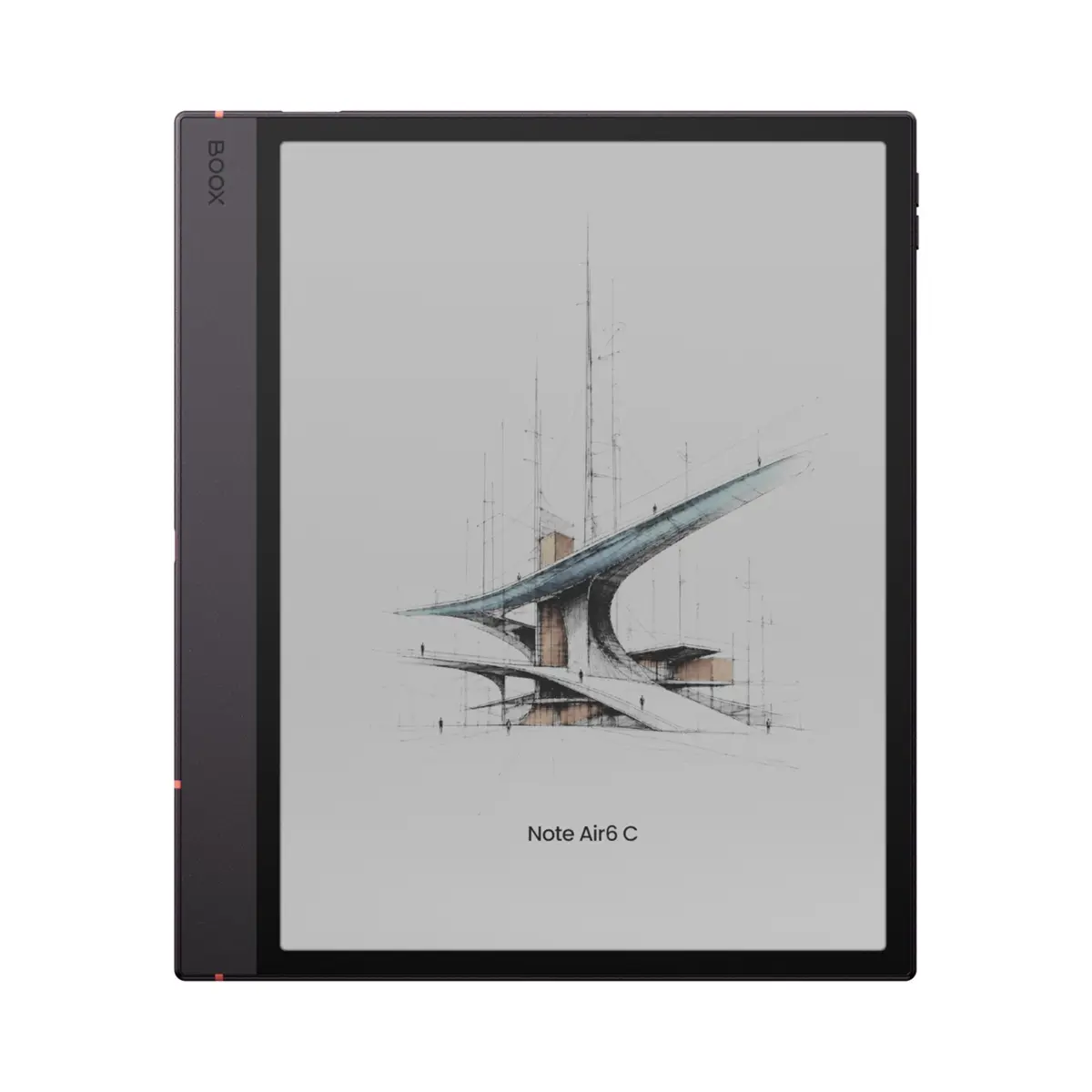
As the direct successor to the Note Air5 C, the BOOX Note Air6 C establishes a new benchmark for 10.3-inch color E Ink tablets. Encased in an ultra-thin 5.8mm premium aluminum chassis with a striking purple-tinted black finish, this device blends high-end industrial design with bleeding-edge internals.
The display utilizes next-generation Kaleido 3 color screen technology, protected underneath an anti-glare flat cover-lens and illuminated by a dual-tone adjustable front light. It delivers crisp, high-contrast 300 PPI clarity for black-and-white typography, while dropping to 150 PPI when rendering a palette of 4,096 vibrant colors. Page-turn speeds and application navigation are accelerated by an updated BSR processing algorithm, which yields a 40% to 45% speed increase and drastically reduces visual ghosting compared to previous generations.
Driven by an upgraded 4nm octa-core processor, 6GB of RAM, and 64GB of storage (expandable to 2TB), the Note Air6 C runs Android 16 with a customized tablet-style UI featuring interactive widgets and a dedicated app dock. Productivity is further enhanced by the included BOOX Pen3 Stylus, which delivers 4,096 levels of pressure sensitivity and features a clever, built-in storage compartment inside the pen body for replacement nibs. Additional hardware inclusions comprise a 3,700 mAh battery, dual stereo speakers, a fingerprint power button, and a magnetic pogo-pin connector supporting charging passthrough.
4. The Note Mini C: Mid-Sized Portability Meets Kaleido 3
- Release Date: September 15, 2026
- Retail Price: $549.00 USD
- Target Audience: Mobile creatives, field researchers, and students needing one-handed color productivity.
Rounding out the hardware blitz is the BOOX Note Mini C, a compact 8.52-inch color E Ink tablet designed to bridge the gap between pocket-sized readers and full-sized 10.3-inch canvases. Weighing just 300 grams and measuring 6mm thick, it is engineered explicitly for effortless one-handed operation.

The screen leverages the same Kaleido 3 color matrix found on its larger sibling, producing 4,096 colors alongside 300 PPI monochrome text rendering. Under the hood, the device packs an octa-core 2.9 GHz processor, 6GB of RAM, and 64GB of internal storage, complete with a microSD expansion slot capable of handling up to 2TB cards.
Running Android 16 with full Google Play access, the Note Mini C ships with the BOOX InkSight magnetic active stylus—featuring a functional side button—and is bundled with an eye-catching orange magnetic folio case. Powering the system is a 3,150 mAh battery, supplemented by Bluetooth 6.0, dual speakers, biometrics via a fingerprint power button, and BSR technology for ghost-free visual transitions.
Supporting Context & Technical Metrics
To fully appreciate Onyx BOOX’s late 2026 product cycle, one must evaluate the macro-level technological shifts implemented across the entire lineup.
| Device Model | Screen Size & Tech | Resolution / PPI | Processor | RAM / Storage | Operating System | Battery Capacity | Key Differentiator |
|---|---|---|---|---|---|---|---|
| Onyx BOOX Picco | 3.97" Monochrome | 480 x 800 (235 PPI) | Unknown Quad/Octa | 16GB (MicroSD to 2TB) | Proprietary/Custom UI | 920 mAh | Ultra-compact micro-form factor |
| BOOX Palma 3 | 6.13" Carta 1200 Mono | 300 PPI | Qualcomm Q-6690 | 6GB / 128GB + MicroSD | Android 16 | 3,950 mAh | Active stylus support & 16MP camera |
| Note Air6 C | 10.3" Kaleido 3 Color | 300 PPI (B&W) / 150 PPI (Color) | 4nm Octa-Core | 6GB / 64GB + MicroSD | Android 16 | 3,700 mAh | Pen3 stylus with internal nib storage |
| Note Mini C | 8.52" Kaleido 3 Color | 300 PPI (B&W) / 150 PPI (Color) | Octa-Core 2.9 GHz | 6GB / 64GB + MicroSD | Android 16 | 3,150 mAh | Highly portable 8.5" one-handed canvas |
The Significance of Android 16 in E-Paper
For years, E Ink manufacturers faced criticism for shipping expensive hardware running heavily outdated versions of Android (often Android 11 or 12), which created long-term security vulnerabilities and software incompatibility issues with modern applications. By transitioning its core 2026 lineup directly to Android 16, Onyx BOOX hasFuture-proofed its devices. Users can now run modern enterprise software, messaging platforms, and heavy reading suites without encountering API deprecation errors or security bottlenecks.
BOOX Super Refresh (BSR) Optimization
Ghosting has historically been the Achilles’ heel of electronic paper displays—particularly when rendering video, scrolling web pages, or utilizing color Kaleido 3 layers. The implementation of advanced BSR algorithms across the Palma 3, Note Air6 C, and Note Mini C addresses this by dynamically shifting pixel refresh rates. This results in a claimed 40% to 45% reduction in page-turn latency, bringing the user experience closer to traditional LCD and OLED tablets without sacrificing eye comfort or battery endurance.

Industry Analysis & Expert Commentary
The 2026 product rollout has sparked lively debate across the digital reading community. Industry veterans have praised Onyx BOOX for refining its industrial design language—particularly the shift toward anodized aluminum and textured fiberglass on the Palma 3 and Note Air6 C. The inclusion of active stylus support in smaller form factors like the Palma 3 indicates a growing demand for micro-notetaking solutions among field journalists, medical professionals, and students.
However, critical voices within the tech community point out that the core reading and note-taking mechanics remain largely iterative. As Michael Kozlowski, Editor-in-Chief at Good e-Reader, notes in his concluding assessment:
"The new Onyx Boox devices are not really doing anything radically new, other than the transition to Android 16 and some minor spec bumps. That said, the Palma 3 has undergone a substantial structural redesign that looks and feels vastly superior to the previous generation."
This perspective highlights a pivotal challenge for the e-reader market: hardware maturation. With screen resolutions plateauing around 300 PPI for monochrome and 150 PPI for Kaleido 3 color, manufacturers must increasingly rely on software ecosystem integration, build material luxury, and ergonomic refinement to drive consumer upgrades.
Future Outlook
As we look toward the horizon of electronic paper technology, Onyx BOOX’s late 2026 strategy offers a clear roadmap for the industry. The successful migration to Android 16 sets a new standard that competing brands—such as Kobo, Amazon Kindle, and Bigme—will inevitably be pressured to match.

Looking ahead, consumer adoption will likely hinge on software ecosystem stability and pricing accessibility. While niche devices like the $99 Picco lower the barrier to entry for micro-readers, high-end color canvases like the Note Air6 C and Note Mini C represent significant financial investments for professionals and creatives.
Whether these incremental upgrades in processing power, BSR refresh speeds, and structural engineering will trigger a massive wave of consumer migration remains to be seen. What is certain, however, is that Onyx BOOX continues to dominate the bleeding edge of versatile, open-ecosystem e-paper engineering.
Will you be upgrading to any of these new Android 16 BOOX devices, or are you sticking with your current hardware setup? Let us know your thoughts in the comments below.

Comments
Facebook App ID not configured. Please add it in the Customizer.