
Executive Overview
In a significant branding and structural shift, Amazon has officially phased out the long-standing “Kindle Unlimited” moniker, transitioning its flagship e-reading subscription service to the streamlined name Kindle+. This change represents the first major nomenclature overhaul for the platform since its inception, signaling Amazon’s intent to modernize and expand the service beyond traditional text-based e-books. However, the launch has been far from seamless.
Simultaneously, the introduction of Kindle+ has brought a massive, highly controversial expansion of audiobooks into the subscription catalog, driven primarily by Amazon’s proprietary AI-generated “Virtual Voice” technology. Designed to rapidly scale content by allowing independent authors on Kindle Direct Publishing (KDP) to convert text into audiobooks at no upfront cost, this move has fundamentally altered the catalog’s composition.
While the new service aims to provide a unified, multimedia subscription experience, the rollout has been plagued by website bugs, international rollout discrepancies, and fierce debate over the quality and integration of AI narration versus professional studio-recorded audiobooks. This report provides an exhaustive, investigative look at the Kindle+ rebrand, the technical missteps surrounding its debut, the integration of AI voice technology, and what this pivotal transition means for the future of digital literature.
Read Also
Detailed Chronology: The Rough Rollout of Kindle+
The transition from Kindle Unlimited to Kindle+ began quietly across Amazon’s digital infrastructure, quickly snowballing into a chaotic deployment marked by broken links, contradictory product pages, and widespread user confusion across multiple international markets.
The Initial Transition and Website Glitches
When Amazon flipped the switch on the Kindle+ branding, the company seemingly failed to update its sprawling ecosystem of product listings, landing pages, and cross-promotional banners. Consequently, the transition was immediately marred by system-wide bugs and glaring administrative errors.
For instance, promotional materials and checkout pages for unreleased flagship hardware—such as the highly anticipated Kindle Colorsoft Signature Edition—continued to reference the outdated "Kindle Unlimited" branding days after the official announcement. This disconnect created immediate friction for consumers attempting to understand what benefits came bundled with their device purchases.
Inconsistent Hardware Bundling and Regional Discrepancies
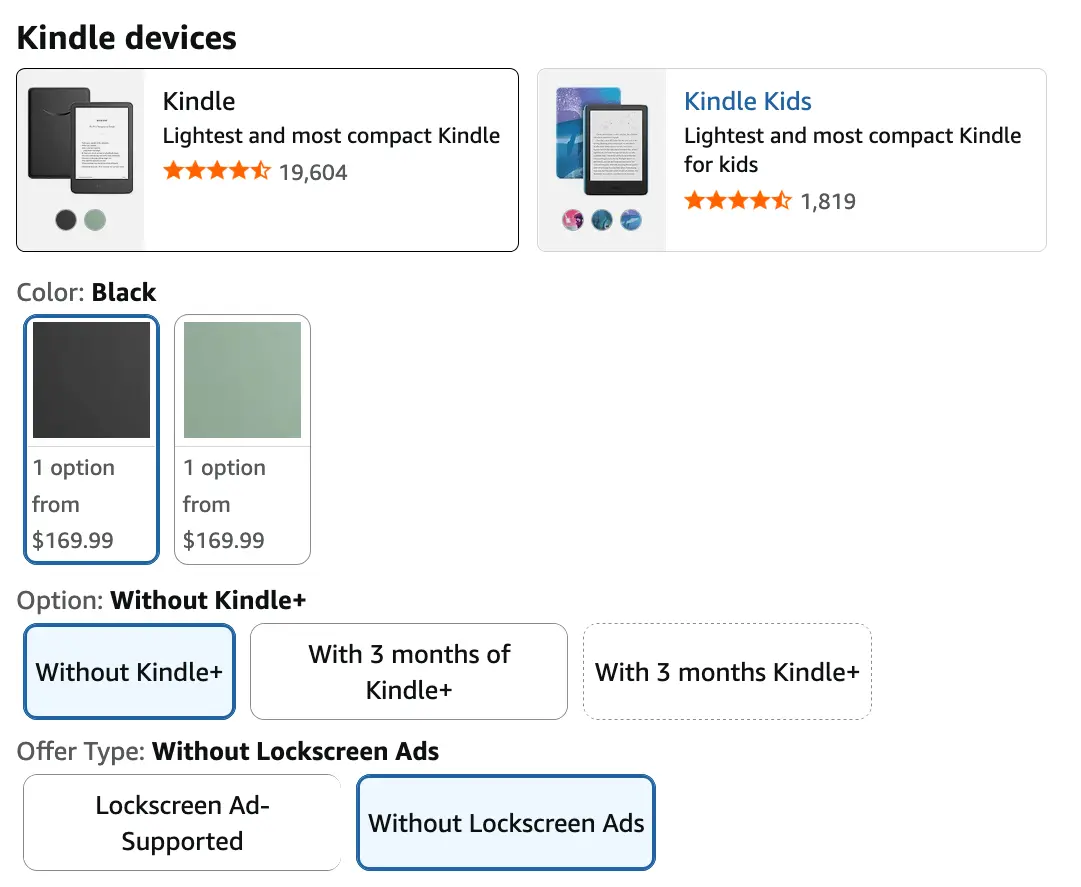
The implementation errors extended deep into hardware sales funnels. When consumers attempted to purchase older, 11th-generation Kindle devices (available in colors such as basic Black or the popular Matcha), the site displayed erratic subscription options. Some purchasing paths offered a choice between "Without Kindle+" and erratic text boxes of varying sizes reading "With Kindle+," indicating broken cascading style sheets (CSS) or faulty backend database flags.
Compounding the issue, newer hardware iterations—such as the newly designed Kindle featuring an premium aluminum back plate—mysteriously omitted the option to enroll in Kindle+ entirely during the checkout process. Rather than presenting a unified upsell opportunity, the checkout workflow became a maze of missing toggles and contradictory text strings.
These technical failures were not contained to the United States marketplace. Consumers in international territories, including the United Kingdom and Canada, reported identical systemic errors, proving that the rollout suffered from a lack of regional quality assurance and uncoordinated backend deployments.
Supporting Context & Metrics: The Mechanics of AI "Virtual Voice"
Beyond the cosmetic rebranding and website glitches, the most impactful—and controversial—dimension of Kindle+ is the massive integration of audiobooks, heavily weighted toward Amazon’s Virtual Voice technology.
Scaling the Catalog via Kindle Direct Publishing (KDP)
To transform Kindle+ into a comprehensive hybrid reading and listening service, Amazon required an expansive inventory of audiobooks almost overnight. Traditional audiobook production is notoriously capital-intensive and time-consuming, requiring professional voice actors, dedicated sound engineers, and multi-day studio recording sessions. To bypass these economic and logistical bottlenecks, Amazon turned inward, leveraging its proprietary generative AI tools.
Under the updated KDP Select guidelines, independent authors publishing e-books can utilize Amazon’s Virtual Voice technology to generate AI-narrated audiobooks completely free of charge. If an author’s e-book is enrolled in the KDP Select program, the newly minted AI-generated audiobook is automatically integrated into the Kindle+ subscription catalog.

This mechanism allows Amazon to inflate its audiobook catalog metrics exponentially, converting millions of indie e-books into spoken-word formats with a single click. For Amazon, this creates an attractive value proposition: a vastly larger content library that seemingly rivals dedicated audiobook giants like Audible or Spotify.
The Consumer Value Proposition: A High-Stakes Gamble
However, industry analysts and long-time digital readers point out that quantity does not equal quality. The infusion of thousands of synthetic-voice audiobooks into the main search and recommendation architecture creates a distinct consumer dilemma.
Subscription services rely heavily on discovery. When subscribers browse Kindle+, distinguishing between a meticulously crafted, emotionally resonant performance by a seasoned professional narrator and a flat, synthesized AI voice becomes increasingly difficult without deep inspection of the metadata. For purists who value the human element of narration—pacing, character inflection, dramatic tension, and emotional nuance—the current catalog structure feels less like an upgrade and more like a lottery.
Industry Perspectives & Critical Analysis
The introduction of AI narration on an industrial scale has polarized the publishing and audio entertainment sectors. Industry veterans argue that while generative AI has valid utility in accessibility applications (such as text-to-speech for visually impaired readers), forcing synthetic audiobooks into a mainstream commercial subscription tier devalues the art of professional narration.
The Divide Between Studio Production and Algorithmic Scaling
In traditional audiobook production, the narrator acts as a secondary author, interpreting subtext and breathing life into characters. Professional narrators undergo rigorous vocal training, maintain union standards, and work collaboratively with directors to ensure artistic integrity.
Conversely, Amazon’s Virtual Voice relies on neural text-to-speech models that, while improving rapidly, frequently struggle with complex homographs, regional accents, foreign words, and nuanced emotional cues. When these synthetic files are placed side-by-side with studio-recorded masterworks under the uniform banner of Kindle+, it creates an uneven user experience that risks alienating audiophiles.
Industry commentators have pointedly framed the situation:
"I only listen to Audible audiobooks with proven narrators; subscribing to Kindle+ just for audiobooks is a gamble right now. It will be hard to find audiobooks with legit narrators who are trained, sit in a studio with a sound engineer, and ones that click ‘turn my e-books into an audiobook with AI.’"
This sentiment captures the core anxiety of the consumer base. Subscribers are paying for peace of mind and curated quality; introducing a massive wave of algorithmically generated content without clear demarcation undermines that trust.
Future Outlook: What Lies Ahead for Kindle+?
As Amazon works behind the scenes to patch the backend bugs plaguing its international web stores and finalize hardware integration for upcoming releases like the Kindle Colorsoft Signature Edition, the platform faces a critical juncture regarding its content strategy.
Market observers and publishing insiders anticipate two inevitable outcomes as the Kindle+ ecosystem matures:
- Mass Subscriber Pushback or Churn: If the influx of synthetic narration continues to dilute search results and user recommendations, frustrated subscribers accustomed to high-production Audible titles may cancel their memberships, viewing Kindle+ as an over-hyped, lower-quality alternative.
- Catalog Segregation: To preserve user trust and improve search relevance, Amazon will likely be forced to segregate AI-generated "Virtual Voice" audiobooks into a clearly labeled, distinct category or filter. Allowing users to opt-out of synthetic narration entirely would restore confidence and give consumers granular control over their listening experiences.
Ultimately, the rebrand from Kindle Unlimited to Kindle+ was intended to signal a bold new chapter in Amazon’s digital reading dominance. Yet, how the company manages the friction between rapid technological scaling and consumer expectations for quality will determine whether Kindle+ becomes a triumphant multimedia standard or a cautionary tale of algorithmic overreach.





Comments
Facebook App ID not configured. Please add it in the Customizer.