
Executive Overview
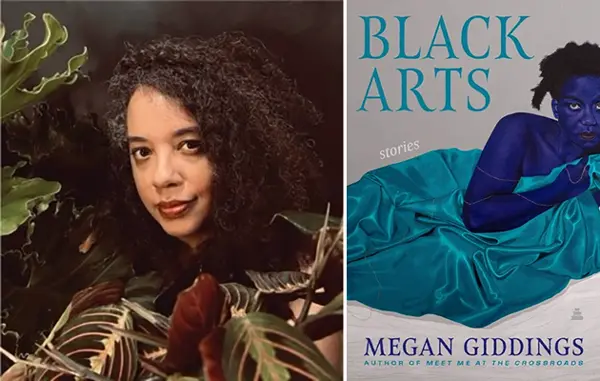
In the contemporary literary landscape, few authors weave the unsettling boundaries of psychological horror and speculative fiction quite as adeptly as Megan Giddings. Renowned for her critically acclaimed novels, Giddings returns to the literary conversation with her latest release, Black Arts. This striking collection laces sharp, masterfully crafted narratives with speculative elements and horror tropes, deeply probing the human condition.
The conceptual foundation of Black Arts—which focuses heavily on Black women artists navigating the treacherous terrain of creative authenticity versus market-driven expectations—was catalyzed by an unexpected moment of cultural observation in a Dublin hotel room. Confronted by international discourse regarding the necessity of a "shared reality" in an age of artificial intelligence, Giddings experienced a profound realization: for marginalized communities, navigating the world often means operating entirely outside the consensus reality experienced by the majority.
To achieve the macro-level reflections on reality present in Black Arts, Giddings frequently pulls from literary traditions that blur the lines between the mundane and the surreal. Eschewing the ubiquitous influences of genre titans like Kelly Link and Octavia Butler, Giddings has curated a personal canon of short story collections that fundamentally informed her writing process. This feature explores the intersection of marginalization, fractured realities, and the five transformative short story collections—ranging from Jen George’s unsettling domesticity to Kenji Miyazawa’s Meiji-era fables—that helped bring Black Arts to life.
Read Also

Detailed Chronology: From MFA Burnout to Black Arts
To understand the artistic rigor behind Black Arts, one must trace Giddings’s trajectory through the modern literary ecosystem—a journey defined by professional pivots, creative exhaustion, and the eventual reclamation of her storytelling voice.
The Post-MFA Landscape and Digital Fatigue
Years before cementing her status as a powerhouse in speculative literature, Giddings found herself at a crossroads familiar to many modern writers. Fresh out of her MFA program, she navigated the precarious economic realities of the literary job market by stepping into a corporate social media management role.
Caught in the relentless cycle of digital metrics, algorithm updates, and platform anxieties—typified by the stress dreams induced by tools like TweetDeck—Giddings faced a severe creative drought. The pursuit of feeling like a "writer" had been temporarily eclipsed by the soul-crushing realities of digital labor.
Reawakening Through Surrealism
The catalyst for her return to fiction came not from traditional kitchen-sink realism, but from the weird, unmooring spaces of speculative short fiction. Specifically, reading Jen George’s collection The Babysitter at Rest provided the necessary creative jolt. The title story—a masterclass in atmospheric atrophy where consensus reality disintegrates around the protagonist—reminded Giddings of the power inherent in narrative disorientation. This reawakening set off a chain reaction of editorial work, novel writing, and ultimately, the synthesis of ideas that culminated in Black Arts.
The International Spark: Dublin, AI, and Consensus Reality
The final philosophical framework for Black Arts solidified during a trip to Dublin. Jet-lagged and "time-drunk" in a hotel room, Giddings became transfixed by an overseas television broadcast. The segment featured a bizarre hybrid panel of individuals solving math equations, throwing darts, and engaging in sophisticated discourse on artificial intelligence.
During the broadcast, a commentator asserted that without strict regulations, humanity would forfeit one of its most underrated resources: a "shared reality."
This singular statement lingered in Giddings’s consciousness, serving as a direct counterpoint to her lived experiences in the United States. To Giddings, the notion of a universally shared reality has always been an illusion. For marginalized people, daily existence requires constant navigation of a fractured reality—one dictated by systemic biases, distinct cultural experiences, and the dominant majority’s willful blindness to these divergences. This epiphany directly influenced Black Arts, mapping out the psychological landscapes of Black women artists trying to capture truths that traditional structures refuse to validate.
Supporting Context & Metrics: The Anatomy of Marginalized Realities
Giddings’s exploration of "fractured realities" is not merely a stylistic choice; it is an interrogation of social psychology and institutional structures. When writing about marginalized lives, the friction between the individual’s lived experience and the dominant societal narrative generates the tension characteristic of great speculative fiction.
The Economics of Authenticity in Art
At the heart of Black Arts lies a central artistic dilemma: Do marginalized artists produce work designed to satisfy the palatable, marketable expectations of the majority, or do they risk alienation by rendering their unvarnished, complex realities?
| Narrative Focus | Market-Driven Expectation | Lived Marginalized Reality |
|---|---|---|
| Aesthetic Presentation | Safe, universally digestible tropes; frictionless comfort. | Fragmented truths; systemic friction; psychological survival. |
| Character Agency | Predictable arcs conforming to consensus norms. | Multi-dimensional characters operating under distinct social pressures. |
| Genre Blending | Strict adherence to commercial genre boundaries. | Fluid integration of horror, surrealism, and literary fiction to mirror macro-level societal anxieties. |
By utilizing elements from horror and surrealism, Giddings forces readers to step outside their comfort zones. Speculative fiction provides the metaphorical distance required to examine systemic inequities without the immediate defensive postures often triggered by direct, realistic-fiction critiques.
Official Statements & Curated Insights: Giddings’s Personal Canon
Below are the five foundational short story collections that guided Megan Giddings through the creation of Black Arts, accompanied by her critical reflections on their structural and thematic brilliance.
1. The Babysitter at Rest by Jen George
- Publisher: Dorothy, a Publishing Project (SPD, dist.)
- Format/Length: Trade paper, 168 pp.
- ISBN: 978-0-9973666-2-4
- Giddings’s Take: "I first read this story collection the fall after I graduated from my MFA program. I was working as a social media manager and while I was trying to feel like a writer, I was feeling mostly like someone who was having stress dreams about TweetDeck. What made me want to start writing again was the title story, ‘The Babysitter at Rest,’ in which reality atrophies around the main character. It’s a story about the ways that people like to infantilize a certain kind of young woman, how some of us might infantilize ourselves when we’re young and beautiful in an effort to (hopefully) use attention as power. It also features a stunt with cement at a birthday party that goes tragically wrong, killing a roommate and destroying a pool."
2. Night Beast by Ruth Joffre
- Publisher: Black Cat
- Format/Length: Trade paper, 208 pp.
- ISBN: 978-0-8021-2808-9
- Giddings’s Take: "I love this collection. The most interesting thing to me is Joffre’s talent for showing uncomfortable or problematic situations and making it clear why her characters would want to be in them. Reality distorts in these stories not just from their creative premises, but from the characters’ desires to push and warp the world around them. On a personal note, ‘Softening’ is the first story that I ever worked on as an editor that ended up in a published collection, so I also have a real tender spot for this book. It’s still so exciting to know a writer is talented and see a publisher agree."
3. Reconstruction by Alaya Dawn Johnson
- Publisher: Small Beer Press
- Format/Length: Trade paper, 256 pp.
- ISBN: 978-1-61873-177-7
- Giddings’s Take: "The second story in this collection, ‘They Shall Salt the Earth with Seeds of Glass,’ takes place in a speculative future where Earth is being terrorized by beings called ‘The Glassmen.’ The genius of this story—and the collection as a whole—is that Johnson knows well the ways that people’s anxieties about the unknown can create rumors and shape a shared sense of reality. Also, Libby is a devastating character. She’s trying to take care of everyone!"
4. Bliss Montage by Ling Ma
- Publisher: Farrar, Straus and Giroux
- Format/Length: Hardcover, 240 pp.
- ISBN: 978-0-374-29351-2
- Giddings’s Take: "’Returning’ is one of the few stories about writers that I don’t feel embarrassed recommending. In it, a writer describes taking a trip to Eastern Europe with her husband, where he wants her to take part in a strange ritual, and she reflects on her extramarital affair. In many ways, it’s the piece in the book that feels the most like traditional literary fiction. There are no hundred boyfriends or Narnia-esque spaces; it’s about how the writer can use a relationship to promise to be a certain kind of person, but no relationship can change who she fundamentally is."
5. Once and Forever by Kenji Miyazawa (Trans. by John Best)
- Publisher: New York Review Books
- Format/Length: Trade paper, 288 pp.
- ISBN: 978-1-68137-260-0
- Giddings’s Take: "Look, this story collection has the dated politics of being written by a writer who was born in Meiji-era Japan. Don’t get mad at me! In ‘The Dahlias and the Crane,’ Miyazawa is writing in a fable tradition (anthropomorphized nature used to teach the reader a life lesson), but with complex characters. There is a crane who just wants to fly around and chill, but the dahlias always want him to talk to them about their looks. The end, where Miyazawa reminds the reader that nature is always subject to the whims of men, is unusually devastating."
Future Outlook: The Evolution of Speculative Literary Fiction
As Black Arts finds its place on bookshelves worldwide, Megan Giddings’s trajectory points toward an increasingly vital sub-genre of contemporary literature: fiction that refuses to separate high literary craft from the destabilizing mechanics of horror and speculative surrealism.
The literary world is experiencing a paradigm shift. Readers and critics alike are growing fatigued by sanitized narratives that pretend a monolithic "shared reality" exists without friction, inequality, or institutional distortion. Authors like Giddings, informed by eclectic reading habits that span from contemporary indie presses to Meiji-era fables, are charting a new path forward.
By continuing to interrogate the boundaries of what is real, what is marketable, and what is survived, Giddings ensures that speculative literature remains one of our most potent tools for cultural critique. In an era dominated by rapid technological changes, algorithmic echo chambers, and the ongoing splintering of social consensus, Black Arts and the works that inspired it offer a necessary mirror—reflecting not the world we wish we lived in, but the complex, multifaceted realities we actually navigate every day.





Comments
Facebook App ID not configured. Please add it in the Customizer.