
Executive Overview
The global e-reader market has long been dominated by large-format, dedicated reading tablets from industry giants such as Amazon, Kobo, and Boox. However, a parallel, highly passionate sub-market of consumers has continuously demanded ultra-portable, pocket-sized reading devices that can comfortably fit into a pair of jeans, a small purse, or a jacket pocket. Enter Xteink, an agile Chinese technology startup that carved out a niche with its impossibly thin XTEINK X4. Building upon the foundational success of that device, the company is preparing to launch its highly anticipated successor: the XTEINK S4.
The XTEINK S4 represents a monumental shift in philosophy for the hardware manufacturer. While the predecessor relied on a proprietary, closed Linux-based operating system that severely restricted users to factory-installed software, the S4 transitions to a versatile, open Android 11 platform. This architectural pivot transforms the diminutive device from a novelty e-reader into a fully fledged, customizable micro-tablet capable of running native Android reading applications like Kindle, Kobo, and KOReader.
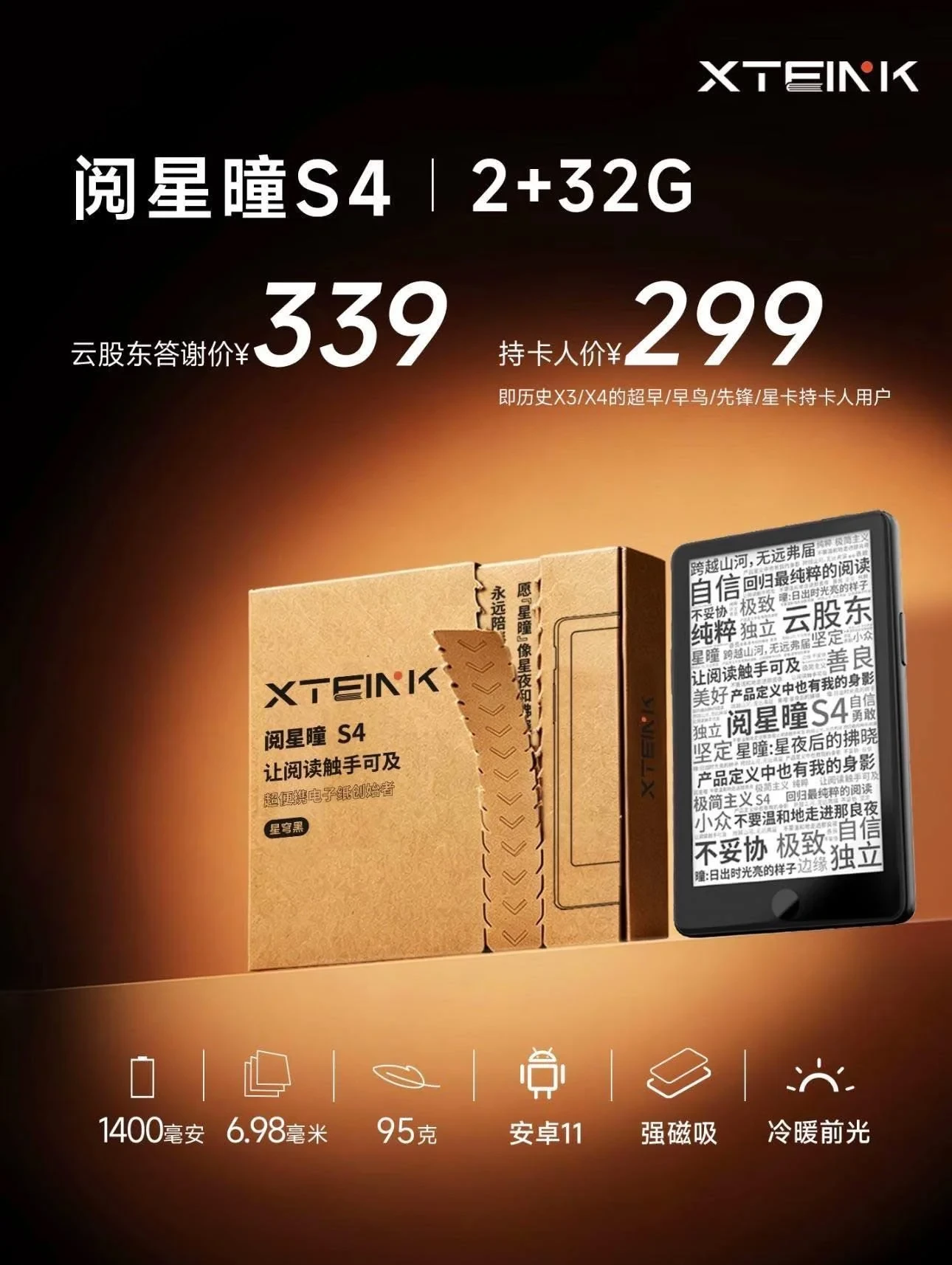
Weighing a mere 95 grams and measuring a paper-thin 6.98 millimeters in thickness, the XTEINK S4 packs a remarkably dense feature set into its ultra-compact chassis. Featuring a 4.3-inch E-Ink touchscreen boasting a crisp 220 PPI, integrated temperature-adjustable warm and cool front lighting, a vastly upgraded 1,400mAh battery, and clever MagSafe compatibility on its backplate, the S4 is engineered to challenge conventional wisdom about what a pocket e-reader can achieve. Currently rolling out exclusively within the Chinese domestic market, international tech enthusiasts are already tracking import channels in anticipation of a broader global release. This report delves deep into the specifications, ecosystem implications, and market positioning of the XTEINK S4.
Read Also
Detailed Chronology and Hardware Evolution
To understand the engineering achievement that the XTEINK S4 represents, it is vital to examine the trajectory of the product line. When Xteink first introduced the XTEINK X4, it captured the imagination of minimalists worldwide. The X4 was celebrated for its ultra-thin profile and dedicated focus on distraction-free reading. Yet, despite its aesthetic appeal, the device faced substantial criticism from power users due to its restrictive, closed Linux firmware. Readers were locked out of their preferred digital bookstore ecosystems unless they manually converted and sideloaded files via cumbersome transfer methods, entirely unable to sync reading progress natively through official cloud apps.
Recognizing these software limitations, Xteink’s engineering team went back to the drawing board for the S4. The primary developmental milestone was transitioning the operating system architecture from Linux to a tailored, lightweight iteration of Android 11 (32-bit). This engineering pivot required significant optimization to ensure that Google’s resource-heavy mobile OS could run smoothly on low-power E-Ink hardware without draining the battery instantaneously.
Simultaneously, the physical hardware received a comprehensive overhaul. While retaining the beloved ergonomic layout of the previous generation—including physical side page-turn buttons for tactile navigation and a single front home button—the S4 refines its external dimensions. The device retains its signature featherlight 95-gram footprint and slim 6.98 mm profile, making it one of the most pocket-friendly electronic devices on the market.
A major structural addition to the S4’s chassis is the integration of built-in rear magnets. Designed to snap seamlessly onto MagSafe-compatible phone cases and accessories, this feature bridges the gap between smartphone convenience and dedicated e-reader hardware. Users can now mount their e-reader onto magnetic car mounts, stands, or wallet attachments, drastically increasing the device’s versatility in everyday carry (EDC) configurations.
Supporting Context, Specifications, and Technical Metrics
The technical specifications of the XTEINK S4 reveal a carefully calculated balance between performance, energy efficiency, and physical constraints. Designing an Android-powered device with a 4.3-inch form factor requires meticulous hardware selection to prevent thermal throttling and ensure acceptable battery endurance.
Display and Visual Performance
At the heart of the XTEINK S4 is a 4.3-inch E-Ink touchscreen display operating at a pixel density of 220 PPI (Pixels Per Inch). While large-format e-readers routinely push 300 PPI, a 220 PPI density on a sub-five-inch screen provides remarkable sharpness for text rendering, ensuring that smaller font sizes remain crisp and legible without noticeable jagged edges.
Crucially, Xteink addressed one of the most glaring omissions of past micro-readers by integrating a fully adjustable dual-color front-light system. Users can seamlessly blend cool and warm LEDs, allowing for comfortable, glare-free reading in pitch-dark environments without straining the eyes—a stark improvement over ambient-light-dependent predecessors.

Processing Power, Memory, and Storage
Under the hood, the XTEINK S4 is powered by an efficient processor paired with 2GB of RAM. While 2GB of RAM might sound modest by modern smartphone standards, it is more than adequate for managing a dedicated E-Ink reading client, lightweight background syncing services, and basic UI navigation.
To accommodate local digital libraries, audiobooks, and sideloaded applications, the device features 32GB of internal flash storage. This is a substantial allocation for a pocket e-reader, ensuring users can store thousands of EPUBs, PDFs, and audio files without constantly managing local storage constraints.
Power Management and Battery Endurance
One of the most impressive engineering feats of the XTEINK S4 is its energy architecture. Despite maintaining an ultra-thin 6.98 mm profile and a 95-gram weight, Xteink managed to pack a massive 1,400mAh battery into the chassis. Given the minuscule energy draw of a 4.3-inch E-Ink panel—which only consumes power when pixels change state—a 1,400mAh cell translates into phenomenal battery longevity, often lasting days or even weeks of moderate reading on a single charge, depending on Wi-Fi and front-light usage.
Connectivity and Expansion
Modern reading habits extend beyond static text, and the XTEINK S4 accommodates this with comprehensive connectivity options:
- Wi-Fi and Bluetooth: Built-in wireless capabilities allow users to download books directly via cloud apps, sync reading positions across devices, and pair wireless headphones or earbuds for listening to audiobooks and text-to-speech narration.
- USB Type-C: Serving as the primary conduit for rapid charging and wired data synchronization, the universal USB-C port eliminates the need for legacy proprietary cables.
Official Statements and Industry Impact
The announcement of the XTEINK S4 has sent ripples through digital reading communities, enthusiast forums, and tech blogs alike. Industry observers have noted that the device addresses a long-standing vacuum in the market for open-ecosystem micro-readers, a space previously occupied by aging hardware or expensive, specialized hobbyist devices like the Palm Phone running custom launchers.
While official press statements from Xteink’s corporate headquarters have remained concise, focused primarily on the domestic Chinese rollout, company insiders have hinted at aggressive ambitions for international expansion. Because the device runs on an open Android 11 foundation, localized app compatibility is vastly simplified compared to closed ecosystems. Users outside China do not have to rely on custom-translated firmware modifications; they can simply download standard English-language APKs directly from trusted sources or app stores.
Analysts tracking the e-reader sector emphasize that the S4 could inspire larger manufacturers to revisit the sub-five-inch form factor. For years, the industry trend moved inexorably toward larger 7-inch, 8-inch, and 10-inch screens to accommodate manga, academic PDFs, and note-taking stylus integration. The XTEINK S4 serves as a timely reminder that there is a vibrant, highly dedicated demographic of readers who prioritize extreme portability, single-handed operation, and digital minimalism above all else.
Future Outlook and Global Availability
As of right now, the XTEINK S4 remains officially available exclusively within the Chinese domestic market. For eager consumers residing in North America, Europe, and other global regions, acquisition requires utilizing cross-border import platforms, third-party reseller sites, and specialized tech-shipping services.
However, industry indicators strongly suggest that an official international release is on the horizon. Given the widespread global coverage the device has received across prominent tech publications and e-reader communities, Xteink has clear commercial incentives to translate packaging, establish international distribution partnerships, and offer localized software support.
Looking further ahead, the success of the XTEINK S4 may well dictate the future trajectory of pocket-sized reading technology. If an open Android environment on a 4.3-inch E-Ink display proves commercially viable and warmly embraced by consumers, we can expect a wave of competing micro-devices from rival manufacturers. For now, all eyes are on Xteink as it transitions its promising prototype philosophy into a mass-market reality, redefining what it means to carry an entire library in the palm of your hand.



Comments
Facebook App ID not configured. Please add it in the Customizer.