
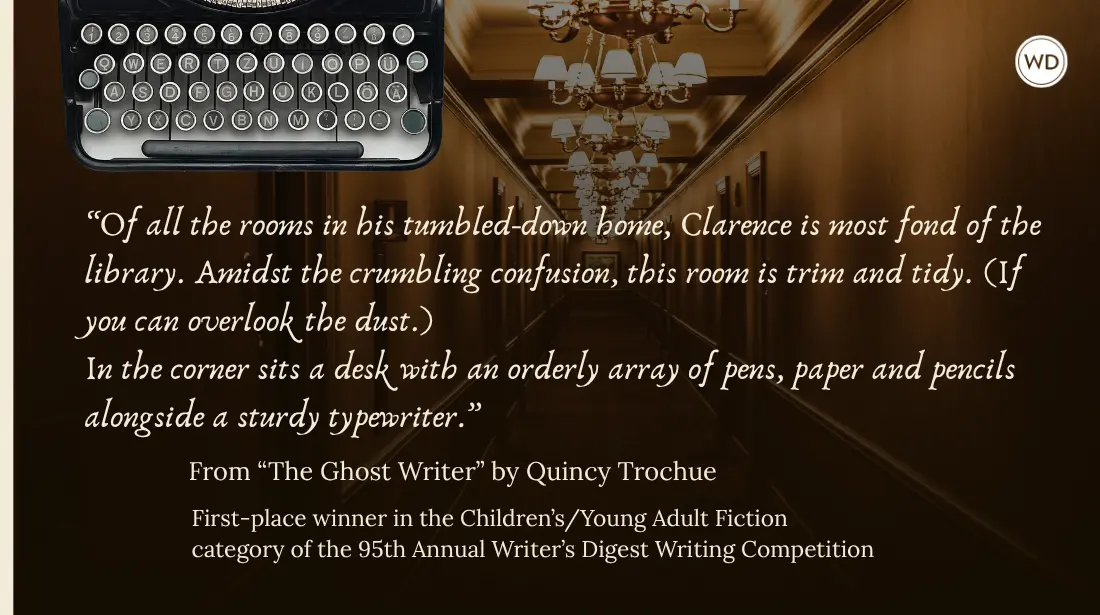
The literary landscape continually rewards ingenuity, voice, and narrative vision. In a remarkable demonstration of these storytelling virtues, Quincy Trochue has captured the first-place honor in the Children’s/Young Adult Fiction category of the 95th Annual Writer’s Digest Writing Competition. Trochue’s winning submission, a delightfully imaginative and deeply resonant tale titled "The Ghost Writer," introduces readers to Clarence—a well-meaning, endearingly inept spectral resident of a dilapidated Victorian house situated precisely at the literal and figurative dead end of Lingering Way.
This professional profile examines Trochue’s award-winning narrative, analyzing its structural brilliance, thematic depth, and cultural resonance within the contemporary children’s and young adult literary spheres. By blending traditional gothic tropes with modern understandings of loneliness, creativity, and unlikely companionship, "The Ghost Writer" transcends standard genre conventions. It offers a masterclass in character development and pacing, establishing Trochue as a formidable new voice in imaginative fiction.
Detailed Chronology: The Evolution of Clarence’s World
To fully appreciate Trochue’s award-winning manuscript, one must trace the meticulously constructed narrative arc that defines "The Ghost Writer." The story unfolds across six distinct, character-driven chapters that chart Clarence’s transformation from a chronically ignored specter to an inspired co-author.
Read Also
Chapter 1: The Plight of the Unseen Resident
The narrative establishes its atmospheric setting at the end of Lingering Way—a literal dead end dominated by an ivy-choked, dust-shrouded Victorian manor. Here, Clarence resides. Unlike the terrifying poltergeists of urban legend, Clarence suffers from a uniquely modern form of performance anxiety: he desperately wants to scare the rare trick-or-treater who braves his door on October 31st, but his chronic indecision sabotages him. By the time he weighs whether to deploy a monstrous moan or a chilling howl, the visitor has departed. His attempts to terrorize the local fauna—mice, spiders, and passing flies—meet with utter apathy, leaving Clarence to confront the most agonizing fate imaginable for a ghost: being entirely ignored.
Chapters 2 and 3: Domestic Routines and Accidental Catalysts
Clarence’s daily routine is a poignant cycle of phantom normality—hovering through non-functional showers and inhaling the scent of coffee beans. His sanctuary is the estate’s library, a dust-laden room dominated by an enormous, cracked gilt mirror where he practices his ghoulish expressions.
A turning point arrives in Chapter 3. While attempting a particularly dramatic swooping maneuver before the mirror, Clarence inadvertently dislodges a heavy brass gong. The resulting cascade triggers a domino effect that collapses a towering bookshelf, bringing down centuries of accumulated dust and hundreds of neglected volumes. Initially horrified by the domestic chaos, Clarence notices the contents of the spilled books. For the first time, he looks past the powdery spines to feast upon the words within: eerie, ghastly, uncanny, ominous, perplexing. A voracious intellectual curiosity is instantly ignited.
Chapters 4 and 5: The Birth of Inspiration and a Fateful Encounter
Immersing himself in the printed word, Clarence discovers an epiphany: terror is not the only emotional resonance available to a storyteller; words can evoke playfulness, daring, and sorrow. As autumn transforms the world outside—painting the leaves in brilliant golds and reds—Clarence’s mind overflows with story ideas. Frustrated by his incorporeal state, which prevents him from lifting a pen, operating a typewriter, or whispering audibly to the cold marble bust on the mantel, he despairs that his stories will remain locked inside him.
However, the approach of Halloween changes everything. As the front door swings open on a squeaking hinge, Clarence braces for his annual opportunity to terrify a human. Instead, he is confronted by Marley, a young neighborhood child wearing a crude bedsheet ghost costume with eye-holes cut out, seeking out the source of the spooky stories she overheard from the sidewalk.
Chapter 6: Collaboration and New Beginnings
Rather than executing a fright, Clarence steps cautiously into the light. A charming dialogue ensues, culminating in Marley introducing herself and grasping the ghost’s freezing hand—her warm flesh passing right through his ethereal form. Delighted to meet an authentic ghost, Marley begs Clarence to finish his tale.
As Clarence spins his narratives, Marley hangs on his every word, gasping and giggling in tandem. This interaction initiates a lasting bond. Marley becomes a regular afternoon visitor after school, organizing the library’s chaotic book stacks while co-creating wildly inventive scenarios with Clarence—shifting fluidly from vampires to pirates, and finally to pirate-vampire hybrids. The narrative culminates in a poignant synthesis of human vitality and ghostly imagination: Marley sits at the sturdy typewriter, her living fingers resting upon the keys, while Clarence hovers protectively at her shoulder. Together, they begin their masterwork with the timeless invocation: “Once upon a time…”
Supporting Context & Metrics: The Writer’s Digest Legacy
The magnitude of Quincy Trochue’s achievement is contextualized by the storied history and rigorous standards of the Writer’s Digest Writing Competition. Now in its 95th year, the competition stands as one of the longest-running, most prestigious international writing contests for self-published and unpublished authors alike.
Competition Scope and Rigor
- Longevity: Spanning nearly a century, the competition has served as an early indicator of emerging literary talent, offering a platform across multiple genres including mainstream fiction, genre fiction, poetry, and children’s literature.
- Competitive Landscape: Thousands of manuscripts are submitted annually from around the globe. Entries are evaluated by a panel of established authors, literary agents, and industry editors based on voice, originality, emotional resonance, technical execution, and thematic depth.
- Category Focus: The Children’s/Young Adult Fiction category demands a delicate balance of accessible language, high narrative stakes, and emotional intelligence—qualities that Trochue’s "The Ghost Writer" exhibits in abundance.
Official Statements and Critical Reception
Industry analysts and competition judges have praised Trochue’s manuscript for its distinct literary merits, noting its exceptional ability to merge classic gothic aesthetics with modern sensibilities about mental health, isolation, and creative expression.
"Quincy Trochue has crafted a modern fairy tale that speaks directly to the universal human—and supernatural—desire to be seen and understood," noted an editorial reviewer close to the competition. "In Clarence, we see the embodiment of creative frustration; in Marley, the healing power of shared imagination. It is a rare work that manages to be simultaneously spooky, hilarious, and deeply heartwarming."
Literary commentators have further observed that Trochue’s treatment of the "haunted house" trope subverts traditional horror expectations. Instead of a site of trauma or malice, the decaying estate at the end of Lingering Way becomes a sanctuary for intellectual awakening and artistic collaboration. The transition from physical fright to narrative communion highlights a sophisticated thematic progression that resonates profoundly with young readers navigating their own places in the world.
Future Outlook: The Horizon for Quincy Trochue
Winning the Children’s/Young Adult Fiction category of the 95th Annual Writer’s Digest Writing Competition positions Quincy Trochue as a significant new voice to watch in the realm of juvenile and young adult literature.
Industry Trajectory
- Publication Potential: Historically, top-tier placements in the Writer’s Digest Writing Competition serve as a powerful launching pad for authors seeking literary representation and traditional or hybrid publishing contracts. "The Ghost Writer" possesses strong crossover appeal, making it an ideal candidate for illustrated middle-grade chapter books or graphic novel adaptations.
- Thematic Expansion: Trochue has demonstrated a rare aptitude for balancing whimsical world-building with emotional depth. Future works exploring similar intersections of the uncanny and the everyday are eagerly anticipated by industry professionals and readers alike.
- Literary Impact: As schools and libraries increasingly seek literature that addresses themes of loneliness and the therapeutic power of storytelling, Trochue’s narrative arrives at a prescient moment. By framing literacy not as an academic chore, but as a magical portal to connection, “The Ghost Writer” champions the transformative joy of reading.
In summary, Quincy Trochue’s triumph in this year’s competition is well-deserved. "The Ghost Writer" is more than a clever seasonal ghost story; it is a timeless celebration of friendship, the resilience of the imagination, and the enduring truth that no one—living or dead—is ever truly beyond the reach of a good story.

Comments
Facebook App ID not configured. Please add it in the Customizer.