
Executive Overview
In the fast-paced, high-stakes ecosystem of the Indian film industry—colloquially known as Bollywood—public personas are meticulously curated, manufactured, and managed by public relations machinery. Yet, every so often, the pristine veneer cracks to reveal raw, untamed human emotion. Prominent Indian filmmaker, producer, and television host Karan Johar recently provided one such rare, poignant glimpse into his private world.
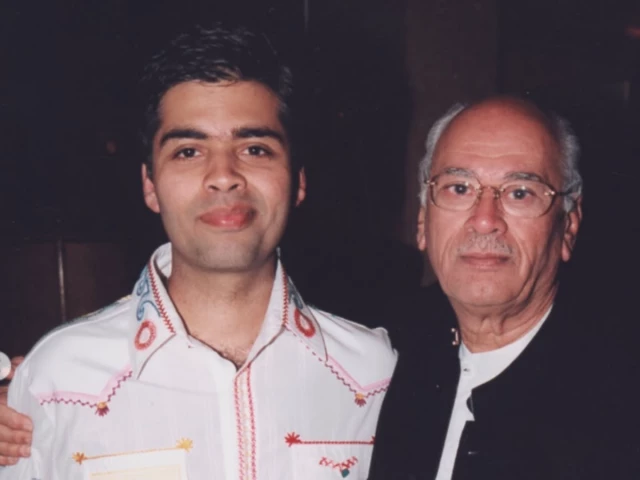
Marking the birth anniversary of his late father, the legendary producer Yash Johar, the founder of Dharma Productions took to social media to share an intimate series of nostalgic photographs and deeply personal anecdotes. Eschewing the typical glossy, hyper-stylized tributes common among high-profile celebrities, Johar opted for a tone of radical vulnerability, gentle self-deprecation, and profound emotional resonance.
The social media tribute was not merely a sentimental walk down memory lane; it served as a masterclass in emotional storytelling. Spanning decades of personal and professional evolution, Johar’s retrospective wove together disparate threads of his life: the giddy, conspicuous consumption of a newly minted blockbuster director, the unconditional and sometimes blinding adoration of a devoted father, and the stark, sobering reality of a parent’s final days under the shadow of terminal illness. At its core, the viral post evolved into a meditation on grief, the enduring weight of paternal wisdom, and the revolutionary power of kindness in an industry frequently defined by ruthlessness and superficiality.
Read Also
This retrospective offers more than a transient moment of celebrity nostalgia. It invites a broader examination of Yash Johar’s foundational role in shaping modern Indian cinema, the unique psychological architecture of industry dynasts navigating loss, and the philosophical tenets that continue to steer Dharma Productions under Karan Johar’s stewardship.
Detailed Chronology: From Childhood Innocence to Industry Stardom
To fully understand the weight of Karan Johar’s recent tribute, one must chart the trajectory of his relationship with his father, Yash Johar—a partnership that served as both the emotional anchor and the professional launching pad for one of Indian cinema’s most influential moguls.
The Foundation of Dharma Productions
Long before Karan Johar became a household name synonymous with opulent weddings, emotionally charged melodrama, and blockbuster global hits, his father was carving out a distinct niche within the Hindi film fraternity. Yash Johar was celebrated for his courtly manners, profound integrity, and unwavering commitment to producing cinema that prioritized emotional resonance, familial bonds, and high production values. Having worked alongside legends like Dev Anand’s Navketan Films and later establishing Dharma Productions in 1976 with Dostana, Yash Johar built a reputation as a producer who valued human relationships over cold-hearted commercial calculations.
When Karan Johar stepped behind the camera for his directorial debut, Kuch Kuch Hota Hai (1998), the cinematic landscape of India was undergoing a seismic shift. Released at the cusp of a new millennium, the film was an unmitigated cultural phenomenon that redefined youth culture, fashion, and romantic storytelling in the diaspora and at home.
The Burberry Jacket Anecdote: A Study in Paternal Groundedness
Among the most charming vignettes shared in Johar’s recent Instagram post was an anecdote from the immediate aftermath of Kuch Kuch Hota Hai’s historic success. Intoxicated by the heady rush of sudden, monumental validation and flush with newly acquired financial capability, a young Karan decided to treat himself to his very first luxury designer purchase.
He recounted visiting a Burberry flagship store, where he gravitated toward a high-end designer jacket. Crucially, as Johar playfully noted, these were his "mega plus-size days," meaning options were severely constrained. Finding the only jacket that physically accommodated his frame, he purchased it, donned it, and walked out feeling, in his own words, "rather smashing."
Enter Yash Johar. Devoid of the sycophancy that inevitably surrounds a successful film director, the elder Johar surveyed his son’s extravagant, imported acquisition with a mixture of profound puzzlement and paternal amusement. Looking at the iconic British plaid, Yash Johar delivered a swift, hilarious reality check, remarking in Punjabi:
"Beta, yeh Burberry nahi… bohat buri hai."
(Son, this isn’t Burberry… it’s very bad.)
For Karan, this gentle teasing encapsulated his father’s entire ethos: deeply rooted, fundamentally basic, and possessing an exquisite, self-effacing sense of humor. Yash Johar was constitutionally incapable of pretension, a trait that frequently clashed with—and brilliantly grounded—his son’s early penchant for theatrical extravagance.
Unconditional Adoration vs. Objective Reality
In the same reflective post, Johar touched upon another facet of his father’s character that many creative individuals desperately crave yet rarely receive: unalloyed, fiercely loyal fandom.
Karan candidly admitted that during phases of his life when his physical appearance was far from conventional—periods when he humorously confessed he looked like he "had eaten an entire country"—Yash Johar’s paternal gaze remained entirely untainted by societal beauty standards. To his father, Karan was not an overweight young man struggling with body image; he was an infallible Adonis.
"You are so handsome—you should become a hero!"
Yash Johar would enthusiastically declare, offering an absolute psychological sanctuary to a son who would later grow up to become one of the most recognized, scrutinized media personalities in the country. This unwavering validation created a secure emotional attachment style that allowed Karan to experiment boldly with his cinematic vision, uninhibited by personal insecurities.
Supporting Context & Metrics: The Anatomy of a Dynasty
The emotional resonance of Karan Johar’s tribute cannot be divorced from the institutional and commercial scale of the empire his father founded and he subsequently expanded. Understanding the stakes of Dharma Productions provides vital context for why moments of personal vulnerability from its leader resonate so deeply across the entertainment ecosystem.
The Evolution of Dharma Productions
Founded nearly five decades ago, Dharma Productions has transitioned through distinct operational eras:
| Era | Key Characteristics | Landmark Releases |
|---|---|---|
| The Paternal Era (1976–2004) | Focus on human relationships, emotional sacrifice, lavish overseas locales, and ethical storytelling under Yash Johar’s direct leadership. | Dostana (1980), Agneepath (1990), Gumrah (1993), Duplicate (1998), Kuch Kuch Hota Hai (1998), Kabhi Khushi Kabhie Gham… (2001), Kal Ho Naa Ho (2003). |
| The Expansion Era (2004–2018) | Aggressive commercial scaling, introduction of the studio model, talent management agencies (DCA), and diversification into digital platforms and distinct genres (action, coming-of-age, psychological thrillers). | Kabhi Alvida Naa Kehna (2006), Wake Up Sid (2009), My Name Is Khan (2010), Student of the Year (2012), Yeh Jawaani Hai Deewani (2013), Baahubali (Hindi Distribution, 2015), Raazi (2018). |
| The Contemporary Era (2018–Present) | Multi-platform content creation, strategic equity partnerships (such as Adani Enterprises’ planned stake acquisitions), pan-Indian cinematic distribution, and high-stakes streaming content (Netflix, Amazon Prime Video). | Shershaah (2021), Brahmāstra: Part One – Shiva (2022), Rocky Aur Rani Kii Prem Kahaani (2023), Kill (2024). |
The Psychological Cost of Public Success
When Yash Johar passed away in June 2004 following a prolonged battle with cancer, the loss sent catastrophic shockwaves through Karan’s personal and professional life. As noted in his retrospective, the filmmaker views his father’s death as an irrevocable fracture:
"He left a void in my life 22 years ago that I refuse to fill and I never will. When you lose a parent, you gain a God. He is my God."
In an industry where relationships are notoriously transactional, Karan Johar’s grief serves as a stabilizing, humanizing thread. For decades, cultural critics have analyzed Johar’s filmography—notably his persistent cinematic explorations of complex family dynamics, parental validation, and unrequited familial love—as a direct artistic manifestation of this foundational loss. Films like Kabhi Khushi Kabhie Gham…, where the patriarch Yashvardhan Raichand (played by Amitabh Bachchan) demands unquestioned filial obedience before undergoing a redemption arc centered on love, bear striking thematic parallels to the Johar family dynamic.
Official Statements & Industry Reactions
The deeply personal nature of Karan Johar’s Instagram post triggered an immediate, impassioned wave of responses from the upper echelons of the Indian film fraternity, bridging generational divides and highlighting the enduring respect commanded by the Johar family name.
Peer and Celebrity Tributes
Prominent figures within the Hindi film industry—many of whom grew up under the protective, nurturing umbrella of Yash Johar’s hospitality—rallied in the comments section to offer solidarity and reverence.
- Manish Malhotra, legendary fashion designer and a lifelong confidant of the Johar family, expressed his enduring love and deep reverence for Yash Johar’s memory. Malhotra, whose career ascension closely mirrored Dharma Productions’ aesthetic evolution in the late 1990s and 2000s, has frequently noted how Yash Johar treated everyone on a film set with equal dignity, regardless of their billing.
- Kareena Kapoor Khan, a generational icon of Indian cinema whose career was significantly shaped by her collaborations with Karan Johar (starting notably with Kabhi Khushi Kabhie Gham…), left symbolic tokens of affection, acknowledging the profound emotional imprint left by the patriarch.
The Final Words on Kindness
Perhaps the most arresting element of Johar’s public post was his recollection of his father’s final days. Undergoing rigorous chemotherapy sessions that drained his physical vitality, Yash Johar summoned his son to deliver a final, enduring moral directive—one that starkly contrasts with the cynical, hyper-competitive realities of modern show business.
Recalling that poignant conversation, Johar wrote:
"In his last days, he told me post his chemo session, ‘I don’t want to leave mom and you, but I feel like I am going to. Just promise me you will always be kind. Success means nothing if you’re not kind.’"
This ethical mandate serves as the ideological bedrock of Karan Johar’s public and professional survival. Despite frequently facing intense public scrutiny, social media vitriol, and the pressures of running a multi-billion-rupee entertainment conglomerate, Johar has consistently returned to this core philosophical axiom. In an industry where professional failure is weaponized and success breeds intense isolation, Yash Johar’s dying wish remains a hauntingly simple yet radical prescription for grace.
Future Outlook: Honoring the Past While Shaping the Future
As Karan Johar navigates his third decade as a leading figure in Indian cinema, his retrospective gaze is paradoxically paired with an aggressive, forward-looking slate of creative endeavors. The emotional grounding provided by his father’s enduring memory continues to fuel a remarkably diverse professional renaissance.
Upcoming Cinematic Ventures
Recent industry developments indicate that Johar is preparing to step back into the director’s chair with renewed vigor. Following the critical and commercial success of his 2023 romantic drama Rocky Aur Rani Kii Prem Kahaani—a film that successfully married classic Dharma emotionality with contemporary socio-cultural commentary—reports confirm that Johar is set to film two back-to-back features.
Industry insiders reveal that this upcoming slate will explore contrasting narrative textures:
- An Intense Love Story: A project designed to return Johar to his signature explorations of yearning, heartbreak, and soaring romanticism, filmed with contemporary stylistic rigor.
- A Grand Family Saga: A sweeping, multi-generational epic that directly channels the thematic DNA of Kabhi Khushi Kabhie Gham…, exploring the friction between traditional familial expectations and modern individual autonomy.
Television and Digital Domination
Beyond feature films, Johar continues to dominate India’s non-fiction television and streaming landscapes. Earlier this month, he successfully wrapped up production on the second season of the high-stakes reality competition series The Traitors, proving his versatility across diverse formats. Furthermore, through his digital content arm, Dharmatic Entertainment, Johar remains a primary engine for content creation across global streaming platforms, ensuring that the foundational storytelling principles instilled by Yash Johar continue to adapt to changing consumer habits worldwide.
Conclusion: A Timeless Moral Compass
Ultimately, Karan Johar’s birthday tribute to his late father transcends the ephemeral metrics of social media engagement. It stands as a powerful public testament to the reality that behind the glittering facade of Bollywood glamour, box office tallies, and corporate strategy lies the universal, unyielding grief of a son missing his father.
By sharing the humorous memory of an ill-fitting Burberry jacket alongside the profound, solemn gravity of a dying father’s plea for kindness, Johar has offered the public a rare gift: a reminder that true legacy is measured not in corporate valuations or cinematic blockbusters, but in the enduring capacity to remain deeply rooted, profoundly human, and relentlessly kind.




Comments
Facebook App ID not configured. Please add it in the Customizer.