For decades, writing pedagogy has treated the foundational premise of transformational fiction as a straightforward formula: the protagonist believes a lie, encounters conflict, and eventually learns the thematic truth. In her seminal instructional texts, author and theorist K.M. Weiland popularized the concept of "The Lie the Character Believes" as the essential psychological anchor for positive and negative change arcs.
However, a sweeping conceptual reevaluation by Weiland posits that this long-standing terminology requires a profound evolution. Drawing on Jungian psychology, sociological frameworks, and developmental philosophy, the updated theory suggests that the "Lie" is rarely a deliberate falsehood or a simple logical error. Instead, it operates on a continuum of human consciousness—serving initially as a functional truth, later hardening into a rigid ego identity, and ultimately manifesting as a psychological fissure between the surface self and deeper inner wholeness.
This investigative analysis examines the evolution of Weiland’s character arc framework, mapping out how the understanding of narrative psychology is shifting from mechanical "transformation" to organic "alignment." By synthesizing insights from Carl Jung, sociologist Thomas Luckmann, and contemporary developmental thinkers, this report explores the mechanics of narrative arcs, the role of social conditioning, and what this paradigm shift means for contemporary storytellers.
Detailed Chronology: The Evolution of "The Lie" in Narrative Theory
To understand the magnitude of this theoretical pivot, it is necessary to trace how character arc mechanics have been taught and understood over the past twenty years.
Phase 1: The Mechanical Era of Story Structure (Early 2000s)
In the nascent stages of modern screenwriting and novel-writing guides (popularized by gurus like Blake Snyder, Robert McKee, and later K.M. Weiland), character flaws were largely treated as mechanical components. The protagonist started with a clearly defined defect or a mistaken belief about the world—such as "I am unlovable" or "Money is the only source of security." The narrative served as a gauntlet designed to disprove this specific falsehood, forcing the character to adopt its binary opposite by the climax.
Phase 2: The Continuum of Perspective (2010s)
As narrative theory matured, theorists recognized that binary definitions of "Lie vs. Truth" were overly simplistic. Weiland and others began framing the concept as a spectrum. In this intermediate phase, the "Lie" was redefined not as an absolute falsehood, but as a comparatively limited perspective.
The Mechanism: What worked as a survival mechanism for a character in Act I (such as Feyre’s hyper-focused self-reliance in A Court of Thorns and Roses) inevitably became a liability when thrust into a broader, more complex environment. Yesterday’s truth became tomorrow’s limitation.
Phase 3: The Consciousness Paradigm Shift (Present Day)
The current evolution moves past mere cognitive adjustments into the realm of depth psychology. Weiland’s recent analytical frameworks argue that deep internal transformations do not feel like switching from a wrong idea to a right one; rather, they feel like clarity.
The Core Premise: The character’s initial belief is actually a coping mechanism born from early childhood wounds (the "Ghost"). When that coping mechanism outlives its utility, it turns into an ego identity—a defensive shell that separates the conscious self from the total psyche. Consequently, a successful character arc is less about radical transformation and more about alignment: stripping away the false self to reveal a deeper, pre-existing authenticity.
Supporting Context & Metrics: The Three Models of the Lie
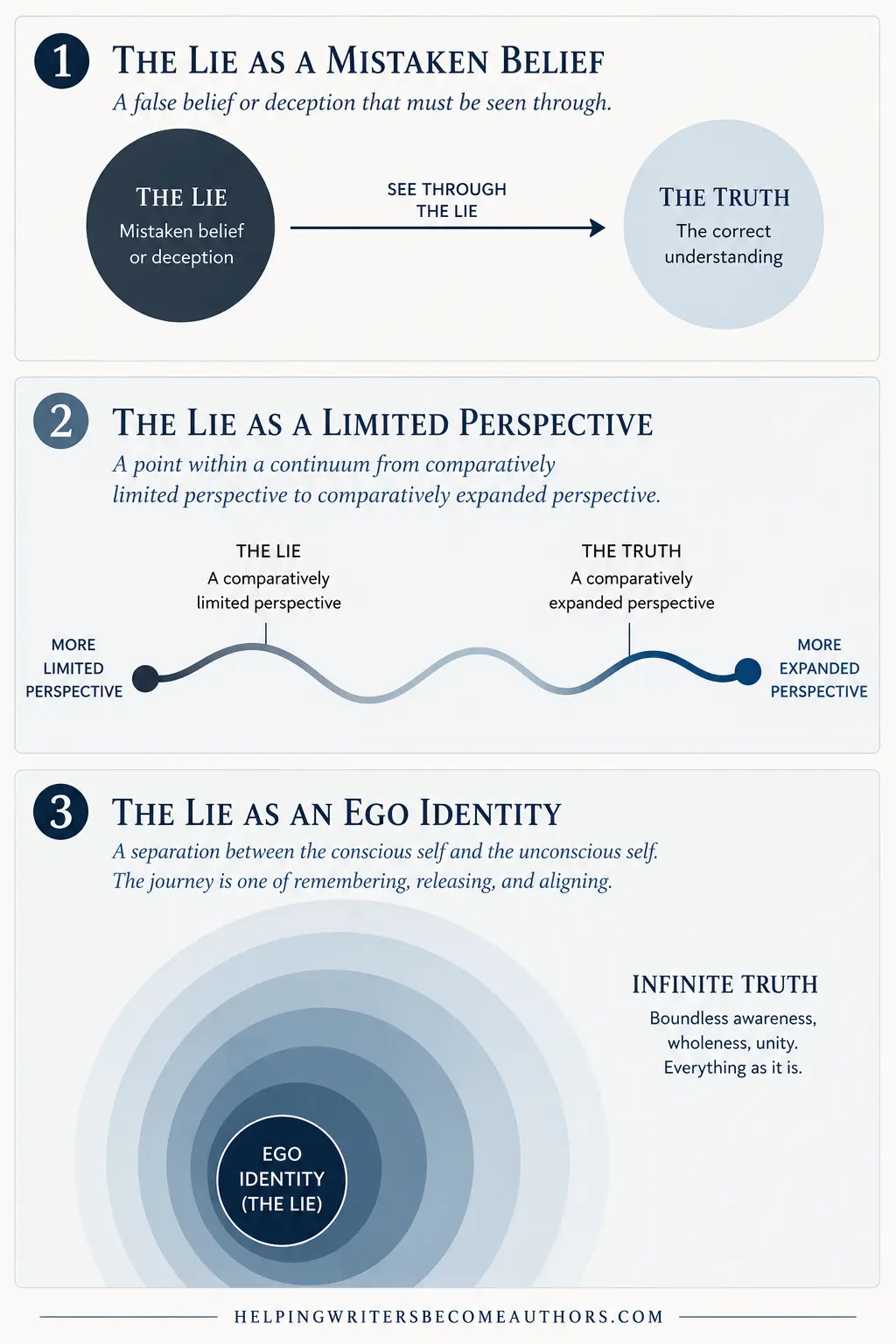
To help writers navigate this psychological depth, Weiland’s updated framework introduces three distinct, increasingly complex models for understanding how limiting beliefs function within a narrative.
[Model 1: Mistaken Belief] ---> [Model 2: Limited Perspective] ---> [Model 3: Ego Identity / Separation]
  (Outright deception)           (A point on a continuum)           (Fissure in consciousness)
Model 1: The Mistaken Belief
At its most fundamental level, the Lie functions as an outright deception or a surface-level error in judgment.
Application: Common in genre fiction, mysteries, and thrillers.
Example: A protagonist believes they were abandoned by their parents out of malice, only to discover later that they were hidden away for their own protection.
Model 2: The Limited Perspective
Here, the Lie and the Truth are not locked in a moral binary of "bad vs. good." Instead, they represent waypoints on a continuous spectrum of human understanding.
Application: Found extensively in coming-of-age stories and multi-book epic fantasy series (such as The Lord of the Rings or the Jane Eyre adaptations).
Example: Elizabeth Bennet’s initial prejudice in Pride and Prejudice is not a comic book villainy; it is simply a localized, narrow worldview that must expand to accommodate a more nuanced reality.
Model 3: Ego Identity and Separation
At its deepest psychological tier, the Lie is understood as an ego-driven defense mechanism. The ego—defined by Jungian psychology as a limited awareness that equates identity with roles, trauma, titles, and social conditioning—creates a severance between the conscious self and the unconscious totality of the psyche.
Application: Literary fiction, deep mythic storytelling, and character-driven dramas (such as Everything Everywhere All at Once or The Truman Show).
Example: Evelyn Wang’s struggle in Everything Everywhere All at Once is not merely about learning to be kinder; it is about shattering her rigid ego-identification with failure, regret, and domestic exhaustion to align with the infinite expanse of existence.
Official Statements & Theoretical Insights
The pivot toward an alignment-based model of character arcs draws heavily on established psychological and sociological authorities. Weiland’s synthesis relies on several key pillars:
1. Carl Jung and the Psychology of Individuation
Jungian scholar Marie-Louise von Franz noted in Man and His Symbols that the ego was never meant to function as an isolated, tyrannical ruler of the mind. Rather, its purpose is to illuminate the greater whole of the psyche.
"The ego must be able to listen attentively and to give itself, without any further design or purpose, to that inner urge toward growth."
In the context of writing, this means that a protagonist’s resistance to change is actually the ego desperately defending its artificial boundaries against the expansive pressures of the unconscious self.
2. Richard Rudd and the Physiology of Suffering
Drawing on Richard Rudd’s work in The Gene Keys, the report highlights that the physical suffering associated with emotional growth is largely an illusion maintained by the frantic, confused mind.
"All it takes is willingness to feel the pain, and the miracle begins."
This informs why the climax of a Positive Change Arc is invariably painful: the character must willingly surrender their protective coping mechanism—their psychological armor—to step into the terrifying unknown of authentic self-awareness.
3. Peter Berger, Thomas Luckmann, and Social Reality
On a macro level, the Lie is not just personal; it is societal. Sociologists Peter L. Berger and Thomas Luckmann established that human reality is largely a social construction. The roles, traditions, and national borders we accept as absolute truths are collective agreements.
When characters navigate a flawed society (or an internal world bound by cultural expectations), they are battling Joseph Campbell’s "Keeper of the Status Quo." Overcoming the socialized Lie is the narrative equivalent of individuation—breaking free from collective hypnosis to find individual sovereignty.
Future Outlook: The Implications for Modern Storytellers
As narrative theory embraces these more nuanced, psychologically sophisticated models, the way writers approach plotting and character development is undergoing a quiet revolution.
1. Moving Away from Manufactured Conflict
Writers who adopt the "Alignment Model" often find themselves moving away from artificial, melodramatic plot hurdles. Instead of forcing characters into arbitrary obstacles simply to tick off structural beat sheets, stories become deep explorations of inner resistance. Conflict arises naturally when a character’s rigid ego identity clashes with the fluid demands of reality.
2. The Rise of Soul-Driven Arcs
In contrast to high-conflict, karmic, ego-driven arcs where characters fight tooth and nail against their own evolution, contemporary and mythic fiction increasingly showcases soul-driven or dharmic arcs (exemplified by archetype models like the Mage). These characters exhibit non-reactivity, understanding that spiritual growth cannot be forced; it can only be accommodated through radical acceptance and the stripping away of falsehoods.
3. A Deeper Resonance with Readers
Ultimately, stories that reflect this psychological journey—where growth is framed as an unmasking rather than an invention—resonate more deeply with audiences. By tapping into the universal human quest to unite conscious awareness with the unconscious self, writers do more than entertain; they provide a mythic mirror for real-world healing and transformation.
As narrative pedagogy continues to evolve, the death of the "Lie" as a simple falsehood opens the door to a richer, more profound understanding of what it means to write—and to be human.








Comments
Facebook App ID not configured. Please add it in the Customizer.