
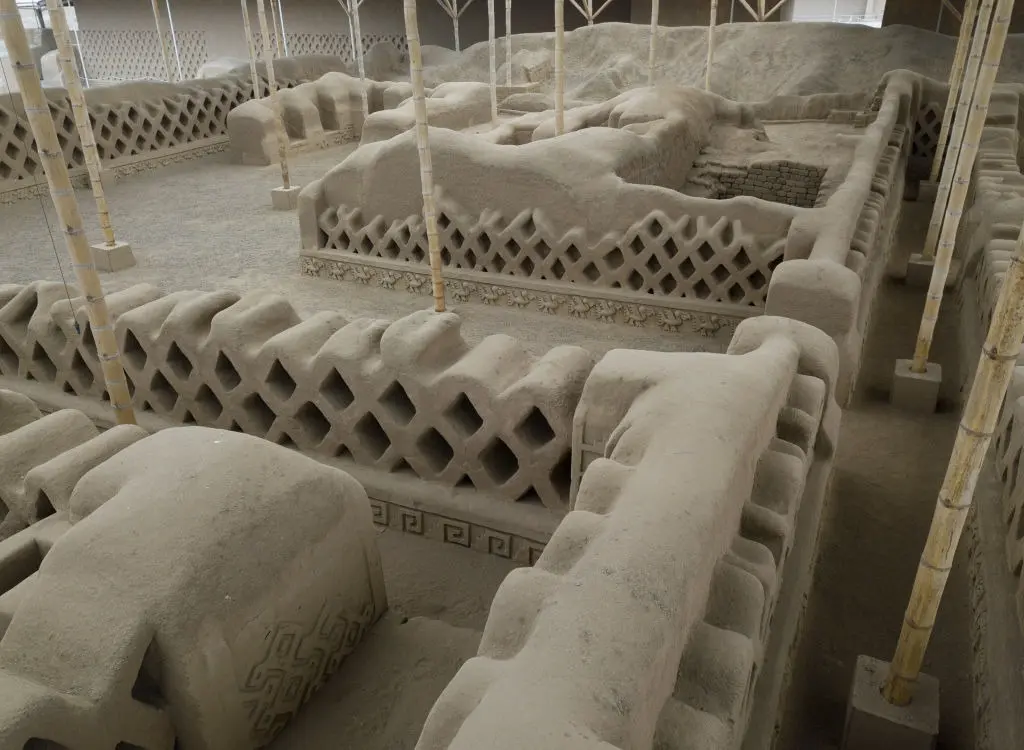
Executive Overview
In a monumental breakthrough for South American archaeology, researchers on Peru’s northern coast have announced the unearthing of an ancient, completely untouched mausoleum complex buried deep beneath a ruined citadel at the UNESCO World Heritage site of Chan Chan. Dating back some 600 years to the mid-15th century—a precarious historical pivot point just prior to or coinciding with the expansionist conquests of the Inca Empire—the sprawling tomb complex represents the first intact burial site ever discovered within the ancient metropolis.
For decades, excavations at Chan Chan have yielded architectural wonders but frustratingly sparse funerary contexts. Centuries of calculated pillaging by the invading Inca, subsequent Spanish conquistadors, and generations of illicit tomb raiders have historically left the city’s major architectural complexes stripped of their most prized artifacts and skeletal remains. The discovery of this sealed, pristine chamber changes the paradigm.
Housing the remains of 38 individuals—believed to be members of the Chimu elite—alongside a staggering treasury of precious metals, textiles, minerals, and ritual weapons, the find offers an unprecedented, uncorrupted window into the funerary traditions, social hierarchies, and spiritual worldview of the pre-Inca civilization that once dominated the western coast of South America. As excavations continue and laboratory analyses get underway, this pristine archaeological time capsule promises to rewrite our understanding of how the Chimu aristocracy honored their dead during the twilight of their regional hegemony.
Read Also
Detailed Chronology and Architectural Discovery
The momentous discovery unfolded beneath the imposing adobe brick ruins of Chan Chan, situated near the modern-day coastal city of Trujillo. Spanning an estimated nine square miles in its prime, Chan Chan was the administrative, religious, and political heartbeat of the Chimu Kingdom, which flourished along the hyper-arid Peruvian coast for centuries before falling under the shadow of the Inca Empire.
The architectural layout of the newly discovered mausoleum complex highlights the sophisticated urban and mortuary planning of the Chimu architects. Measuring approximately 55 feet on each side and towering 16 feet high, the massive adobe structure remained entirely hidden beneath layers of later ruin and debris.
The descent into the mausoleum begins with a grand stairway plunging eight feet downward into the subterranean heart of the complex. This primary entryway leads into a central mortuary chamber flanked symmetrically on either side by much larger ancillary rooms. The interior layout immediately signaled to the archaeological team that they had encountered a unique architectural space:
- The Central Chamber: Housing a single primary burial, this focal point of the complex featured remains marked by a striking, vibrant red pigment applied directly to the skull and select bones—a ritual treatment that extended to two additional bodies on the funeral platform.
- The Eastern Room: Surprisingly sparse, this lateral chamber was found almost entirely empty, presenting a spatial mystery that researchers are currently working to decode.
- The Western Room: Acting as the primary repository for the elite dead and their earthly wealth, this chamber contained a dense concentration of human remains alongside an extraordinary hoard of high-status grave goods and ritual artifacts.
In total, archaeologists identified 38 human skeletons scattered across the chambers and surrounding areas of the complex. The precise spatial arrangement, combined with the structural integrity of the sealed chambers, has allowed researchers to reconstruct mortuary staging events that have remained invisible for six centuries.
Supporting Context & Metrics: Material Culture and Funerary Practices
The wealth of artifacts recovered from the western chamber and the central platform underscores the immense economic and political power wielded by the Chimu elite. Among the items cataloged by the excavation team are exquisite examples of pre-Columbian metallurgy, lapidary art, and organic preservation:
- Precious Metals and Metallurgy: A large number of metal weapons, heavy copper and silver beads, and silver- or copper-plated necklaces indicate a martial aristocracy deeply invested in public displays of authority and divine right.
- Lapidary and Exotic Goods: Jewelry meticulously crafted from marine shells, high-purity quartz, and various semipresent stones highlights the expansive trade networks maintained by the Chimu, stretching from the high Andes down to the Pacific coastline and deep into the Amazon basin.
- Organic Artifacts and Textiles: Perhaps one of the most remarkable survivals within the humid, salt-kissed coastal environment is a finely crafted wooden chest. Adorned with intricate iconography depicting monkeys and seabirds, the chest preserved a cache of brightly colored, highly complex textiles that showcase the pinnacle of Andean weaving technology.
- The Cinnabar Enigma: The vivid red pigment identified on the cranial remains and funeral platform is strongly suspected to be cinnabar (mercury sulfide). In ancient Andean cosmology, this toxic mineral was deeply sacred. Associated with blood, rebirth, and eternal preservation, cinnabar was an exclusive luxury strictly reserved for the highest echelons of Chimu society.
The "Open Tomb" Paradigm
Beyond the physical objects, the architectural design of the mausoleum provides profound insights into Chimu spiritual life. According to external anthropological experts not directly involved in the current dig, the structural configuration of the complex aligns with a broader understanding of Chimu mortuary ideology.
Gabriel Prieto, a professor of anthropology at the University of Florida, noted in interviews regarding the discovery that mausoleums of this specific scale and layout were fundamentally "designed to be open." Unlike modern Western burials meant to seal the dead away permanently, Chimu elite tombs functioned as dynamic ritual spaces. Descendants and religious specialists would periodically re-enter the chambers, deposit new offerings, introduce additional bodies, or even extract specific human remains to be carried out into the city’s massive public plazas, where they were venerated as ancestral intercessors.
This cyclical engagement with death bridges the gap between the living community and the spiritual elite, illustrating a society where ancestors remained active, visible participants in political and religious life.
Official Statements and Academic Perspectives
The emotional weight of the discovery was palpable among the field team. For generations of archaeologists working in Peru—a nation rich in cultural heritage but heavily targeted by centuries of treasure hunting—encountering a completely undisturbed tomb is the ultimate professional milestone.
"It was a feeling of anxiety and urgency, to know if we were really in front of a chamber that had never been looted," said archaeologist Jorge Meneses, who is directly overseeing the excavation project, in an interview with the New York Times. "In that moment, we realized that the chamber had not been looted."
This sentiment is echoed by the wider academic community, who view the Chan Chan find as a methodological turning point. Because the site has been thoroughly mapped using modern scientific protocols—utilizing rigorous stratigraphic recording, photogrammetry, and environmental sampling—every artifact and bone can be contextualized with a precision entirely absent from historical excavations.
Anthropologists stress that the timing of the mausoleum—dating to the mid-1400s—places it squarely at the crossroads of imperial transition. As the expanding Inca state under leaders like Pachacuti marched northward along the Peruvian coast, indigenous kingdoms like the Chimu were forced to negotiate, fight, or submit. Understanding the wealth, ideology, and social stratification of the Chimu elite on the eve of this geopolitical collision will help historians map how local cultures were absorbed, transformed, or systematically erased by the incoming Inca administration.
Future Outlook: Preservation, Analysis, and Historical Legacy
As the dust settles on the initial discovery, the hard scientific work is only just beginning. The excavation of the Chan Chan mausoleum complex remains ongoing, with specialized conservation teams working meticulously to stabilize fragile organic materials, particularly the colorful textiles and wooden artifacts exposed to air after six centuries of vacuum sealing.
Concurrently, the 38 human remains recovered from the site are undergoing comprehensive bioarchaeological analysis. Laboratories will subject the bones and teeth to:
- Isotopic analysis to determine the geographic origins and dietary habits of the interred elites.
- Ancient DNA (aDNA) profiling to map familial relationships, dynastic succession patterns, and genetic affinities within the Chimu ruling class.
- Pathological examination to uncover indicators of health, disease, and the exact causes of death.
The implications of this discovery extend far beyond academic journals. Cultural heritage authorities in Peru plan to leverage the find to bolster conservation efforts at Chan Chan, a site constantly threatened by urban encroachment, climate change, and weathering from El Niño weather patterns.
By illuminating the sophisticated spiritual world, artistic brilliance, and complex social structures of the Chimu civilization just before their historic collision with the Inca Empire, this untouched mausoleum ensures that the voices of ancient Chan Chan will continue to resonate loudly across the modern world.





Comments
Facebook App ID not configured. Please add it in the Customizer.