
Executive Overview
Defining what makes a film genuinely "scary" remains one of the most elusive challenges for horror enthusiasts and critics alike. Human psychology is remarkably resilient; over time, audiences build psychological tolerances to gore, jump scares, and supernatural tropes. Furthermore, what paralyzes one viewer may leave another entirely cold. One individual might experience visceral dread at the inexorable, creeping approach of mortality, while another feels intense anxiety simply watching a character’s facial features distort. Fear is deeply subjective, entirely personalized, and anchored to unique psychological triggers.
However, beneath the vast spectrum of individualized phobias lie universal terrors—primal fears that a significant portion of the human population carries on a daily basis. These are not anxieties born of occult curses, supernatural entities, masked serial killers, or even death itself. They are often unexplainable, untraceable to a specific catastrophic event, and woven into the fabric of everyday existence. They are the minor annoyances and quiet vulnerabilities that people easily dismiss in the daylight hours, only for them to resurface in the dark.
Horror filmmakers, uniquely attuned to the architecture of human anxiety, have long capitalized on these universal vulnerabilities. Rather than relying exclusively on otherworldly monsters, master storytellers frequently identify foundational, everyday terrors and twist them into elaborate narrative nightmares. By examining how cinema translates real-world phobias into celluloid dread, this report explores the definitive films that weaponize common human fears—ranging from arachnophobia and social anxiety to the claustrophobic terror of being lost.
Read Also
Detailed Chronology: The Evolution of Phobia-Driven Horror
To understand how modern horror utilizes everyday phobias, it is essential to trace how the genre has evolved from exploiting external monsters to weaponizing internal psychological vulnerabilities.
- The Mid-20th Century (External Monsters & Gothic Tropes): Early cinematic horror primarily relied on the unknown and the supernatural. Universal Monsters and Hammer Horror films focused on vampires, mummies, and werewolves—threats far removed from the daily lives of everyday audiences.
- The 1970s and 1980s (Societal Vulnerabilities & Visceral Realism): As societal landscapes shifted, filmmakers began turning inward. Seminal releases like Brian De Palma’s Carrie (1976) shifted focus away from the supernatural and toward the agonizing, all-too-real social terrors of bullying and public humiliation. Similarly, David Cronenberg and subsequent directors began exploring body horror and medical anxiety.
- The 1990s (Everyday Environments & Practical Threats): The decade ushered in a wave of terror grounded in domestic or professional spaces. Arachnophobia (1990) proved that an audience did not need giant, mutated radioactive spiders to be terrified; ordinary household pests in standard environments were quite enough. Fearless (1993) translated the common, crippling fear of aviation disasters into an intense psychological character study.
- The 2000s to Present (Immersive, Psychological, and Relational Dread): Contemporary horror has doubled down on psychological realism, exploring claustrophobia (The Descent, 2005), paranoia (Bug, 2006), social paralysis (Speak No Evil, 2022), and sensory deprivation (Skinamarink, 2022). Modern cinema increasingly recognizes that the most effective monster is often an ordinary situation pushed to its absolute breaking point.
Supporting Context & Metrics: Breaking Down the Cinematic Phobias
Spiders — Arachnophobia (1990)
While cinematic history is littered with mutated, skyscraper-sized arachnids, Frank Marshall’s Arachnophobia separates itself from creature-feature tropes by keeping its antagonists entirely life-sized. The film weaponizes everyday domestic spaces—lampshades, bathroom drains, and garden sheds. Despite moments of comedic relief provided by John Goodman, the film instills a lingering paranoia that turns routine household chores into potential minefields of multi-legged terror.
Heights — Fall (2022)
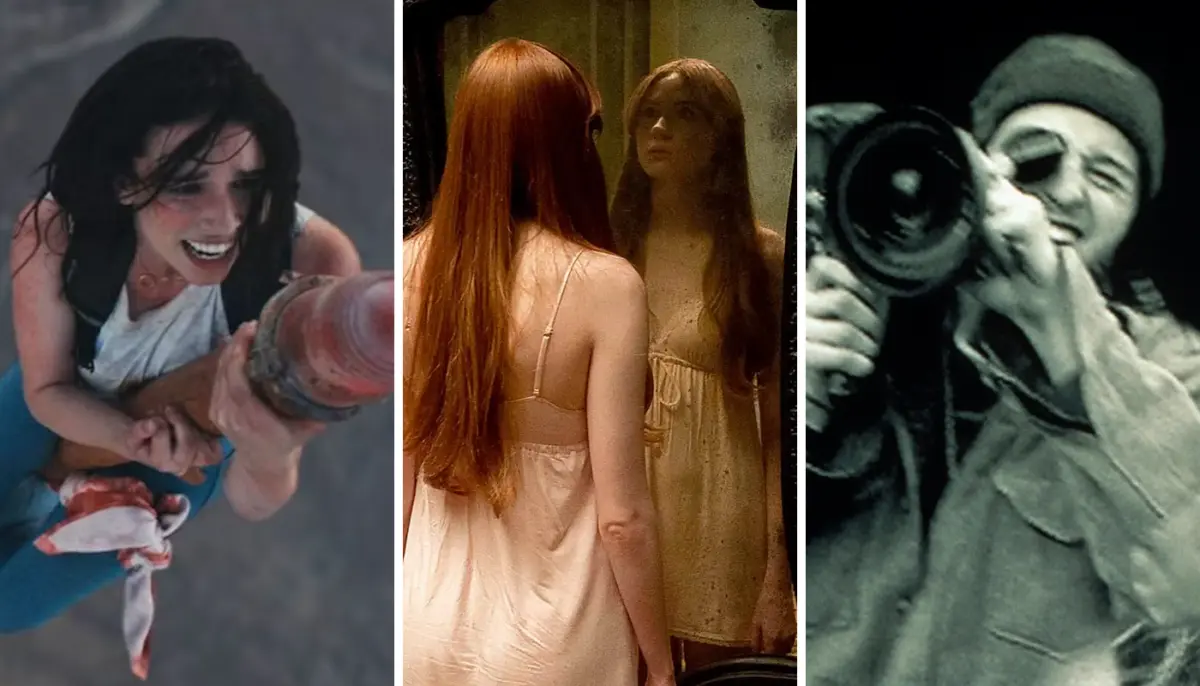
Logically, individuals crippled by a fear of heights are unlikely to scale a 2,000-foot abandoned television tower. Yet, Scott Mann’s Fall embraces this "don’t-look-down" scenario with relentless precision. Utilizing a vertiginous bird’s-eye perspective, the film turns survival logistics into an agonizing exercise in psychological endurance, punishing viewers who harbor any inkling of acrophobia.
Medical Institutions — Dead Ringers (1988)
While films like The Dentist lean into visceral, surface-level squeamishness, David Cronenberg’s Dead Ringers tackles a much more complex and pervasive terror: the fear of medical detachment. Featuring Jeremy Irons in a dual masterclass as twin gynecologists, the film introduces specialized surgical instruments that appear barbaric to the untrained eye. It taps directly into the unsettling anxiety that medical professionals often view patients not as human beings, but as experimental objects.
Confined Spaces — The Descent (2005)
Neil Marshall’s cave-diving horror film achieves something remarkable: when underground predators eventually emerge, their arrival feels like a welcome relief compared to the suffocating natural horrors of spelunking. The film’s centerpiece sequence—in which a character suffers a harrowing panic attack while wriggling through an impossibly tight, jagged stone fissure—remains the gold standard for cinematic claustrophobia.
Germs, Disease, and Paranoia — Bug (2006)
Though David Cronenberg’s The Fly brilliantly captures the tragedy of degenerative illness, William Friedkin’s adaptation of Tracy Letts’ Bug masterfully explores folie à deux and chemical paranoia. Set inside a desolate motel room, the film tracks a waitress and a drifter as they convince themselves their bodies and rooms are infested with invisible insects. It captures the terrifying psychological reality of believing your immediate environment is actively conspiring against your health.
Social Anxiety and Microaggressions — Speak No Evil (2022)
Modern audiences increasingly recognize the debilitating weight of social anxiety—specifically, the paralyzing fear of causing a scene or breaking social etiquette. The original Danish psychological thriller Speak No Evil turns polite society into an inescapable trap. As visiting guests endure a mounting series of invasive microaggressions from their hosts, the film weaponizes politeness, forcing viewers to squirm as the protagonists repeatedly silence their own survival instincts to avoid being "rude."
Aviation — Fearless (1993)
Though technically a psychological drama rather than a traditional horror film, Peter Weir’s Fearless is universally recognized by critics as the ultimate cinematic trial for those afraid of flying. By interspersing the psychological aftermath of a catastrophic plane crash with intensely realistic flashback sequences, the film validates and amplifies every underlying terror associated with commercial air travel.
Agoraphobia and Home Invasion — No One Will Save You (2023)
Agoraphobia is frequently misunderstood as merely a fear of leaving the home, rather than a complex panic disorder regarding open spaces and loss of control. No One Will Save You bridges the gap between agoraphobic isolation and home invasion. When an isolated young woman’s sanctuary is targeted by an extraterrestrial threat, her safe haven transforms into a battlefield, forcing her to confront both the entities outside and the internal choices that led to her seclusion.
Modern Dating and New Relationships — Fresh (2022)
The modern dating landscape is fraught with uncertainty, but Mimi Cave’s Fresh takes the baseline anxieties of the early "getting-to-know-you" phase to a literal and horrifying extreme. Seamlessly transitioning from a charming romantic comedy setup into a grotesque narrative about modern cannibalistic trafficking, the film capitalizes on the deep-seated fear that a seemingly perfect romantic partner may be hiding a monstrous reality.
Parking Garages — P2 (2007)
Despite being universally recognized as desolate, high-risk nocturnal environments, parking garages remain underutilized in horror cinema. P2 directly targets this architectural anxiety, trapping a lone office worker in a subterranean concrete labyrinth. By weaponizing long shadows, echoing footsteps, and labyrinthine structural design, the film validates every nervous glance over the shoulder while walking to a vehicle at night.
The Dark — Skinamarink (2022)
While virtually every horror movie utilizes darkness for atmosphere, Kyle Edward Ball’s experimental feature Skinamarink plunges headfirst into primal, childhood-born nyctophobia. Following two young children navigating an infinitely distorted suburban home in the dead of night, the film replicates the illogical, lingering dread of long hallways and the paralyzing conviction that something malevolent is lurking just beyond the edge of visibility.
Mirrors — Oculus (2014)
Mirrors have long been staples of folklore and superstition, representing portals to alternate realms or distortions of self-image. Mike Flanagan’s Oculus elevates this common household object into an active, malevolent antagonist. By centering its narrative on a centuries-old supernatural mirror that induces hallucinations and forces tragic memory manipulation, the film captures that uniquely unsettling impulse to keep bathroom mirrors covered when walking down a dark hallway at night.
Getting Lost — The Blair Witch Project (1999)
Long before the supernatural elements of the Burkittsville woods manifest, The Blair Witch Project preys upon a profoundly universal terror: geographical disorientation. The true horror of the film stems not from stick figures or whispered noises, but from the creeping, claustrophobic hopelessness of walking endlessly in circles with no compass, no signal, and no clear direction home.
Public Humiliation — Carrie (1976)
Decades after its initial release, Brian De Palma’s adaptation of Stephen King’s Carrie remains a masterclass in social terror. Stripped of its telekinetic spectacle, the narrative is fundamentally about the lingering, indelible scars of public humiliation. Few psychological wounds run as deep as experiencing a moment of profound vulnerability where those around you respond with mockery rather than mercy.
Official Statements and Industry Insights
Psychologists and filmmakers frequently note that horror functions as a safe laboratory for processing real-world anxieties. Dr. Katherine Thompson, a cognitive behavioral researcher specializing in phobias, explains the cinematic appeal:
"When individuals experience a phobia in daily life, it triggers an involuntary fight-or-flight response accompanied by a profound loss of control. Horror cinema allows audiences to voluntarily step into that exact emotional loop within a controlled environment. By externalizing internal fears—whether it’s an intrusive thought about heights, a panic attack in a tight space, or social paralysis—movies provide a bizarre form of emotional catharsis."
Similarly, independent horror directors often emphasize that relatability is the primary driver of lasting dread. As filmmaker-centric panels frequently discuss, special effects and monsters can be easily dismissed as fantasy, but an audience member walking out of a theater who checks their rearview mirror twice, looks under their bed, or hesitates before answering a rude acquaintance proves that everyday phobias leave the most enduring impressions.
Future Outlook
As the horror genre continues to evolve into the mid-21st century, the trend toward psychological realism and relatable phobias shows no signs of slowing down. With contemporary society facing shifting paradigms of isolation, hyper-connectivity, institutional distrust, and environmental instability, filmmakers are finding innovative ways to reflect these cultural neuroses onto the screen.
Future cinematic landscapes will likely lean even further away from traditional, rubber-mask monsters in favor of conceptual terror. As virtual reality, immersive storytelling, and psychological research uncover new depths of human vulnerability, horror directors will continue to mine the mundane. Ultimately, the most enduring takeaway for audiences is a sobering reminder: the scariest things in life are not hiding in the shadows of an imaginary realm—they are already sitting comfortably in our everyday routines.




Comments
Facebook App ID not configured. Please add it in the Customizer.