
Executive Overview
The landscape of electronic paper technology has undergone a profound transformation over the past decade. For years, the electronic paper display (EPD) market was defined strictly by the binary dichotomy of black-and-white screens: high-contrast, highly readable panels that mimicked physical paper perfectly under direct sunlight, yet lacked the dynamic visual fidelity required for rich media, illustrated textbooks, or digital signage. Today, E Ink Holdings has decisively shattered those monochromatic constraints. By engineering sophisticated multi-particle systems and advanced color filter arrays, the company has carved out three distinct technology tracks tailored specifically to disparate market segments.
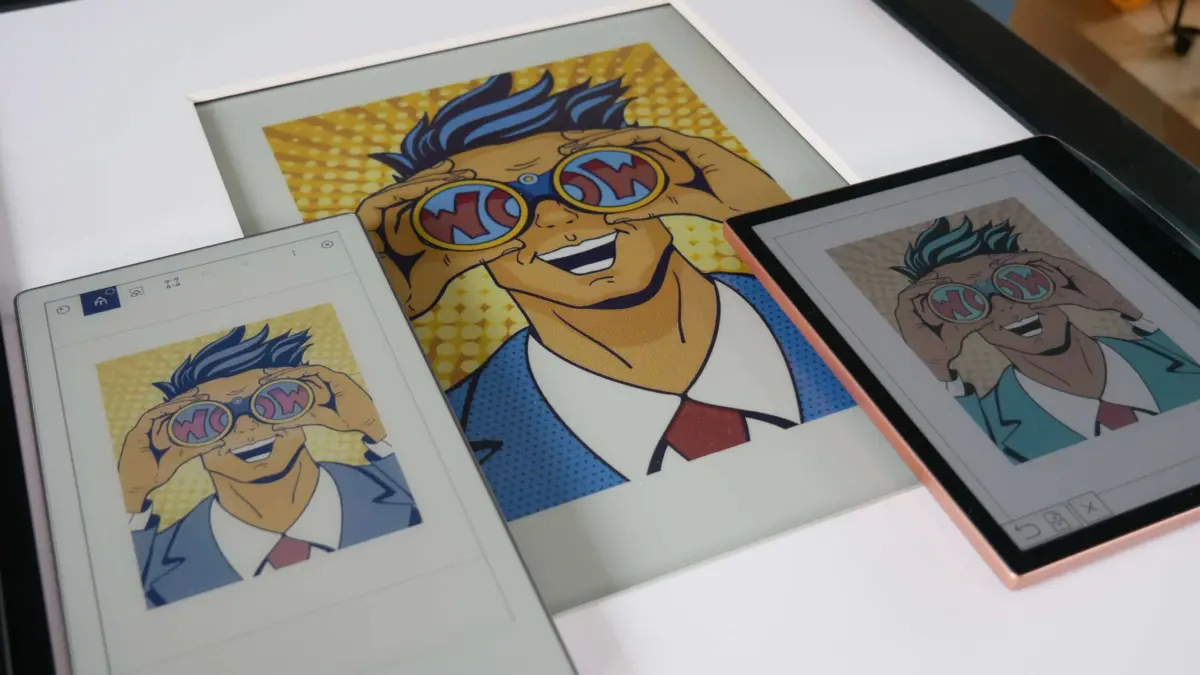
Understanding this modern e-paper ecosystem requires looking beyond simple definitions and examining the underlying engineering mechanics of E Ink’s current flagship color platforms: Kaleido 3, Gallery 3, and Spectra 6.
- Kaleido 3 acts as the primary bridge for mainstream consumer e-readers and digital notebooks, preserving the lightning-fast refresh speeds of traditional black-and-white electrophoretic displays while overlaying a refined color filter to deliver a comfortable, paper-like reading experience.
- Gallery 3 represents a monumental leap forward for full-color gamut fidelity, eschewing color filters entirely in favor of an advanced four-particle ink system embedded natively within every single pixel. This empowers devices like e-note and professional reading tablets to render deep, vibrant illustrations at a crisp 300 pixels per inch (PPI).
- Spectra 6 abandons the consumer reader space altogether to conquer the high-impact commercial sector, deploying a groundbreaking six-particle architecture designed to revolutionize retail shelving, digital signage, and smart-city infrastructure.
This deep-dive technical and market analysis investigates the structural architecture, performance metrics, and commercial applications of these three core technologies, illuminating how E Ink continues to redefine the boundaries of reflective display innovation.
Read Also
Detailed Chronology
The evolution of E Ink’s color technologies did not happen overnight; it is the culmination of decades of chemical engineering, particle physics, and iterative hardware refinement. Tracing the trajectory of these platforms reveals how engineering hurdles—such as sluggish refresh rates, washed-out color saturation, and eye-strain-inducing blue light profiles—have been methodically addressed.
[Early Monochrome EPDs] ──> [Kaleido Series (1 & 2)] ──> [Kaleido 3 (Current Consumer)]
                           └──> [ACeP & Early Gallery] ──> [Gallery 3 (Full-Color 300 PPI)]
                           └──> [Spectra 3000/3100]    ──> [Spectra 6 (Commercial Signage)]
The Foundations of Electronic Paper
Long before color was a viable commercial reality, electrophoretic displays relied on microcapsules filled with positively charged white pigments and negatively charged black pigments suspended in a clear fluid. Applying an electrical field would drive either particle to the surface, creating the text we read. While peerless in terms of power efficiency—consuming energy only when the image changes—the absence of a full spectrum severely limited e-paper to reading-centric devices.
The Rise of the Kaleido Lineage
The demand for consumer-friendly color reading devices forced engineers to introduce color filters rather than reinventing the core particle microcapsules.
- The Genesis: Early iterations of color e-paper suffered from dim, washed-out hues because the color filter array (CFA) blocked a significant portion of ambient light.
- Kaleido Plus & Kaleido 3: Through successive generations, E Ink aggressively optimized the optical transmission of the CFA. Kaleido 3 emerged as a massive leap forward, boosting color saturation by 30% compared to Kaleido Plus while integrating specialized front-light technologies to radically reduce blue-light emission—a critical requirement for nighttime reading comfort.
The ACeP Revolution and Gallery Evolution
While filter-based screens like Kaleido maintained high refresh speeds, true full-color fidelity required an internal particle overhaul. This led to the development of Advanced Color ePaper (ACeP) technology.
- Early Gallery Hurdles: The first generation of E Ink Gallery was a technical marvel for achieving true full color at the pixel level, but it was plagued by severely restricted refresh latencies—taking up to two seconds for black-and-white updates and a sluggish ten seconds for full-color transitions.
- The Gallery 3 Breakthrough: Recognizing that commercial viability depended on responsiveness, E Ink re-engineered the voltage waveforms and particle mobility. Gallery 3 slashed black-and-white update times to 350 milliseconds and introduced tiered color modes, making interactive stylus input and color note-taking a fluid reality.
Advancing Commercial Signage with Spectra
Simultaneously, the industrial and retail sectors demanded signage solutions that could match the vibrancy of traditional LCD or LED screens without requiring continuous, power-hungry grid connectivity.

- Spectra 3000 and 3100: The initial Spectra line began with a simple three-particle system (black, white, and red) primarily utilized for electronic shelf labels (ESLs), later expanding to a four-particle configuration incorporating yellow.
- Spectra 6: The release of Spectra 6 marked the pinnacle of commercial e-paper, expanding the particle palette to six distinct colors combined via sophisticated algorithms to yield photographic-grade signage capable of replacing paper posters permanently.
Supporting Context & Metrics
To appreciate how these technologies perform in real-world scenarios, one must examine their core specifications side by side. Each platform is precision-engineered for a specific use case, meaning that trade-offs in resolution, refresh latency, and color depth are deliberately optimized for the target market.
Comparative Technical Specifications
| Feature / Metric | E Ink Kaleido 3 | E Ink Gallery 3 | E Ink Spectra 6 |
|---|---|---|---|
| Primary Market | E-readers & E-notebooks | Premium E-readers & E-note Tablets | Digital Signage & Retail ESLs |
| Technology Base | RGB Micro-Color Filter Array over Monochrome EPD | 4-Particle System (Cyan, Magenta, Yellow, White) per pixel | 6-Particle Full-Color System |
| Color Depth / Palette | 4,096 Colors (16 Grayscale levels) | Full Color Gamut | Full Color Spectrum (Advanced Algorithms) |
| Resolution (Color Mode) | 150 PPI | 300 PPI | Up to 200 PPI |
| Refresh Latency (B&W) | Instantaneous / High speed (~Frames/Animation capable) | 350 ms | N/A (Signage focused) |
| Refresh Latency (Color) | Fast refresh, suitable for video and UI | Fast: 500 ms Standard: 750–1000 ms Best: 1500 ms |
Variable based on update mode |
| Stylus / Pen Input | Supported | Supported (B&W + select colors at ~30 ms update) | Not applicable |
| Front Light Tech | ComfortGaze™ (Reduced Blue Light) | ComfortGaze™ (Blue-light-safe viewing) | Reflective / External lighting dependent |
| Contrast Ratio | Optimized for ambient light reading | High contrast paper-like | ~30:1 |
| Operating Temp. | Standard consumer range | 0°C to 50°C | Commercial retail operating range |
Deep-Dive Analysis of the Three Core Platforms
1. Kaleido 3: The Consumer Reader’s Balanced Choice
Kaleido 3 is structurally designed for the everyday reader who wants illustrated magazines, children’s books, and graphic novels rendered in color without sacrificing the eye-friendly, battery-sipping nature of traditional e-readers.
- The Optics: By layering an optimized RGB (Red, Green, Blue) micro-color filter array on top of a classic electrophoretic layer, Kaleido 3 achieves a color palette of 4,096 distinct shades at a resolution of 150 PPI. While 150 PPI is lower than modern monochromatic panels, it strikes a functional balance that allows color data to pass through the filter efficiently.
- Motion and Responsiveness: One of Kaleido 3’s most impressive engineering achievements is its ink responsiveness. Unlike older color e-papers that suffered from debilitating ghosting and lag, Kaleido 3 possesses the frame-rate capabilities necessary to render smooth animations and video playback—transforming the e-reader from a static text device into a multimedia-capable companion.
- Eye Safety Innovations: A primary concern with illuminated displays is exposure to high-energy visible (HEV) blue light. Kaleido 3 incorporates E Ink ComfortGaze™ front-light technology. This proprietary lighting design dramatically curtails blue-light emissions, reducing the Blue Light Ratio (BLR) by up to 60% and the Blue Light Toxicity Factor (BLTF) by up to 24%. By engineering the light to reflect off the display surface rather than shining directly into the user’s eyes, it drastically mitigates visual fatigue during extended reading sessions.
2. Gallery 3: Eliminating Filters for True Full-Color Fidelity
For users demanding uncompromising color precision and crisp high-definition text, Gallery 3 represents the holy grail of e-paper engineering.
- The Four-Particle Innovation: Unlike Kaleido, which filters a monochrome background, Gallery 3 utilizes E Ink’s advanced ACeP (Advanced Color ePaper) platform. Within every single pixel, a complex four-particle ink system containing cyan, magenta, yellow, and white particles is suspended. By shifting these four particles independently using precise electrical charges, the display achieves a true full-color gamut natively at the pixel level, eliminating the optical distortion inherent in physical filter arrays.
- Resolution and Performance Scaling: Gallery 3 delivers a sharp 300 pixels per inch (PPI) in full color, matching the gold standard of modern black-and-white e-readers. Furthermore, E Ink drastically improved refresh latencies. While the first-generation Gallery required agonizing multi-second waits, Gallery 3 offers tiered update speeds:
- Black & White: 350 milliseconds
- Fast Color Mode: 500 milliseconds
- Standard Color Mode: 750 to 1,000 milliseconds
- Best Color Mode: 1,500 milliseconds
- Stylus Integration & Temperature Range: Gallery 3 bridges the gap between reading and productivity by supporting active pen input. Users can write and sketch in black and white—and select accent colors—with a responsive 30-millisecond update time. Additionally, the display operates seamlessly within a 0 to 50 degrees Celsius temperature window, ensuring robust reliability across diverse professional environments. Like its sibling, it also features ComfortGaze™ front-light integration.
3. Spectra 6: Reimagining Commercial Retail and Signage
Moving away from personal electronics, E Ink Spectra 6 is engineered explicitly to displace traditional paper posters, static billboards, and digital LCD screens in commercial spaces.
- Six-Particle Architecture: While earlier commercial iterations like Spectra 3000 used a three-particle system (black, white, red) and Spectra 3100 introduced a fourth particle (yellow), Spectra 6 integrates six distinct color particles. By intelligently combining these six pigment types via advanced color-imaging algorithms, the display generates rich, saturated, full-color commercial imagery that rivals traditional printed paper.
- Visual Impact and Metrics: Offering up to 200 PPI and an impressive contrast ratio of approximately 30:1, Spectra 6 delivers stunning visual clarity from afar. It is fully compatible with E Ink Sparkle technology, which supports dynamic, localized partial-image flashing effects. This capability allows retailers to draw consumer attention to dynamic promotions, price drops, or animated signage elements without drawing excessive electrical power. Because e-paper consumes power only when the image state changes, retail chains deploying Spectra 6 electronic shelf labels (ESLs) and digital art frames can drastically reduce their facility energy footprints while eliminating mountains of physical paper waste.
Official Statements and Industry Perspective
Industry leaders and technical analysts have consistently highlighted E Ink’s strategic bifurcation of its technology stack as the key driver behind the mainstream adoption of electronic paper.
Executive leadership at E Ink Holdings has frequently emphasized that the future of paper replacement lies in matching human physiological comfort with digital versatility. By separating consumer-facing reading products (Kaleido and Gallery) from high-visibility commercial signage (Spectra), the company ensures that engineering resources remain laser-focused on the precise physical demands of each market.
- On Consumer Comfort: Speaking on the implementation of ComfortGaze™ lighting across the Kaleido and Gallery lines, E Ink engineers noted that combating digital eye strain is non-negotiable for the future of reading devices. The drastic reductions in Blue Light Ratio (BLR) and Blue Light Toxicity Factor (BLTF) represent a paradigm shift in how backlit and front-lit electronic displays protect long-term ocular health.
- On Commercial Sustainability: Retail analysts have pointed to Spectra 6 as a transformative milestone for green retail logistics. As global enterprises face mounting pressure to eliminate single-use paper signage and reduce carbon footprints, the transition to ultra-low-power, high-resolution e-paper price tags and promotional boards offers an immediate, scalable solution that aligns corporate sustainability goals with economic efficiency.
Future Outlook
The continuous refinement of Kaleido, Gallery, and Spectra technologies signals an aggressive horizon for electronic paper. As manufacturing yields improve and material science advances, several key trends are poised to shape the next generation of E Ink development:
- Mainstream Color Adoption in Education: With Gallery 3 achieving 300 PPI and responsive stylus latency, the educational sector is primed for a massive migration away from heavy, battery-intensive tablets and traditional paper textbooks. Lightweight, distraction-free color e-note devices equipped with Kaleido 3 or Gallery 3 panels offer the ideal medium for digital annotation, illustrated study guides, and prolonged reading without eye fatigue.
- Further Reduction of Refresh Latencies: While current speeds are remarkably improved compared to early generations, ongoing research into voltage waveform optimization and fluid dynamics will continue to shrink refresh times. Narrowing the latency gap between traditional LCDs and electrophoretic displays will unlock even more fluid UI animations and seamless multi-media integration.
- Ubiquitous Smart Retail Infrastructure: The rapid deployment of Spectra 6 in grocery stores, department outlets, and smart-city transit hubs points toward a fully digitized, paperless retail ecosystem. As dynamic pricing and real-time inventory updates become standard, the ability of Spectra displays to maintain vivid, high-contrast imagery indefinitely without a continuous power supply will make static signage entirely obsolete.
Ultimately, E Ink’s tripartite strategy—harnessing Kaleido 3 for balanced consumer reading, Gallery 3 for high-resolution professional color work, and Spectra 6 for vibrant commercial signage—proves that the future of visual display is not merely about emitting more light, but about perfecting the art of reflecting it.





Comments
Facebook App ID not configured. Please add it in the Customizer.