
Executive Overview
In the fast-evolving consumer electronics landscape, few trends have generated as much debate as the "unbundling" phenomenon. Initially popularized by smartphone giants removing power bricks in the name of environmental sustainability, the practice has now bled into the e-reader market. With the launch of its 13th-generation Kindle lineup, Amazon has crossed a significant threshold: for the first time, no USB-C charging cable is included in the box.
This omission affects the entire refreshed hardware ecosystem—spanning the base Kindle, the popular Kindle Paperwhite, the innovative Kindle Colorsoft, various Signature Editions, and the newly introduced aluminum-backed models. Even consumers who opt for bundled packages containing wall chargers and protective cases find themselves missing a basic tethering cord.
Compounding the consumer frustration is a notable jump in retail pricing, with this generation’s devices seeing increases ranging from $30 to $60 compared to their 12th-generation predecessors. To many loyalists, stripping out a fundamental accessory while simultaneously raising prices feels less like an eco-conscious maneuver and more like nickel-and-diming. This in-depth investigative report examines the justifications behind Amazon’s move, the financial implications for global buyers, the industry precedent, and whether this cost-saving measure will ultimately alienate the core reading community.
Read Also
Detailed Chronology of the 13th-Generation Kindle Launch
The shift toward cable-free packaging did not happen overnight; it represents a calculated evolution in Amazon’s hardware logistics and retail strategy.
The Lead-Up and October 2026 Rollout
Rumors of streamlined packaging had circulated within tech forums for months, but the reality crystallized in October 2026 with the official rollout of the 13th-generation hardware family. Displaying sleek names like Kindle Alpine Sky, Ube, Graphite, and Kindle Aluminum, the new devices commanded immediate attention for their upgraded displays, faster page-turn processors, and expanded color fidelity on the Colorsoft variations.
However, eagle-eyed early buyers unpacking their deliveries quickly noticed a stark departure from past traditions. Inside the newly formatted, minimalist boxes lay only the e-reader itself and a standard quick-start guide. Gone was the familiar coiled white or black USB-C cable that had long anchored the unboxing experience.
The Retail Disclosure Policy
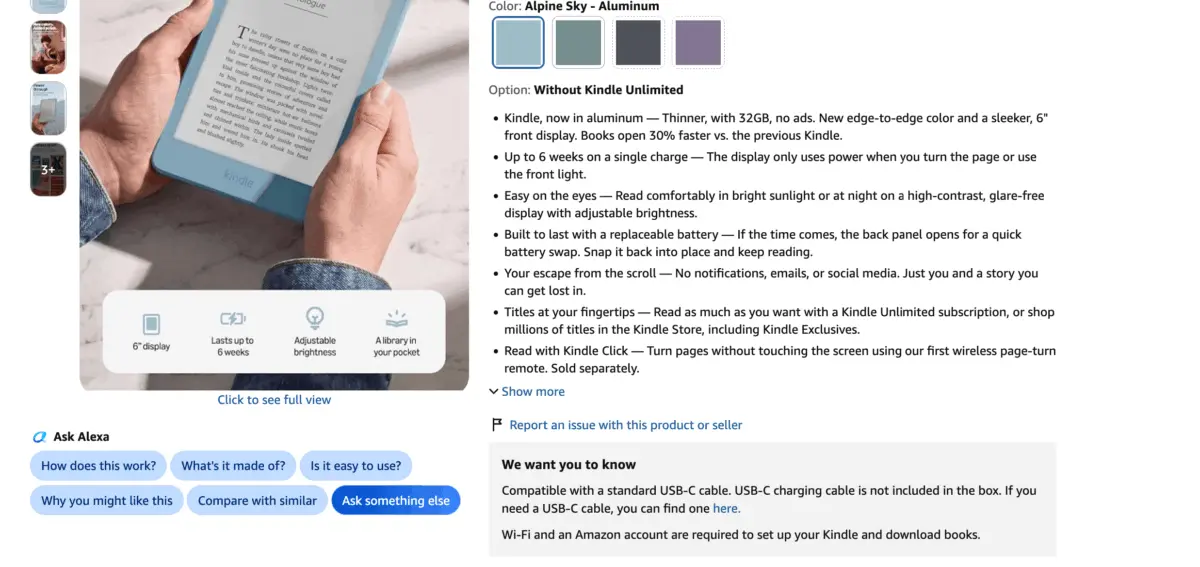
Recognizing that the absence of a cable would catch consumers off guard, Amazon updated its official product listing pages. Buried beneath the vibrant color swatches and bullet-point feature breakdowns—such as battery life metrics, display resolutions, and storage capacities—shoppers encountered a newly instituted disclosure box.
The prompt reads explicitly:
"We want you to know: Compatible with a standard USB-C cable. USB-C charging cable is not included in the box. If you need a USB-C cable, you can find one here. Wi-Fi and an Amazon account are required to set up your Kindle and download books."
To bridge the gap for unprepared consumers, Amazon concurrently launched a standalone official USB-C to USB-C cable on October 1, 2026. Yet, this "solution" quickly became a secondary flashpoint due to stark regional pricing disparities, adding fuel to an already volatile consumer debate.
Supporting Context, Metrics, and Financial Implications
To fully understand the consumer backlash, one must analyze the intersection of hardware pricing, accessory costs, and global market variations.
The Price Hike versus Missing Components
For over a decade, purchasing an e-reader meant receiving an all-in-one kit: device, instructions, and a cable. While many households do possess a drawer full of USB-C wires inherited from phones, tablets, and gaming controllers, the psychological impact of paying a $30 to $60 premium for a 13th-generation device—only to find an essential component missing—cannot be overstated.
When hardware prices rise significantly, consumers generally expect an elevated unboxing experience or added value. Removing a component that costs pennies to manufacture while raising the retail price creates a clear disconnect in value perception.

The Cost of the "Official" Fix
For customers who genuinely require a new charging cord—particularly first-time e-reader adopters upgrading from micro-USB devices or physical book formats—Amazon’s aftermarket solution comes with a noticeable price tag.
- In the United States, Amazon’s official USB-C to USB-C cable is priced at a modest $4.99.
- In contrast, the Canadian market faces a significantly steeper levy, with the exact same cable retailing for $16.99 CAD.
This stark regional pricing discrepancy has amplified criticism, particularly from Canadian consumer advocacy groups and online forums, who view the international markup as opportunistic rather than logistical.
The Wireless Workaround: Signature Editions
Amazon does offer a hardware-based escape hatch for buyers willing to invest at the high end of the market. Purchasers of the 13th-generation Signature Editions—such as the Paperwhite Signature or the Colorsoft Signature—can bypass physical cords entirely. These premium units are compatible with wireless charging docks and proprietary pogo-pin dock accessories, allowing users to drop their devices onto a charging pad.
However, these docks are sold separately, meaning that avoiding the cable dilemma requires an even greater upfront financial commitment to Amazon’s ecosystem.
Industry Precedent and Environmental Rationalization
Amazon’s move to unbundle charging accessories does not occur in a vacuum; it mirrors a broader transformation across the consumer electronics sector over the past half-decade.
The Smartphone Blueprint
The precedent was decisively set by Apple when it removed power adapters from iPhone boxes under the banner of reducing electronic waste and shrinking packaging sizes to maximize shipping efficiency. Samsung, Google, and other major smartphone manufacturers quickly followed suit. The underlying logic presented by these tech giants is twofold:
- Redundancy Reduction: Millions of compatible charging bricks and cables already circulate in consumer households, rendering bundled additions redundant and destined for landfills.
- Logistics Optimization: Smaller, lighter boxes allow freight liners, cargo planes, and delivery trucks to transport more units per trip, thereby lowering corporate carbon footprints and shipping costs.
Applying the Logic to E-Readers
When applied to Kindles, the environmental argument holds superficial weight. E-readers are notoriously long-lasting devices, often surviving for five to ten years under normal use. A user upgrading from a 10th-generation Kindle already owns a stable of USB-C or micro-USB infrastructure (though transitioning to USB-C standardized models has rendered older micro-USB cables obsolete, modern USB-C cords are ubiquitous).
However, critics argue that e-readers occupy a fundamentally different product category than smartphones. While phones are replaced every two to three years—ensuring a steady rotation of modern accessories—e-readers are legacy devices bought infrequently. A first-time Kindle buyer may well lack a compatible high-grade USB-C setup, making the unbundled box a practical hurdle rather than an eco-friendly triumph. Furthermore, skeptics note that corporate sustainability initiatives conveniently align with profit maximization, lowering manufacturing and packaging expenditures while passing the accessory burden onto the buyer.
Future Outlook: Will Consumer Backlash Spark Change?
As the dust settles on the rollout of the 13th-generation Kindle family, the long-term ramifications for Amazon’s hardware division remain to be seen.
Brand Loyalty vs. Consumer Fatigue
Amazon enjoys a near-monopolistic dominance in the dedicated e-reader market, competing primarily with Kobo and specialized Android-based e-readers like Boox. Because the Kindle ecosystem—anchored by the Kindle Store, Kindle Unlimited, and Whispersync technology—is so deeply entrenched, most consumers grumble about missing accessories rather than migrating to alternative platforms.
Yet, cumulative friction points matter. Between rising device prices, unbundled accessories, and aggressive software monetization within the Kindle interface, consumer goodwill is a finite resource. If hardware prices continue to climb while out-of-box utility shrinks, Amazon risks opening the door for competitors willing to offer a more complete, friction-free consumer experience.
The Verdict on In-Box Cables
The central question posed to the reading community—Should Amazon Kindle e-readers include a USB cable, or does everyone already have multiple cables at home?—divides users cleanly into two camps.
- The Pragmatic Minimalists argue that cluttering homes with redundant plastic-wrapped cables is an outdated practice that harms the environment and inflates baseline manufacturing overhead.
- The Value Purists maintain that when a consumer drops upwards of $150 to $300+ on a premium reading device, receiving a complete kit required to operate the device out of the box should be an immutable standard, not an optional micro-transaction.
Ultimately, while the tech industry marches inexorably toward a cable-free future, Amazon’s handling of the 13th-generation Kindle rollout serves as a cautionary tale in consumer communication. Clearer messaging, more equitable international pricing for replacement accessories, and greater transparency regarding cost savings could have softened the blow. As it stands, the missing USB-C cable will likely be remembered as the hidden cost of the 2026 Kindle upgrade cycle—a small omission that left a noticeable mark on consumer trust.





Comments
Facebook App ID not configured. Please add it in the Customizer.