
Executive Overview
The long-running, politically charged legal battle over the naming rights and structural future of the John F. Kennedy Memorial Center for the Performing Arts reached a dramatic inflection point in federal court. Facing intense skepticism from a U.S. district judge and an emergency legal challenge spearheaded by congressional Democrats, the Kennedy Center board announced it will temporarily halt efforts to affix President Donald J. Trump’s name to the historic federal building until at least October 8.
The one-month delay follows a high-stakes, two-hour emergency hearing before U.S. District Judge Christopher Cooper in Washington, D.C. The session was hastily scheduled after the Department of Justice (DOJ)—acting in defense of the administration’s initiatives—filed an alarming warning that the iconic arts institution could face total demolition and replacement with an outdoor amphitheater. According to government filings, this drastic measure would be required if the board is legally blocked from closing the facility for a two-year capital repair cycle.
At the core of the dispute is a persistent effort by the board and the DOJ to credit President Trump for the center’s financial and physical turnaround. The administration seeks to permanently display the inscription, “Restored and renovated by President Donald J. Trump,” directly beneath the name of the assassinated 35th president. However, critics, led by congressional Democrats like Representative Joyce Beatty, argue that the renaming bypasses federal statutes, violates prior court orders, and desecrates a federally designated living memorial. Thursday’s hearing laid bare the deep constitutional tensions between executive overreach, congressional authority, and the preservation of national landmarks.
Read Also
Detailed Chronology of the Dispute
To understand the current legal paralysis at the Kennedy Center, one must trace a timeline marked by executive action, judicial intervention, and legislative pushback.
The Initial Renaming and Federal Pushback (December 2025 – June 2026)
- December 2025: President Trump’s name was officially added to the primary façade of the Kennedy Center following an aggressive board push and executive maneuvers. Proponents argued the addition was a well-deserved acknowledgment of his administration’s financial contributions.
- May 2026: U.S. District Judge Christopher Cooper—an appointee of former President Barack Obama—issued a definitive ruling ordering the removal of Trump’s name. Cooper concluded that the unilateral renaming violated federal law, explicitly stating that only the United States Congress holds the statutory authority to alter the designation of the national cultural center.
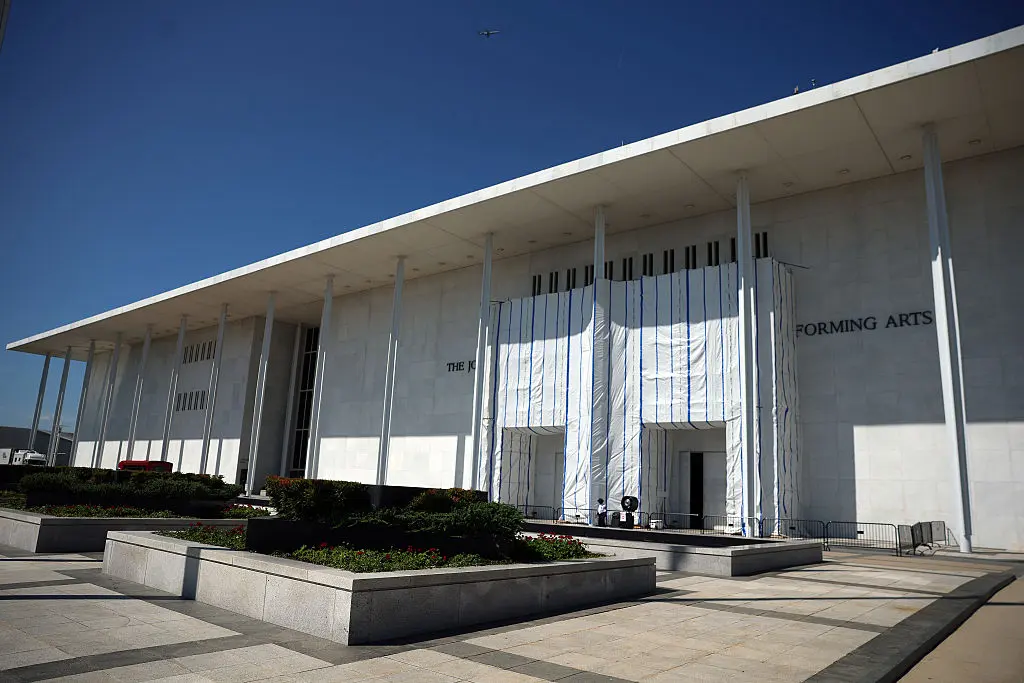
- June 2026: Complying with the judicial mandate, workers removed the lettering from the building’s exterior, leaving a dark patch on the stone façade. However, the board immediately pivoted, defying the spirit of Cooper’s ruling by announcing alternative plans to officially rename the institution. Since that announcement, a large protective tarp has obscured the building’s front façade to shield ongoing backroom maneuvers and construction from public view.
Escalation and Emergency Intervention (August – September 2026)
- Late August 2026: Democratic Representative Joyce Beatty, serving in her capacity as an ex officio member of the Kennedy Center board, spearheaded a renewed legal challenge against the DOJ. Beatty’s legal team argued that the board’s workarounds were illegal end-runs around the May ruling.
- Monday, September 2026: The DOJ filed an emergency memorandum warning that the center faced imminent financial ruin and structural collapse. The filing dropped a bombshell claim: if the board is not permitted to shutter the facility for two years of urgent repairs—and if Trump’s legacy is not officially tied to the project—the building could face demolition and replacement with an outdoor amphitheater.
- Thursday, September 3, 2026: Judge Cooper convened an emergency two-hour hearing. During the proceedings, Cooper aggressively questioned the timeline, pressing government attorneys on why September 8 had been chosen as an immovable deadline for installing the new signage. Finding the date arbitrary, Cooper indicated he was fully prepared to issue a sweeping temporary restraining order. Facing this judicial roadblock, the Kennedy Center board abruptly capitulated, agreeing to push back its self-imposed deadline to October 8.
Supporting Context & Metrics
The battle over the Kennedy Center is as much about financial survival and political legacy as it is about statutory interpretation.
The Financial Stakes and Funding Figures
The DOJ’s defense of President Trump’s naming rights hinges heavily on claims of financial rescue. According to administration filings:
- $258 Million: The amount of congressional funding for capital restoration that the Trump administration reportedly secured for the center in 2025.
- Endowment Recruitment: Administration lawyers assert that President Trump personally recruited high-net-worth private donors to establish a robust endowment fund.
- The "Death Spiral" Argument: Government briefs maintain that Trump’s personal "efforts and prestige" represent the "sole hope for the Center’s financial survival and structural renewal," warning that without his continued involvement, the institution would plunge back into a "financial and structural death spiral."
Alternative Proposals and Naming Concessions
Realizing the primary façade faces insurmountable legal hurdles, the board and its administration allies have floated compromise proposals:
- Plaza Renaming: The center has proposed naming its expansive outdoor plaza after President Trump, arguing this would not violate the core statutes protecting the indoor memorial footprint.
- Tiered Endowment Milestones: The administration suggested adding further honors if the private endowment reaches a $100 million threshold.
Critics, however, view these proposals as a slippery slope that commodifies a federal cultural institution.
Official Statements and Courtroom Confrontations
The tensions in Judge Cooper’s courtroom on Thursday revealed a stark philosophical divide between the government’s pragmatic defense and the judiciary’s strict adherence to statutory law.
The DOJ’s Defense of Executive Action
Representing the government, DOJ lawyer Brantley Mayers anchored his arguments on operational realities. Mayers contended that displaying Trump’s name on the building is a practical necessity required to ensure the continuous flow of private donations. Without the promise of prominent recognition, the government argued, donors would lose interest, halting the much-needed renovations.
Judicial Skepticism and the "For Sale" Analogy
Judge Cooper immediately dismantled this line of reasoning, challenging the government to connect private fundraising to congressional intent.
"What does that have to do with what Congress intended in the statutes?" Cooper demanded during the hearing.
Expanding on his skepticism, Cooper painted a vivid picture of the legal precedent the government’s logic would set. He noted that if the board possesses the discretionary authority to rename sections of a federally protected memorial based on fundraising or executive fiat, there would theoretically be nothing stopping future boards from selling off the institutional identity piece by piece.
Cooper suggested that under the DOJ’s interpretation, the board could theoretically rename the parking garage after former President Barack Obama or designate the surrounding campus after former President George W. Bush.
"The whole thing would be for sale, basically — and that would be consistent with Congress’s overall scheme?" Cooper asked pointedly.
Faced with this rhetorical trap, the DOJ legal team offered no rebuttal, leaving the courtroom in stunned silence.
Future Outlook: What Lies Ahead for the Kennedy Center?
As the October 8 deadline approaches, the legal and cultural fate of the Kennedy Center hangs in the balance. Several key developments will dictate how this unprecedented chapter unfolds:
- The October 8 Deadline: While the board has agreed to pause its renaming efforts for a month, the temporary reprieve is precarious. If settlement talks fail or if the DOJ attempts to reassert its aggressive timeline, Judge Cooper is expected to issue a binding preliminary injunction explicitly prohibiting any alterations to the building’s exterior or honorary designations.
- Congressional Resolve: Representative Joyce Beatty and her congressional allies are expected to use the intervening weeks to reinforce statutory protections. Democrats maintain that any attempt by the executive branch to bypass Capitol Hill sets a dangerous precedent for all national monuments and federally funded cultural spaces.
- The Physical Renovation Debate: Looming larger than the signage dispute is the physical state of the building itself. The DOJ’s threat of demolition—whether posturing or a genuine assessment of structural degradation—has injected high anxiety into the arts community. Stakeholders are demanding transparent, independent engineering assessments to determine whether the facility truly requires a two-year closure, or if the demolition narrative is merely political leverage designed to force compliance.
Ultimately, the Kennedy Center controversy transcends a simple dispute over brass letters on a stone wall. It serves as a high-stakes test of the boundaries of executive power, the sanctity of federal legislation, and the preservation of national cultural heritage in an era of intense political polarization.





Comments
Facebook App ID not configured. Please add it in the Customizer.