
Executive Overview
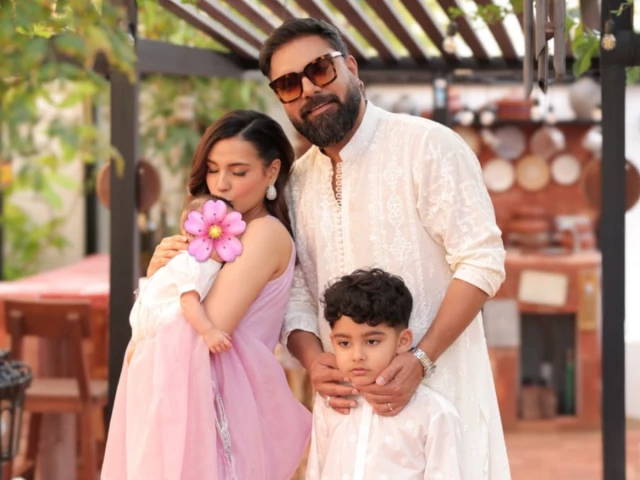
In the fast-paced, high-scrutiny universe of Lollywood—Pakistan’s burgeoning television and film industry—few power couples capture the public imagination quite like Iqra Aziz and Yasir Hussain. Their romance, public engagements, and family life have long been chronicled by both mainstream media and ravenous social media fan bases. However, beneath the gloss of red carpets and curated Instagram grids lies a dynamic, nuanced partnership built on mutual respect, shared ambition, and the balancing act of modern parenthood.
In a recent, candid interview conducted while supporting her husband at the opening of his theatrical production So Suite in Lahore, Aziz offered a rare, unvarnished look into her personal life. Eschewing the standard PR-trained talking points common among celebrities, the award-winning television star addressed the persistent public fascination with their decade-plus age gap, dissected the universal and often debilitating phenomenon of "mom guilt," and shared her deep-seated anxieties and ambitions regarding a potential future in the theater.
This comprehensive report examines Aziz’s recent commentary, contextualizing her remarks within broader cultural discussions surrounding celebrity marriages, the realities of working motherhood in South Asia, and the evolving landscape of Pakistani performing arts. Through detailed analysis, this piece explores how one of Pakistan’s most bankable television stars navigates the intersections of domestic life, public expectation, and artistic evolution.
Read Also
Detailed Chronology and Interview Context
The setting of the interview is crucial to understanding the relaxed, reflective tone struck by Aziz. The event took place in Lahore during the run of So Suite, a theatrical venture spearheaded by Yasir Hussain. Theater represents a distinct and demanding medium in Pakistan—one that requires raw, uninterrupted energy, theatrical projection, and live execution, sharply contrasting with the fragmented, heavily edited nature of television serial production.
As Hussain stepped onto the stage to showcase his theatrical mettle, Aziz was stationed in the audience and the backstage corridors, acting not merely as a supportive spouse, but as an industry insider evaluating a significant artistic pivot. It was in this environment of creative camaraderie that she paused to speak with media outlets about her marriage, her career trajectory, and her children.
A Timeline of the Couple’s Public Journey
- Early Collaborations and Engagement (2018): Aziz and Hussain’s professional relationship gradually transitioned into a personal romance, culminating in a highly publicized, cinematic proposal by Hussain at the Lux Style Awards in 2019.
- Matrimonial Union (December 2019): The couple tied the knot in an intimate, day-time traditional ceremony that celebrated Pakistani cultural heritage while drawing massive digital engagement across platforms.
- Expansion of the Family (2021–Present): The couple welcomed their children, Kabir and Sophia, transforming their household into a bustling center of domestic life alongside their respective, demanding professional schedules.
- The So Suite Milestone (Recent): Hussain’s foray into theater in Lahore prompted widespread industry discussion, drawing prominent figures to the stalls and prompting Aziz to reflect publicly on the differences between television and stage acting.
During this recent media interaction, Aziz did not shy away from the topics that typically generate online controversy. Instead, she met queries regarding her marriage and parenting strategies with a refreshing blend of philosophical calm and practical wisdom.
Supporting Context & Cultural Metrics: Age Gaps, Marital Dynamics, and Public Scrutiny
Deconstructing the Age-Gap Discourse
One of the most persistent refrains in celebrity gossip columns concerning Aziz and Hussain is their age gap, which spans over a decade. In conservative yet rapidly modernizing societies like Pakistan, public unions involving an older man and a younger woman often invite polarized reactions—ranging from traditionalist approval to progressive skepticism regarding power dynamics.
Aziz, however, has consistently dismissed these anxieties as external projections rather than internal realities.
"I think people say otherwise, but I feel it is ‘Khush kismati’ and nothing else," Aziz remarked during the interview, utilizing the Urdu term for good fortune. "Yasir is such a kind husband, and you can see that from being around our family and how happy I am. He is one of a kind."
Sociologists studying marital dynamics in urban Pakistan note that age gaps are historically common across South Asian demographics, often functioning within traditional family frameworks to provide stability. However, when transposed onto the hyper-visible canvas of celebrity culture, such gaps become hyper-analyzed. Aziz directly challenged the notion that numerical age dictates relational success:
"I think this age gap is good because if you see, it was the same with our parents and when they got married. The only important thing is that your life goals align."
By anchoring her marital philosophy in shared objectives rather than chronological alignment, Aziz reframes the discourse. Her commentary suggests that compatibility is forged through shared values—such as creative ambition, domestic partnership, and mutual emotional labor—rather than generational synchronicity.
Official Statements & Intimate Reflections: Navigating "Mom Guilt"
Beyond her marriage, the most resonant portion of Aziz’s interview addressed the emotional topography of motherhood. As a leading lady in Pakistani television—a sector notorious for grueling, multi-month shooting schedules—Aziz’s transition into motherhood with children Kabir and Sophia has necessitated a delicate balancing act.
The Anatomy of Working Motherhood
"Mom guilt"—the pervasive sense of inadequacy or anxiety experienced by mothers who feel they are failing either their children by working, or their careers by staying home—is a global phenomenon. In South Asia, where expectations of maternal self-abnegation remain deeply entrenched, this guilt is frequently compounded by societal judgment.
Aziz offered a remarkably transparent account of how this dynamic plays out within her household:
"When working moms are not present, we do not get to give our kids the same attention. When we are available, they want us to just stay and keep our attention on them. So, today when I was here after a shoot, they were like, ‘No video or photos, and just attention to us.’"
This vignette highlights the acute emotional intelligence required to navigate modern parenting. Children do not evaluate their parents by their cultural prestige or professional accolades; they demand presence. Aziz’s acknowledgment of her children’s demands validates a struggle familiar to millions of working women.
The Architecture of a Support System
Recognizing that no individual can successfully navigate elite-tier career demands and full-time parenting without structural support, Aziz was careful to credit the communal ecosystem surrounding her children. In Pakistan, the extended family model often serves as the bedrock of childcare, a tradition that Aziz identifies as vital to her peace of mind.
"My family is with the kids, and also Yasir’s sister. So they have their grandmother and aunt and so many people in our family that they are always happy," she explained.
This communal child-rearing structure cushions the impact of Aziz and Hussain’s demanding schedules, ensuring that Kabir and Sophia remain immersed in familial affection even when their parents are deployed on professional assignments.
A Message of Solidarity to Mothers
Concluding her thoughts on the subject, Aziz offered a direct, empathetic message aimed at dismantling the self-punishing narratives internalised by mothers everywhere:
"Mom guilt comes to working women and non-working women. Do not put yourself down because of it. You are doing amazing."
This statement transcends celebrity culture, serving as a powerful public service reminder of the psychological resilience required of contemporary women. By normalizing the existence of guilt while simultaneously refuting its legitimacy as a measure of worth, Aziz positions herself as an empathetic voice for a generation of Pakistani women juggling professional autonomy with traditional domestic expectations.
Future Outlook: Career Trajectories, Artistic Fears, and the Call of the Stage
While personal life dominated much of the dialogue, Aziz’s reflections on her professional journey and future aspirations provide valuable insight into the mind of one of Pakistan’s most selective actors.
The Calculus of Career Longevity
Unlike actors who rush to accept every script offered during the peak of their marketability, Aziz has cultivated a reputation for strategic patience. Her filmography—featuring critically acclaimed and commercially dominant projects like Suno Chanda, Raqeeb Se, and Khuda Aur Mohabbat 3—reflects a calculated approach to role selection.
Reflecting on her entry into the industry, Aziz noted:
"It was written for me to come on screen when I got a good character."
This philosophy of patience has insulated her from overexposure, allowing her to maintain a high standard of performance that commands both audience loyalty and critical acclaim.
The Theater Frontier: Fear and Ambition
The immediate catalyst for the interview was Yasir Hussain’s theatrical production, So Suite. While Hussain has frequently traversed the boundaries between television, film, and theater, Aziz admitted that the stage occupies a space of intimidation within her professional psyche.
"I am scared of theater. I’ll do it someday because I have always been on television, so acting that way every day is different," she confessed.
Aziz’s hesitation is well-founded. Television acting relies heavily on cinematic framing, retakes, close-ups, and post-production audio dubbing. Stage acting, by contrast, demands acoustic projection, continuous physical stamina, real-time emotional continuity, and an unyielding connection with a live, unforgiving audience. To transition from the medium-specific comfort of television to the naked exposure of the stage requires a complete recalibration of an actor’s technical apparatus.
However, her admission that she will take on theater "someday" indicates an artistic restlessness. Actors of Aziz’s caliber often reach a saturation point within television where the formulas become repetitive; theater offers a cleansing, high-stakes crucible in which to revitalize their craft.
Conclusion
Iqra Aziz’s recent interview offers far more than standard entertainment journalism fodder. It presents a detailed case study of a modern Pakistani icon successfully negotiating the fault lines of fame, family, and professional ambition.
By addressing the realities of her marriage without defensive posturing, demystifying the emotional labor of working motherhood with unflinching honesty, and mapping out her future artistic anxieties regarding the stage, Aziz demonstrates a maturity that matches her undeniable talent. As she continues to select television projects with care and eyes the distant horizon of theatrical performance, Aziz remains a defining figure in contemporary South Asian entertainment—one whose off-screen narrative is just as compelling, grounded, and resonant as any character she has brought to life on our screens.




Comments
Facebook App ID not configured. Please add it in the Customizer.