
Executive Overview
In 2022, a mysterious cardboard box materialized at a United Service Organizations (USO) office in New York City. Inside rested more than 300 handwritten love letters, postcards, and V-Mail drawings dispatched across the European and North African theaters of World War II. The author of these missives was Louis “Speedy” Weber—a 23-year-old newlywed from the Bronx who had traded his civilian life for the harsh, unpredictable realities of the U.S. Army.
For years, the origins of the donation remained an enigma. No one knew who had dropped off the cache, what had happened to Speedy and his wife, Frances, after the war, or how the letters had survived eight decades.
Through a combination of institutional digitization, media amplification, and the tenacity of an amateur genealogist, researchers have finally unlocked a portion of the mystery. By tracking down two living relatives—his 84-year-old nephew, Arthur Serota, and his niece, Karen Weber Figilis—historians have put faces to the names, recovered rare family photographs, and illuminated the everyday emotional landscape of a regular American soldier caught up in the defining global conflict of the 20th century.
Read Also
Detailed Chronology: From the Bronx to the Battlefields of Europe
1. The Newlywed Soldier (1942)
Louis “Speedy” Weber married Frances in New York around 1941. Shortly thereafter, the United States’ entry into World War II disrupted their newly established life. In the spring of 1942, Speedy entered military service. Plunged into the jarring transition from civilian life to the grueling regimen of kitchen duty, pre-dawn wake-up calls, and mandatory 1.5-inch military haircuts, the young soldier turned to correspondence to tether himself to his past.
/https://tf-cmsv2-smithsonianmag-media.s3.amazonaws.com/filer_public/fe/a4/fea4733a-0d55-495d-8871-35601a376f66/gettyimages-2186736524.jpg)
On June 17, 1942, Speedy wrote to Frances:
"I don’t feel as blue as I did yesterday. They don’t give me a minute to think about anything but Army life, and in a way that’s the best thing for me, because if I stopped to think about home I’d go nuts."
2. Crossing the Atlantic and Documenting History (1942–1944)
Assigned overseas, Speedy spent the next several years writing at a prolific pace. Averaging roughly 100 letters a year—translating to one missive every three or four days—he penned letters from staging grounds and frontlines marked vaguely as "somewhere in England," "somewhere in France," and "somewhere in Luxembourg."
His style was what USO archivist Michael Case termed “everyday elegant”—devoid of high-ranking military political analysis, but rich in emotional clarity, wit, and local color. Speedy showered Frances with imaginative pet names, including "Dearest," "Legs," "Darling," "Knucklehead," "Shape," "the girl I care for most," and famously, "Meatball."
/https://tf-cmsv2-smithsonianmag-media.s3.amazonaws.com/accounts/headshot/Ellen_Wexler.png)
When D-Day arrived in June 1944, Speedy was there. On June 14, 1944, he described crossing the English Channel during the Allied invasion:
"It was quite thrilling and exciting to be able to be there when the curtain went up on the biggest show in the world… When I was on my way across the channel, I felt just as safe as if I were in your arms, because as far as the eye could see, there was nothing but ships of every description."
3. Demotions, Humor, and the Weight of Time (1945)
Despite his optimism, Speedy was not immune to the frictions of military bureaucracy. In early 1945, he wrote to Frances to inform her that he had been demoted from private first class to private over what he and his peers considered a remarkably "flimsy" infraction. He quickly reassured her, however, that she need not worry about him "going any lower than private, because there is no smaller grade than private."
As the years ground on, the psychological toll of the conflict became evident. Reflecting on a family photograph sent by his sister in October 1944—which featured his mother and his young nephew, Arthur—Speedy expressed shock at how much his family had aged:
:focal(1500x1000:1501x1001)/https://tf-cmsv2-smithsonianmag-media.s3.amazonaws.com/filer_public/fe/a4/fea4733a-0d55-495d-8871-35601a376f66/gettyimages-2186736524.jpg)
"I’ll be perfectly frank with you. I didn’t like the way she looked. She looks so old and worried. I never realized that two years could make a person look so different. Now that I’ve seen all those changes, I’m beginning to wonder how you look."
4. Post-War Normalcy and the 2022 Discovery
Following V-E Day and his eventual return home, Speedy and Frances settled into a quiet, enduring domestic life. Speedy worked as a truck driver, while Frances managed a U.S. Post Office. Though they never had children, they eventually relocated to Florida, living out their lives until passing away at ages 78 and 87, respectively. They were laid to rest side-by-side in a Jewish cemetery.
For decades, their story remained locked away within a collection of surviving paper documents until a cardboard box appeared unannounced at a New York USO office in 2022. Transferred to USO headquarters in Virginia, the letters sat under the purview of archivist Michael Case, who recognized that this collection was entirely distinct from the standard single-photo or pin donations typically received by the organization.
5. The Breakthrough (2024–2026)
In 2024, the USO partnered with the Washington Post to publicize the discovery, analyzing census data from 1940 that placed Speedy and Frances in New York. Later, in May 2026, the USO digitized a curated selection of the archive. To draw public attention, the organization enlisted actor Andrew Scott—star of the World War II drama Pressure—to read excerpts from Speedy’s harrowing post-D-Day letters.
/https://tf-cmsv2-smithsonianmag-media.s3.amazonaws.com/filer_public/94/0d/940dfb2b-7f54-4ad0-8162-d1b5b15d54bc/gettyimages-2186736369.jpg)
The media blitz finally pierced the veil of anonymity. Matthew Brown, an amateur genealogist in California, scoured Ancestry.com and uncovered the name of a living relative: Arthur Serota. Working alongside Washington Post journalist Joe Heim, researchers tracked down Serota in Los Angeles, unlocking the final human link to the legendary letter-writer.
Supporting Context & Metrics: The Lifeline of Wartime Mail
To understand the sheer magnitude of Speedy’s collection, historical context regarding wartime communications is vital.
- The Scale of V-Mail: During World War II, the U.S. government actively championed correspondence to sustain morale. Free stationery was provided, and postage fees for service members were routinely waived.
- Frequency: According to official 1944 surveys, deployed military personnel dispatched mail—ranging from detailed multi-page letters to microfilmed V-Mail and postcards—at an astounding rate of approximately six times per week.
- Asymmetric Survival Rates: As National Postal Museum curator Lynn Heidelbaugh points out, letters sent from front-line soldiers to the home front survived at much higher rates than letters sent the other way. Civilians at home could safely store boxes of letters in closets and attics, whereas soldiers on the move were forced to travel light, often abandoning non-essential personal effects.
Official Statements & Archival Insights
The recovery of the Weber archive has offered historians a rare window into the psychological architecture of an ordinary World War II participant.
-
Michael Case, USO Archivist:
/https://tf-cmsv2-smithsonianmag-media.s3.amazonaws.com/filer_public/cc/06/cc0606eb-e5e8-41a8-842c-d31e30c1c266/gettyimages-2287835789.jpg)
"I really felt like I started to know Speedy Weber. It’s an everyday guy—not a general, no one famous—just doing his job and loving and being emotional and screwing up occasionally… He just had this sense of drama. He uses a lot of plain language but really nails the emotion of the time he’s in."
-
Arthur Serota, Nephew (Age 84):
"He was generous and just had this natural warmth that emanated from him." Serota recalled that while his uncle was a comforting and charismatic presence after his return, Speedy never once shared explicit war stories from his time in the European theater.
-
Karen Weber Figilis, Niece:
/https://tf-cmsv2-smithsonianmag-media.s3.amazonaws.com/filer_public/95/2a/952a9cc4-a2ba-4d8c-ae2e-c7c7a0e4a418/louis_speey_weber_20260608_104427_gmail.jpg)
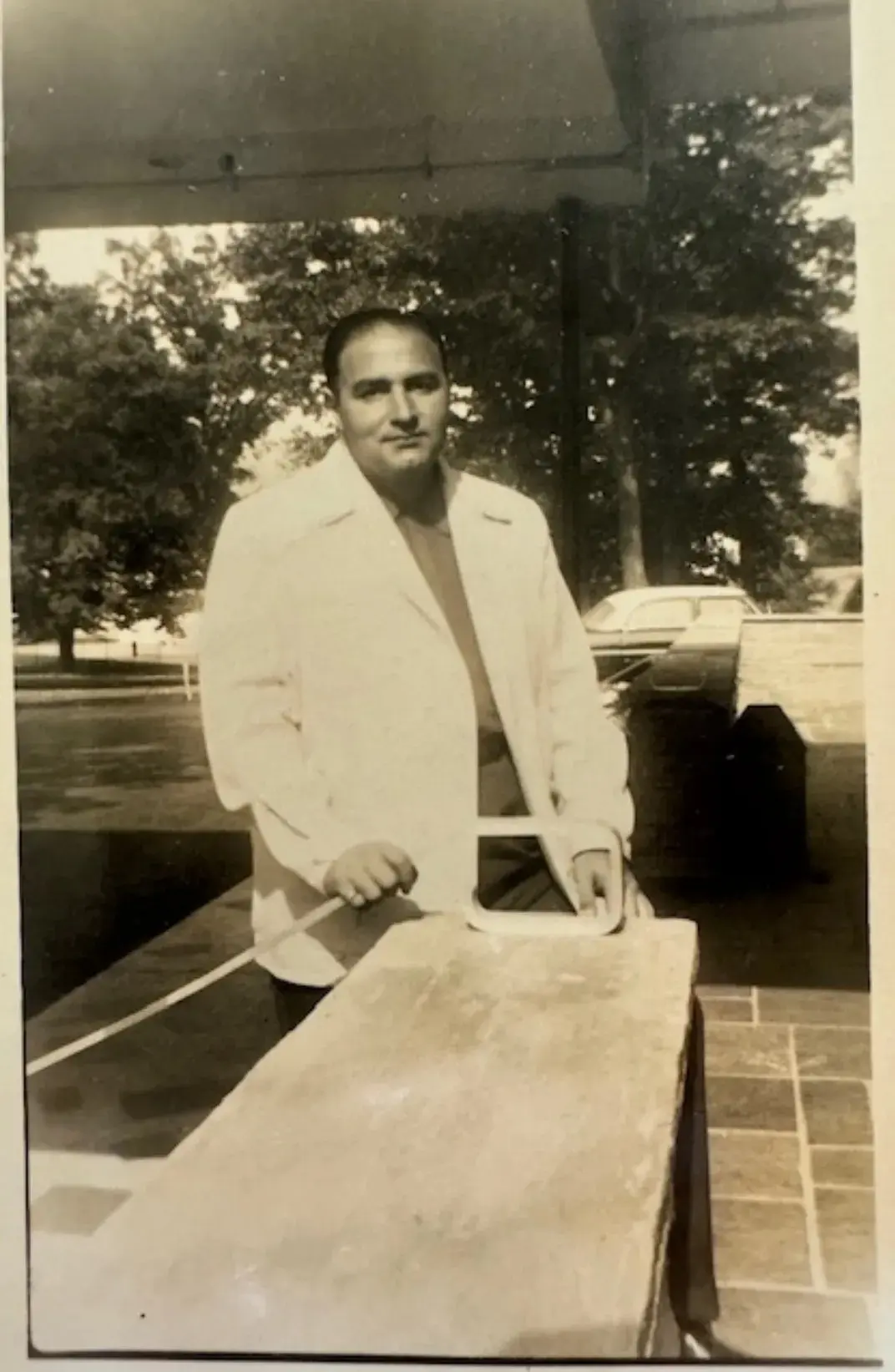
Remembering her aunt and uncle attending family gatherings with Frank Sinatra playing on the stereo, Figilis noted: "I can see her just as if it was yesterday." Figilis provided the critical pieces of the puzzle that had eluded historians: two pristine black-and-white photographs displaying Speedy’s face for the very first time.
Future Outlook & Remaining Mysteries
While the identification of Arthur Serota and Karen Weber Figilis has provided invaluable context, human faces, and emotional depth to the archive, profound questions remain:
- The Anonymous Donor: To this day, nobody knows who dropped off the box of 300 letters at the New York USO office in 2022. Archivists theorize that a family member or estate cleaner may have cleared out an old home, noticed the USO letterhead on several of the vintage pages, and instinctively delivered them to the organization as an act of historical stewardship.
- Frances’s Perspective: The archive is heavily skewed toward Speedy’s voice. Only two letters written by Frances have been identified in the collection, though Speedy’s regular replies indicate she wrote frequently. Furthermore, researchers note that several of Speedy’s letters appear to have remained entirely unopened by his wife—a poignant psychological footnote regarding the overwhelming flood of communication during wartime.
As the USO continues to preserve and exhibit the Letters Home archive, Speedy Weber’s voice serves as an enduring testament to the human spirit. Through ink-stained pages, a whimsical soldier from the Bronx transcended the mud of Europe and the trials of combat, ensuring that across eighty years of silence, his heart remained firmly at home.


Comments
Facebook App ID not configured. Please add it in the Customizer.