
Executive Overview
When the Continental Congress formally ordered the transition from the "United Colonies" to the "United States" on September 9, 1776, the designation was viewed by many as a functional placeholder rather than an immutable identity. As the nation marks its 250th anniversary, historians look back at a turbulent lexical evolution characterized by fierce ideological power struggles, typographical anomalies, and extraordinary rebranding attempts.
Far from being universally embraced, every component of the nation’s name—from the lowercase "u" in united to the geographic breadth of America—has been scrutinized, challenged, or outright ridiculed. Over the centuries, prominent lawmakers, literary giants, and historical societies launched numerous campaigns to rename the republic. Proposed alternatives ranged from nationalist nods to Christopher Columbus, such as Columbia, to regional tributes like the United States of Alleghania, and even wildly ambitious global manifestos like the United States of the Earth.
This report explores the historical archive to examine how a fractured confederation of rebellious colonies negotiated its name, why the balance of power dictated its earliest grammar, and how successive generations attempted to redefine the American identity.
Read Also
/https://tf-cmsv2-smithsonianmag-media.s3.amazonaws.com/filer_public/3d/c2/3dc28526-5383-4097-82ce-16e8da3e588d/us-map.jpg)
Detailed Chronology: From Colonies to Continental Republic
The naming of the United States was not a singular eureka moment, but a protracted negotiation spanning decades of political mobilization and armed revolution.
Phase 1: The Fight for Collective Identity (1754–1775)
Long before the outbreak of the American Revolution, colonial unity was an elusive aspiration. In 1754, Benjamin Franklin published his iconic "Join, or Die" woodcut, depicting a snake sliced into distinct segments representing the colonies. This visual manifesto underscored a grim political reality: individual colonies were too vulnerable to withstand British suppression on their own.
As tensions escalated in the early 1770s, pro-independence pamphleteers seized on the necessity of joint action. Thomas Paine’s wildly successful 1776 pamphlet, Common Sense, urged the colonies to form a congress and establish a "charter of the United Colonies." Throughout this period, terms like the United Colonies of America or the United Colonies of North America circulated broadly, though they were widely understood to be temporary identifiers.
/https://tf-cmsv2-smithsonianmag-media.s3.amazonaws.com/accounts/headshot/greg2.png)
Phase 2: Formalizing the "United States" (1776)
The definitive pivot from "Colonies" to "States" occurred in the summer and autumn of 1776. On June 7, Virginia delegate Richard Henry Lee introduced a historic resolution declaring the colonies "free and independent states." This language heavily influenced Thomas Jefferson’s drafting of the Declaration of Independence. When the document was formally engrossed and signed on August 2, 1776, its heading read: "The unanimous Declaration of the thirteen united States of America."
Weeks later, on September 9, 1776, the Second Continental Congress issued a series of administrative resolutions—primarily focused on funding George Washington’s troops—that officially ordered all official documents to substitute "United Colonies" with "United States."
Phase 3: Constitutional Realignment (1781–1789)
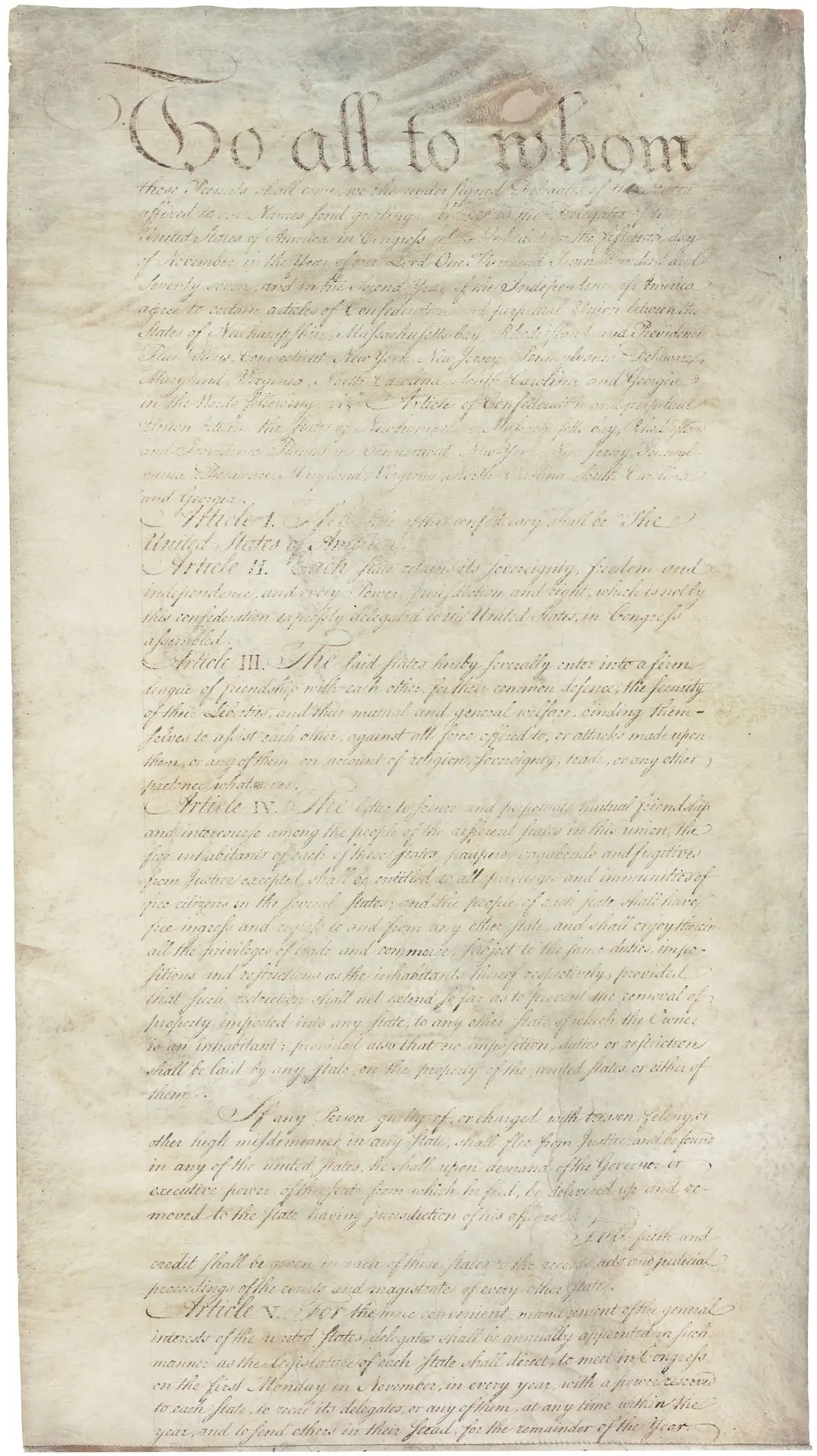
The early republic was structured as a loose confederation under the 1781 Articles of Confederation. Article I reaffirmed the name "The United States of America," while Article II strictly guarded local autonomy, ensuring that individual states retained their sovereignty and freedom.
/https://tf-cmsv2-smithsonianmag-media.s3.amazonaws.com/filer_public/3d/c2/3dc28526-5383-4097-82ce-16e8da3e588d/us-map.jpg)
However, the central government’s inability to levy taxes or maintain a standing army nearly bankrupted the young republic. By 1789, the ratification of the U.S. Constitution superseded the Articles. This new supreme law of the land fundamentally shifted power toward a robust federal government—a transformation permanently signaled by capitalizing the "U" in United.
Supporting Context & Metrics: The Grammar of Sovereignty
To fully appreciate the naming of America, modern observers must look closely at 18th-century typography. The lowercase "u" in the preamble of the Declaration of Independence was neither a misprint nor a stylistic quirk; it reflected a deliberate political philosophy.
| Constitutional Era | Primary Governing Document | Locus of Power | Treatment of the Name |
|---|---|---|---|
| 1776–1781 | Declaration of Independence | Individual States | Lowercase "united states" (Confederation of independent entities) |
| 1781–1789 | Articles of Confederation | Individual States | Capitalized style: "The United States of America" (Strictly limited central authority) |
| 1789–Present | The U.S. Constitution | Central Federal Government | Capitalized "United States" (Paramount federal authority) |
As Pulitzer Prize-winning historian Edward J. Larson notes, the framers did not initially believe they were creating a monolithic nation-state. Citizens of Virginia or Massachusetts viewed themselves primarily through the lens of their home states. They entered into a tactical alliance solely to coordinate military defense and foreign diplomacy.
/https://tf-cmsv2-smithsonianmag-media.s3.amazonaws.com/filer_public/14/71/1471d586-9350-4811-89b0-4ba28f953c2a/1920px-benjamin_franklin_-_join_or_die.jpg)
The structural weakness of this arrangement soon became glaring. As historian Michael Auslin observed, the central government could not pay off its revolutionary war debt or enforce uniform economic policies, plunging the republic into an existential crisis by the mid-1780s. Only when the Constitution centralized national authority did the country truly function as a singular United States.
Official Statements and Alternative Rebranding Campaigns
Once the nation’s survival was secured, attention turned to the second half of its moniker: "of America." Because the geographic term America encompassed two entire continents—much of which had no connection to the republic—critics argued the name was both inaccurate and historically unjust.
The Quest for "Columbia"
In 1792, the 300th anniversary of Christopher Columbus’s 1492 voyage sparked a prominent movement to rename the nation Columbia in his honor. Proponents argued that naming the hemisphere after cartographer Martin Waldseemüller’s tribute to Amerigo Vespucci was an insult to Columbus’s pioneering journey.
/https://tf-cmsv2-smithsonianmag-media.s3.amazonaws.com/filer_public/c2/0d/c20de283-358c-4522-9a28-0efb20a0c68f/1920px-usa_declaration_independence.jpg)
The Literary Interventions: Appalachia and Alleghania
By the mid-19th century, literary figures entered the fray. In 1839, author Washington Irving proposed renaming the nation after its indigenous mountain ranges, suggesting the United States of Appalachia or the United States of Alleghania. Edgar Allan Poe quickly endorsed the idea.
In 1845, the New-York Historical Society formally recommended changing the country’s name to the Republic of Allegania. This initiative prompted a fascinating cross-section of responses from historical institutions across the country:
- John Quincy Adams, writing on behalf of the Massachusetts Historical Society, ridiculed the proposal, dismissing the Allegheny mountains as a "mere clod of earth." Adams favored Columbia, condemning the original naming of the Americas as "a perpetual memorial of human injustice by conferring upon one man [Vespucci] a crown of glory justly due to another [Columbus]."
- The New Jersey Historical Society staunchly defended the status quo, arguing that the nation’s name was inextricably bound to its heroic history. They warned against any attempt to blot out a name that kindled such glorious associations in every citizen’s bosom.
Congressional Ambitions: From Hemisphere Dominance to the Earth
Despite public pushback, lawmakers periodically attempted to amend the Constitution to alter the country’s identity:
/https://tf-cmsv2-smithsonianmag-media.s3.amazonaws.com/filer_public/ee/e4/eee4ff2b-613f-4569-bf90-35c14b35d5c6/articles_of_confederation_1-5.jpg)
- 1849: Newspaper editor and Congressman Horace Greeley introduced a resolution to rename the nation in honor of Columbus, framing it as a "tardy atonement" for historical oversights.
- 1866: Missouri Congressman George Washington Anderson proposed dropping the prefix entirely and calling the nation simply America, intended to reflect the nation’s growing manifest destiny across the Western Hemisphere.
- 1893: Wisconsin Congressman Lucas Miller introduced arguably the most radical proposal in legislative history: renaming the country the United States of the Earth (or World). Miller argued that the republic should continuously admit new states until every nation on the globe had joined. While contemporary newspapers mocked Miller as a "crank," modern historians suggest his proposal was likely biting satire directed at the era’s unchecked imperial expansion.
Future Outlook: A Moniker That Stood the Test of Time
The legislative failure of Lucas Miller’s global proposal marked a turning point. Chastened by the public ridicule directed at radical rebranding efforts, no major political figure has seriously proposed changing the nation’s name in the decades since.
As the United States reflects upon its 250-year legacy, the journey of its name serves as a microcosm of the American experiment itself. Born out of a reluctant alliance of thirteen distinct states, debated by founding architects, tested by civil war, and challenged by romantic nationalists and satirists alike, the "United States of America" has endured. Two and a half centuries later, the moniker stands as a permanent fixture of global history—not because it was universally agreed upon from day one, but because the nation grew large enough and resilient enough to give the name profound meaning.





Comments
Facebook App ID not configured. Please add it in the Customizer.