
Executive Overview
The 1980s represent a singular, unrepeatable epoch in the evolution of fantasy cinema. It was a decade defined by practical creature effects, unpolished grit, and a mythological bravado that largely vanished with the advent of cleaner, more corporate aesthetics in the 1990s, only to be resurrected digitally in the 2000s. Within this historical tapestry, producer Dino De Laurentiis’s Robert E. Howard cinematic trilogy occupies a fascinating, if precarious, niche. Beginning with the surprising psychological nuance of 1982’s Conan the Barbarian and continuing through the campy, creature-heavy escapades of 1984’s Conan the Destroyer, the trifecta concluded with a whimper rather than a roar: 1985’s Red Sonja.
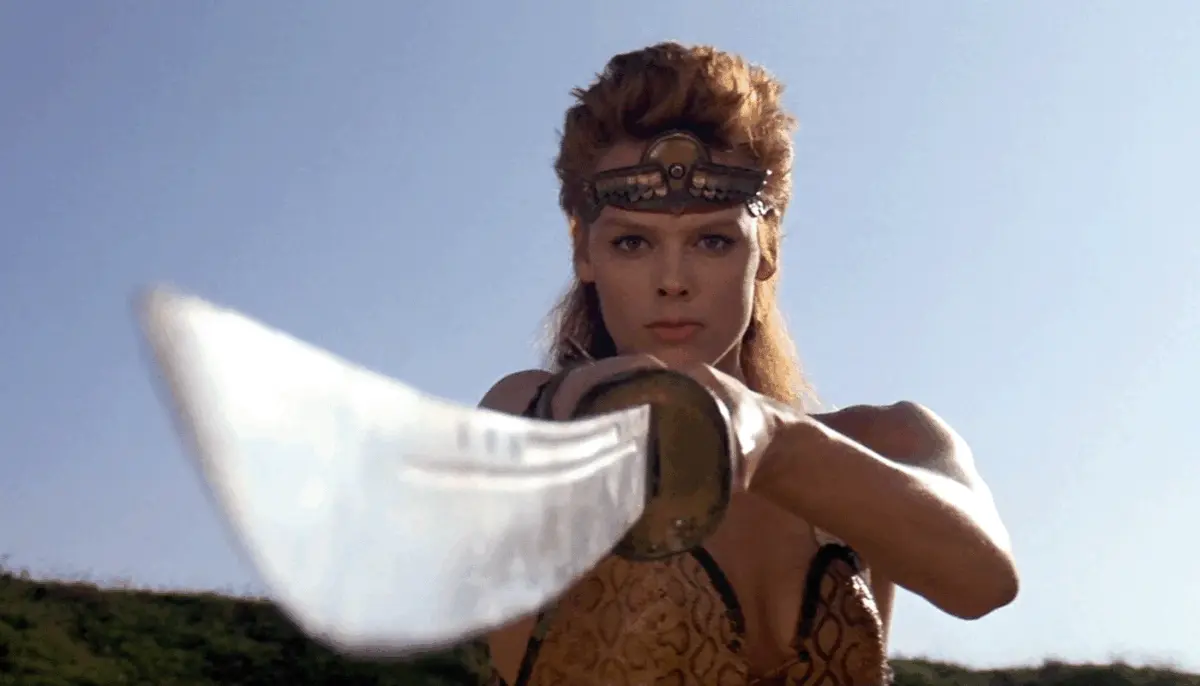
Directed by Richard Fleischer and starring Brigitte Nielsen in her feature film debut alongside action icon Arnold Schwarzenegger, Red Sonja arrived with substantial pedigree. Yet, it plummeted at the box office and was excoriated by critics, famously earning the label of "the worst film I have ever made" from its male lead. Decades removed from its initial theatrical run, Red Sonja remains the red-headed stepchild of 1980s fantasy—a fascinatingly flawed cinematic artifact caught between ambitious world-building, regressive narrative missteps, and accidental comedic gold. This investigative post-mortem examines the anatomy of its failure, the systemic issues plaguing its production, its strange structural anomalies, and its enduring, complicated legacy within the sword-and-sorcery genre.
Detailed Chronology: The Genesis and Execution of a Fantasy Flop
Pre-Production and the Shadow of Conan
Following the commercial viability established by Conan the Barbarian and its lighter, more commercially minded sequel, Dino De Laurentiis sought to expand his proprietary cinematic universe. Based on characters created by fantasy pioneer Robert E. Howard (though Red Sonja herself was largely shaped by writer Roy Thomas and artist Barry Windsor-Smith for Marvel Comics), the project was designed to cement a robust franchise.
Read Also
However, legal roadblocks immediately plagued the production. Due to complex rights issues regarding Howard’s intellectual property, the production team was legally barred from using the name "Conan." Consequently, Arnold Schwarzenegger was cast not as the Cimmerian barbarian, but as Kalidor—a character identical to Conan in every metric save nomenclature. This narrative workaround set a precedent of compromise that would bleed into every tier of the film’s execution.
Narrative Architecture
The film opens on a note of severe structural and moral friction. Sonja (Brigitte Nielsen) watches her remote village burn at the hands of raiders loyal to the tyrannical Queen Gedren (Sandahl Bergman). During the assault, Sonja is subjected to a brutal sexual assault after rejecting Gedren’s advances—a deeply problematic origin beat established in a clumsy opening voiceover by an unexplained spirit. This spirit grants Sonja the supernatural prowess of a master warrior, bypassing the earned, grueling physical training that defined Conan’s path to power in earlier films.
Years later, Queen Gedren acquires "the Talisman"—a primordial green orb responsible for the creation of the universe, which requires darkness to remain dormant. After slaughtering the priestesses guarding the relic and mortally wounding Sonja’s sister, Varna, Gedren triggers the primary quest. Kalidor crosses paths with the dying Varna, who implores him to reunite with Sonja and recover the stolen orb.
The narrative settles into a standard fantasy road-trip formula. Sonja and Kalidor are joined by two unlikely companions: the insufferable, deposed boy-prince Tarn (Ernie Reyes Jr.) and his loyal, towering bodyguard Falkon (Paul L. Smith). The quartet navigates a series of episodic encounters—battling mechanical monsters, traversing treacherous landscapes, and evading Gedren’s henchmen—before culminating in a volcanic final showdown. In a climax reminiscent of The Lord of the Rings, the Talisman is cast into a fiery abyss, Gedren is dispatched, and Sonja honors her vow to only yield to a man who can defeat her in combat by engaging Kalidor in a symbolic duel that ends in a kiss.
Supporting Context & Metrics: Box Office and Critical Reception
The financial and critical post-mortem of Red Sonja paints a stark picture of a property that fundamentally misread its audience.
Financial Metrics
- Production Budget: Estimated at $17.9 million, a robust sum for a mid-1980s fantasy feature.
- Domestic Box Office Gross: A dismal $6.9 million, signaling an immediate rejection by general audiences.
- Franchise Impact: The catastrophic financial return effectively terminated all active development on a third, official Conan sequel, effectively freezing the sword-and-sorcery subgenre at major studios for the remainder of the decade.
Critical Verdicts
Contemporary reviewers tore the film apart, pointing to its sluggish pacing, wooden dialogue, and tonal schizophrenia. The conflation of villainy with queerness in the opening sequence alienated progressive audiences, while the film’s failure to deliver a genuinely empowered female lead disappointed fans expecting a thematic equal to Sandahl Bergman’s Valeria from Conan the Barbarian.
Moreover, the production’s cost-cutting measures were glaringly apparent. The set designs and costumes lacked the rich, lived-in texture of John Milius’s 1982 film, leaning instead into an awkward amalgam of bargain-bin medieval aesthetics and aggressive BDSM-inspired wardrobe choices.
Official Statements and Cast Retrospectives
The behind-the-scenes sentiment regarding Red Sonja is perhaps best encapsulated by its star-studded cast and crew, who harbor few illusions about the film’s artistic merits.
Arnold Schwarzenegger’s Candid Admission
Long before the era of sanitized, contractually mandated promotional praise, Arnold Schwarzenegger was remarkably candid about his misgivings regarding the project. On multiple occasions in later decades, the actor joked that Red Sonja was "the worst film I have ever made." Industry insiders have frequently noted that Schwarzenegger’s participation was largely contractual—a fulfillment of obligations to producer Dino De Laurentiis rather than a passion project. Watching the finished product, the actor’s lack of engagement is palpable; his performance as Kalidor lacks the brooding magnetism that made his initial outings as Conan iconic, exposing the limitations of his early-career dramatic range.
Brigitte Nielsen’s Screen Debut
For Brigitte Nielsen, Red Sonja served as a high-profile launchpad into international pop culture. Thrust into a massive physical role with virtually no prior acting experience, Nielsen cut a striking visual silhouette—highlighted by her legendary, gravity-defying red mullet and chainmail-adjacent armor. While critics derided her dramatic delivery, Nielsen’s physical commitment to the role laid the groundwork for a career that would include high-profile genre entries like Rocky IV and Cobra.
The Raiders of the Lost Ark Connection
One of the most fascinating trivia points surrounding Red Sonja is its heavy cross-pollination with the cast of Steven Spielberg’s Raiders of the Lost Ark. The production functioned as an impromptu reunion for several memorable character actors from the 1981 classic:
- Ronald Lacey (infamous Gestapo agent Major Toht in Raiders) stars here as Gedren’s worm-tongued vizier, Ikol.
- Pat Roach (the iconic "Propeller Nazi" from Raiders, who also appeared as Thoth-Amon in Conan the Destroyer) pivots into campy comedy as the flamboyant toll-keeper, Brytag.
- Tutte Lemkow (Sallah’s Imam friend in Raiders) appears as Gedren’s court wizard.
- Terry Richards (the master swordsman whom Indiana Jones casually shoots) turns up briefly as a well-dressed bandit.
Despite this wealth of seasoned character-acting talent, the film’s structural vacuum often left these performers stranded in underwritten, caricatured roles.
Future Outlook: Remakes and the Enduring Cult Legacy
Nearly forty years after its initial theatrical flameout, Red Sonja refuses to fade entirely into cinematic obscurity. The property occupies a bizarre space in pop culture history—simultaneously recognized as a total misfire and studied as a prime example of 1980s excess.
The 2025 Reboot Initiative
The enduring, undeniable marketability of Robert E. Howard’s character archetypes ensured that Hollywood would eventually revisit the concept. The arrival of the 2025 Red Sonja feature film adaptation, starring Matilda Lutz, signaled a modern attempt to course-correct the missteps of the 1985 original. Updating the visual language, smoothing out the narrative rough edges, and leaning into contemporary understandings of female-led action choreography, the reboot aimed to erase the lingering stink of the De Laurentiis iteration. However, early reactions demonstrated the inherent difficulty of translating vintage pulp fantasy into modern blockbuster idioms without sacrificing the specific, acid-etched weirdness that fans of the era crave.
Cultural Legacy: The Triumph of the Odd
While Red Sonja (1985) failed as a masterclass in epic storytelling, its legacy survives through its charming aberrations. Performances like Paul L. Smith’s surprisingly nuanced, warm-hearted portrayal of Falkon—a rare instance in 1980s cinema where a heavier actor was not reduced to cheap physical gags—provide genuine emotional anchors. Similarly, Ernie Reyes Jr.’s charismatic turn as Prince Tarn injects much-needed levity into an otherwise leaden narrative.
Ultimately, Red Sonja stands as a cautionary tale of franchise expansion gone wrong, yet it remains an essential waypoint in the ’80s Fantasy Film Club canon. It is messy, offensive in its early tonal miscalculations, visually baffling, and occasionally delightful. As modern audiences continue to unearth and re-evaluate the unpolished edges of 20th-century genre cinema, Red Sonja will likely endure not as a lost masterpiece, but as a monument to an era when studios were willing to fund magnificent, unmitigated chaos.


Comments
Facebook App ID not configured. Please add it in the Customizer.