
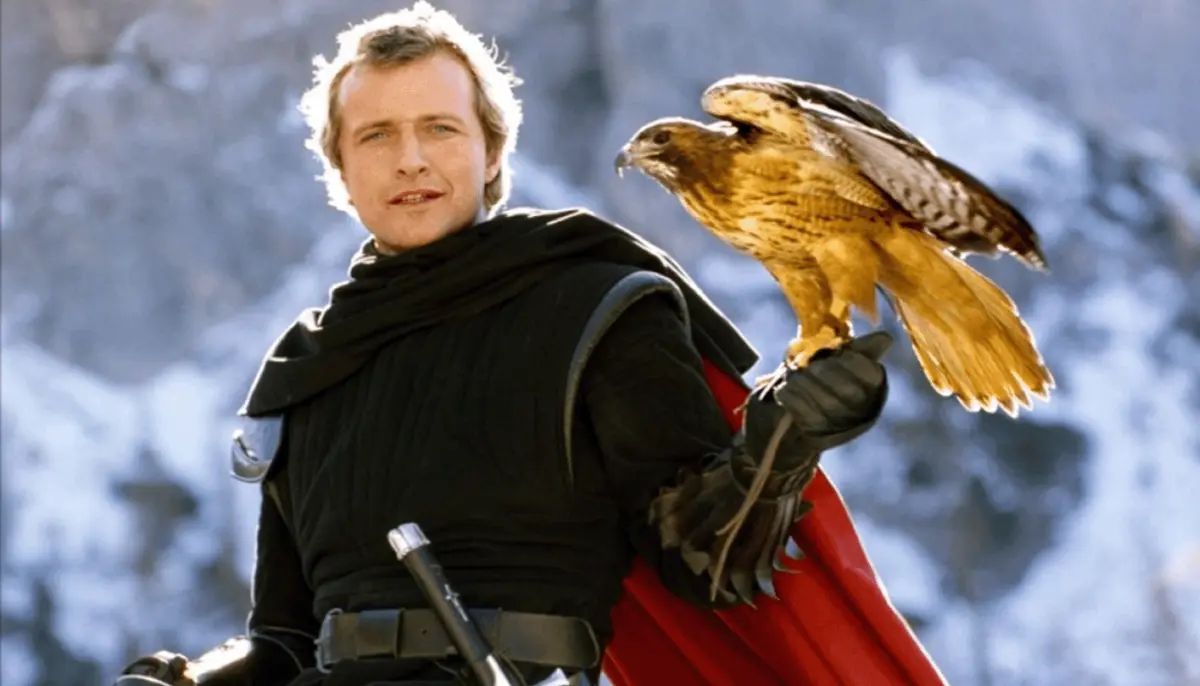
In the cinematic landscape of the 1980s, fantasy filmmaking underwent a peculiar metamorphosis. Distinct from the sleek, high-budget adaptations that would later dominate the 2000s, the fantasy cinema of the Reagan era was defined by a raw, unpolished, and frequently eccentric charm. It was a decade of practical effects, tactile world-building, and bold stylistic gambles that often bridged the gap between gritty medieval realism and lyrical fairy-tale mysticism.
Among the canonical entries from this era, director Richard Donner’s 1985 romantic fantasy Ladyhawke occupies a fascinating, if contested, space. Starring a powerhouse trio of rising and established talent—Rutger Hauer, Michelle Pfeiffer, and Matthew Broderick—the film tells the haunting tale of Etienne of Navarre and Isabeau of Anjou, star-crossed lovers cursed by a jealous, tyrannical bishop. Navarre is condemned to roam the night as a grey wolf, while Isabeau takes the form of a hawk by day, meaning the couple is, in the words of a cynical young thief, "always together, eternally apart."
Despite boasting breathtaking location shoots in the rugged Italian countryside, an original screenplay by Edward Khmara, and a distinct aesthetic vision, Ladyhawke underperformed at the box office and divided contemporary critics. Its anachronistic synth-rock score and Matthew Broderick’s accented performance became lightning rods for debate. Yet, nearly four decades later, Donner’s genre-hybrid experiment invites a profound critical reassessment. Far from being a forgotten cinematic misfire, Ladyhawke stands as a vital precursor to the historical-romantic epics of the 1990s, a showcase of against-type performances, and a remarkably ambitious original Hollywood fairy tale.
Read Also
Detailed Chronology: The Journey of Ladyhawke
Conception and the Battle for Authorship
Long before it reached the silver screen, Ladyhawke began as an original concept born in the mind of screenwriter Edward Khmara. Unlike many of its contemporaries, which drew directly from European folklore, Arthurian legend, or established fantasy literature, Khmara’s narrative was entirely self-generated. Famously, the writer claimed the idea "occurred to [him] while jogging on the roof of the Hollywood YMCA."
However, the film’s journey to production was fraught with administrative and legal hurdles. During its marketing campaign, Warner Bros. heavily implied that the film was a cinematic reinterpretation of an existing, classic European fairytale. This promotional angle not only clouded the film’s original provenance but also triggered a formal dispute by the Writers Guild of America (WGA) against the studio for attempting to deny Khmara full authorship rights. This bureaucratic tussle underscored the paradox of Ladyhawke: its storytelling instincts were so profoundly mythic that studio executives and audiences alike instinctively treated it as an ancient folk tale, even though it was an entirely modern invention.
Production Shifts and Casting Turbulence
The path to realizing Aquila on screen was similarly bumpy behind the scenes. Initially, the role of the stalwart, tormented captain of the guard, Etienne of Navarre, was slated for Kurt Russell. However, creative differences and scheduling pressures during early rehearsals led Russell to depart the project.
In a last-minute casting maneuver that would permanently alter the film’s DNA, director Richard Donner brought in Dutch actor Rutger Hauer. Fresh off his career-defining, terrifying turn as the replicant Roy Batty in Ridley Scott’s Blade Runner (1982), Hauer was thoroughly typecast as unlovable loners, sociopaths, and loose-cannon antagonists. Casting him as a noble, deeply romantic hero was an audacious gamble that ultimately paid massive dividends.
Opposite Hauer, a young Michelle Pfeiffer—having recently starred in Grease 2—was cast as the ethereal Isabeau of Anjou. Meanwhile, Matthew Broderick, hot off his breakthrough in WarGames (1983), was brought in to play Phillipe Gaston, known as "The Mouse," a quick-witted, silver-tongued petty thief whose prison escape serves as the narrative catalyst.
Narrative Architecture
Set in medieval Aquila, the plot unfurls as Phillipe Gaston makes a daring escape from the city’s dungeons. Sentenced to death, he is rescued from the gallows by Navarre, who is traveling with a wounded hawk. Fleeing both the villainous Bishop of Aquila (portrayed with Shakespearean rigidity by John Wood) and the current captain of the guard, Captain Marquet (Ken Hutchison), Navarre enlists the reluctant thief to help him infiltrate the city.
When Navarre’s hawk is injured, the party seeks refuge in a crumbling, isolated castle occupied by Imperius (played by The Prisoner’s Leo McKern), a drunken, cantankerous monk. There, the Mouse discovers the dark truth of the companions: the hawk is actually Isabeau, Navarre’s betrothed. The corrupt Bishop, consumed by unrequited lust and bitter jealousy, had placed a cruel curse upon them: Isabeau must live as a hawk by day and a woman by night, while Navarre is condemned to be a man by day and a wolf by night.
Imperius, burdened by his past betrayal of the couple, reveals the sole loophole to break the curse: the lovers must confront the Bishop while both are in human form during "a day without night and a night without day"—foreshadowing a total solar eclipse. Following a perilous journey, encounters with the Bishop’s master hunter Cezar (an early-career Alfred Molina), and a dramatic infiltration via the city’s sewers, the protagonists achieve their convergence. In the soaring nave of the cathedral, Navarre and Marquet duel, the eclipse occurs, the curse is broken, and the star-crossed lovers are finally reunited in human flesh.
Supporting Context & Metrics
Box Office and Critical Reception
Commercially and critically, Ladyhawke faced a difficult uphill battle upon its theatrical release in March 1985. Operating on a robust estimated budget of $20 million, the film failed to break even during its initial run, narrowly recouping its production costs and largely being categorized as a box-office disappointment.
Critical notices at the time were decidedly mixed. Reviewers frequently targeted two primary elements:
- Matthew Broderick’s Accent: Critics pointed out that Broderick’s attempt at a British accent felt thin, unconvincing, and rhythmically out of place in a medieval European setting.
- The Musical Score: Composed by Andrew Powell and heavily driven by anachronistic, 1980s synth-rock and drum machines, the soundtrack was roundly lambasted by contemporary critics for shattering the historical illusion of the setting.
Despite these hurdles, the film found traction within specific circles. It earned two Academy Award nominations—Best Sound and Best Sound Effects Editing (ultimately losing to Out of Africa and Back to the Future, respectively)—and captured two prestigious Saturn Awards from the Academy of Science Fiction, Fantasy and Horror Films: Best Fantasy Film and Best Costumes.
Production Design and Location Authenticity
Where Ladyhawke met universal praise was its visual presentation. Director Richard Donner bypassed soundstages in favor of on-location shoots across Italy, lending the film a breathtaking tactile authenticity. Utilizing the dramatic, snow-capped peaks of the Apennine Mountains, the verdant plains of Emilia-Romagna, and the ancient stone ruins of Abruzzo, the production created a lived-in, medieval atmosphere.
For the climactic cathedral sequences, the production utilized the imposing architecture of St. Peter’s Basilica in Tuscania. While these real-world locations grounded the film visually, they also created an interesting juxtaposition with the narrative’s more whimsical fantasy elements, creating an aesthetic that felt halfway between a historical epic and a high-fantasy canvas.
| Metric / Category | Detail |
|---|---|
| Release Year | 1985 |
| Director | Richard Donner |
| Estimated Budget | ~$20,000,000 |
| Key Cast | Rutger Hauer, Michelle Pfeiffer, Matthew Broderick, Leo McKern, John Wood, Alfred Molina |
| Major Awards | Saturn Award for Best Fantasy Film, Saturn Award for Best Costumes; 2 Oscar Nominations |
| Filming Locations | Abruzzo, Emilia-Romagna, and Tuscania (Italy) |
Official Statements and Retrospective Commentary
Reflecting on the film decades later, cultural critics and participants have come to view Ladyhawke not as a misguided failure, but as a fascinating cinematic time capsule of 1980s risk-taking.
Though no contemporary director’s cut or exhaustive press tour exists to rewrite its initial reception, the cultural consensus surrounding the film’s elements has evolved significantly:
- On the Soundtrack: While Andrew Powell’s synth-rock score was viewed as a fatal misstep in 1985, modern retrospective analysis views it with a degree of affectionate nostalgia. Stripped of 1980s critical snobbery, the score sounds remarkably in line with the broader, synthesizer-heavy fantasy soundscapes of the decade (such as Tangerine Dream’s work on Legend). Because Ladyhawke is fundamentally a fairy tale rather than a dry historical documentary, the energetic synth beats lend the film an undeniable rhythmic pulse.
- On the Performances: Hauer’s performance remains a masterclass in playing against type. Casting a man globally recognized for unhinged villainy as an epitome of pure, aching devotion gave Navarre a dangerous edge that elevated the romance above standard fairy-tale fare. Similarly, Broderick’s turn as "The Mouse" laid the groundwork for his signature persona: the self-centered, slightly bumbling, yet ultimately endearing underdog who fumbles his way through monumental tasks—an archetype he would later refine in films like Election (1999).
- On Alfred Molina’s Early Work: Film historians frequently highlight Ladyhawke as a delightful mid-80s artifact for featuring a youthful Alfred Molina as Cezar. This serves as a humorous parallel to other 1980s fantasy features where future character-actor greats appeared in minor villainous roles opposite alumni of Blade Runner.
Future Outlook: The Enduring Legacy of Ladyhawke
As we examine the legacy of 1980s fantasy cinema from the vantage point of the 2020s, Ladyhawke’s footprint becomes increasingly clear. While it did not spawn a multi-film franchise or spark an immediate wave of direct imitations, its structural DNA lives on in several key ways.
Blueprint for the 1990s Historical-Adventure Resurgence
Ladyhawke acted as a direct precursor to the glossy, slightly campy, genre-bending historical epics that flooded Hollywood throughout the 1990s. Films like Robin Hood: Prince of Thieves (1991), The Three Musketeers (1993), The Man in the Iron Mask (1998), and The Mask of Zorro (1998) all adopted Ladyhawke’s core thesis: taking a well-worn historical or mythic framework, injecting it with modern narrative sensibilities, casting charismatic young stars, and utilizing authentic European landscapes for visual splendor. Furthermore, the tradition of sticking wildly anachronistic pop songs over the end credits of historical epics traces a direct lineage back to Powell’s controversial musical experiments in Donner’s film.
The Original Fairytale Paradox
Perhaps the most lasting impression Ladyhawke leaves is its triumph as an original myth. In an industry
obsessed with pre-existing intellectual property, remakes, and adaptations of classic public-domain literature, Edward Khmara managed to engineer a story so archetypal, so emotionally resonant, that audiences and studios genuinely believed it was a lost fable recovered from the Middle Ages.
While its pacing can occasionally drag, and its dialogue sometimes sits uncomfortably light against the heavy stone of Italian cathedrals, Ladyhawke remains a monument to earnest filmmaking. It is a movie that swung for the fences with a werewolf, a hawk, a cynical thief, and a synth-rock soundtrack—and in doing so, secured a permanent, peculiar place in the annals of fantasy cinema. As Hollywood continues to relentlessly mine the past for fresh IP, the sheer audacity of an original, high-concept fairy tale like Ladyhawke stands as a reminder of an era when blockbuster cinema was willing to embrace the wonderfully strange.


Comments
Facebook App ID not configured. Please add it in the Customizer.