
Executive Overview
The global art market is bracing for yet another monumental moment as a long-hidden Surrealist masterpiece prepares to re-enter the public eye after seven decades of private seclusion. Leonora Carrington’s mesmerizing 1953 painting, Fil d’Or (translating from the French as "gold thread"), is scheduled to go under the hammer at Heritage Auctions in New York on November 10. Carrying a pre-sale estimate of $250,000 to $350,000, the work’s reappearance is more than a routine market transaction—it is a cultural excavation.
For seventy years, Fil d’Or remained entirely out of public view, sequestered in private collections, its very existence preserved largely through historical documentation and the scholarly study of Carrington’s prolific mid-century output. Now, as the art world undergoes a profound historical reassessment of female Surrealists—driven by institutional rediscovery, record-shattering auction sales, and scholarly revisionism—the painting’s debut offers a rare window into the mature genius of an artist who spent her life blurring the lines between myth, magic, and modernity.
This comprehensive report examines the provenance, technique, and conceptual underpinnings of Fil d’Or, while contextualizing its emergence within the broader explosion of market interest surrounding Leonora Carrington and her female contemporaries. From her harrowing wartime escape from Europe to her creative renaissance in the mystical landscapes of Mexico, we trace the trajectory of a visionary whose works are rapidly transforming from historically underappreciated treasures into some of the most coveted assets in the contemporary fine art market.
Read Also
Detailed Chronology: From Wartime Exile to the Mexican Renaissance
To fully understand the weight of Fil d’Or, one must retrace the harrowing and transformative journey that brought Leonora Carrington to its creation in 1953. Born into an affluent industrialist family in Lancashire, England, in 1917, Carrington famously rebelled against her upper-class upbringing, choosing instead a life of unbridled artistic and personal freedom. Her early association with the Surrealist movement in Europe was cemented through her tempestuous and creatively fertile relationship with the elder German Surrealist master, Max Ernst.
However, the outbreak of World War II shattered the bohemian enclave of the European avant-garde. When the Nazi occupation of France forced Ernst into internment and ultimately flight, Carrington suffered a catastrophic psychological breakdown, culminating in her institutionalization in Santander, Spain. Escaping this traumatic ordeal, she found refuge in the Mexican embassy in Madrid before eventually fleeing Europe altogether, embarking on a new life in Mexico City in 1942.
It was in Mexico that Carrington found her true artistic and spiritual home. Far from the patriarchal domination that sometimes characterized the European Surrealist circle, Mexico offered Carrington a vibrant, syncretic cultural landscape where indigenous mythologies, Catholicism, and ancient pre-Columbian traditions coexisted seamlessly. Here, she forged deep, lifelong bonds with fellow European émigrés and refugees, most notably the visionary Spanish painter Remedios Varo and the pioneering Hungarian-born photographer Kati Horna.
Together, Carrington, Varo, and Horna formed an artistic trinity, diving deep into shared obsessions with alchemy, the occult, herbalism, and esoteric symbolism. They functioned as both muses and collaborators, interrogating the boundaries of reality through a distinctly feminine lens. By 1953—the year Fil d’Or was painted—Carrington was fully immersed in this Mexican renaissance. Her technique had matured, shifting from the dense, narrative-driven dreamscapes of her early career into more cosmic, metaphysical explorations of form, energy, and language. Fil d’Or stands as a direct product of this spiritual and artistic maturation, capturing the exact intersection of alchemical transformation and psychological inquiry that defined her decades-long Mexican exile.
Artistic Technique and Conceptual Framework
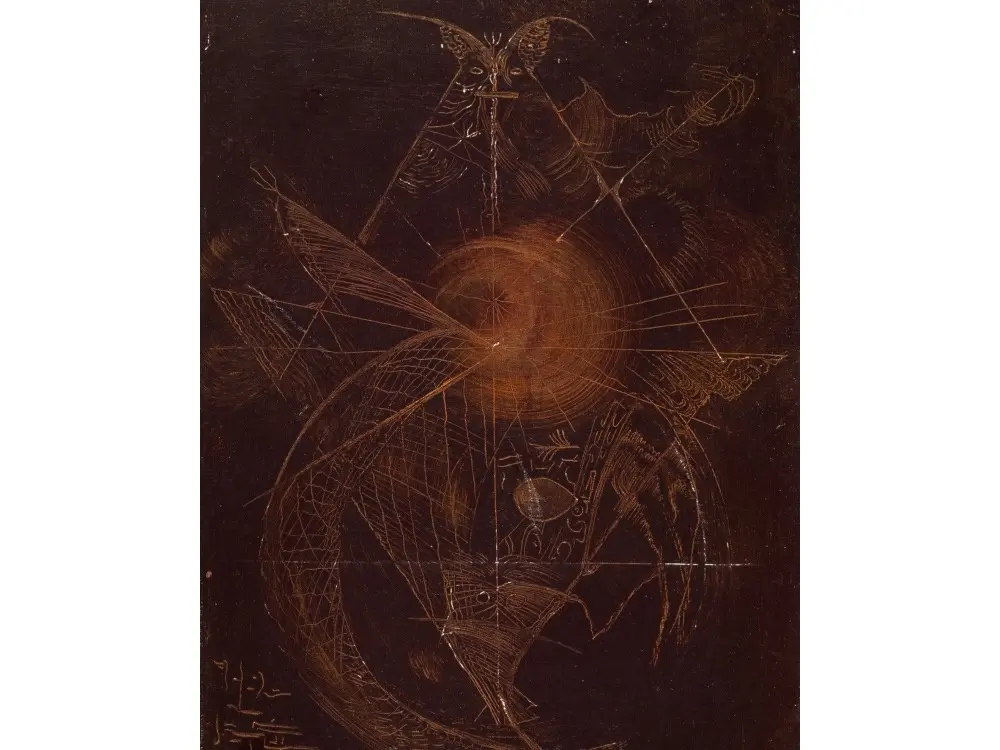
Fil d’Or is a masterclass in Carrington’s technical dexterity and conceptual depth. Measuring within an intimate scale typical of her most personal works, the painting immediately draws the viewer into a celestial, uncanny space. At its center hovers a cosmic bird—a recurring archetype in Carrington’s iconography, often serving as a spiritual avatar or a messenger between earthly reality and hidden dimensions.
Upon closer inspection, the avian figure is not rendered through traditional feathered brushwork. Instead, the creature appears to be composed of a network of delicate, intersecting threads. These luminous lines all emanate outward from a single, pulsating source: a radiant golden galaxy that occupies the anatomical space where a heart should beat. This visualization of internal cosmos mapped onto an organic body encapsulates Carrington’s lifelong fascination with alchemy—the belief that base materials could be transmuted into gold, and by extension, that the human psyche could undergo a similar spiritual elevation.
To achieve this sense of spontaneous, living motion, Carrington employed a sophisticated technique originally developed by her former partner, Max Ernst: grattage. Pioneered during the 1920s, grattage involves laying down fresh, wet layers of oil paint on a canvas and subsequently scraping them away using a blade, spatula, or palette knife. By dragging these sharp implements across the surface, the artist exposes underlying layers of pigment, revealing unexpected textures, ghostly shapes, and accidental patterns that mimic geological strata or celestial maps.
In Fil d’Or, the application of grattage gives the impression that the picture is actively realizing itself before the viewer’s eyes. The background flickers with an indeterminate depth, while the golden threads of the central bird seem to vibrate with kinetic energy, as if caught mid-metamorphosis.
Supporting Context & Metrics: The Carrington Market Boom
The emergence of Fil d’Or on the auction block arrives during a historic realignment of the global art market. For decades, the canonical narrative of Surrealism was dominated almost exclusively by its male protagonists—Salvador Dalí, René Magritte, Max Ernst, and André Breton. Female artists who participated in or expanded upon the movement were frequently marginalized as mere muses, companions, or minor footnotes to their male counterparts.
However, the past ten years have witnessed a radical, long-overdue correction. A combination of aggressive museum acquisitions, scholarly retrospectives, and market demand has propelled female Surrealists to the forefront of the blue-chip art world. A watershed moment in this shift occurred at the 2022 Venice Biennale, masterminded by curator Cecilia Alemani. Titled The Milk of Dreams—a direct homage to Leonora Carrington’s fantastical children’s book of the same name—the international exhibition placed female visionary artists at the center of contemporary discourse, exposing a massive, previously underserved collector base to their brilliance.
This institutional momentum has translated directly into astronomical figures at auction houses worldwide. Until recently, Carrington’s works traded in the low-to-mid six figures, but the market has since experienced an exponential vertical trajectory. In 2022, Carrington set a then-personal auction record when one of her paintings fetched $3.2 million.
That record was utterly obliterated in May 2024, when Sotheby’s in New York offered Carrington’s monumental 1945 masterpiece, Les Distractions de Dagobert. Bidding swiftly escalated into a fierce multi-party contest, culminating in a historic final hammer price of $28.5 million. This staggering sum not only shattered Carrington’s previous auction record by an order of magnitude but also cemented her status as one of the most valuable and sought-after modern artists in history, trailing only a handful of her male peers.
Within this hyper-inflated market climate, the appearance of Fil d’Or with an estimate of $250,000 to $350,000 represents a remarkably accessible entry point for collectors eyeing a museum-quality piece with an impeccable, decades-long provenance of private seclusion.
Official Statements and Critical Interpretation
Heritage Auctions has framed the upcoming sale of Fil d’Or not merely as a commercial event, but as a profound linguistic and philosophical meditation. In its official catalogue citation, the auction house dissected the layers of meaning embedded within the painting’s title and its execution:
"By choosing this title, Leonora Carrington shifts focus away from the obvious. Instead, she redirects the viewer’s awareness to consider coexisting, alternative meanings—in this case, her meaning—by experimenting with how we emotionally respond to different thoughts," Heritage Auctions noted in its scholarly commentary.
"Ultimately, Fil d’Or demonstrates that words hold multiple meanings, explores how others perceive them, and questions whether they are truly understood at all."
Art historians and linguistic analysts point out that in French, fil d’or literally refers to the ultra-thin gold or silver wire historically used in embroidery and the ornamentation of luxury textiles—a craft historically relegated to the domestic sphere and coded as "women’s work." By subverting this definition and applying it to a cosmic, alchemical bird composed of celestial energy, Carrington performs a dual act of reclamation: she elevates domestic craft to the realm of cosmic science, while simultaneously dismantling the rigid boundaries of semantic definition.
The painting asks the viewer to contemplate the fragility of communication. Just as a single gold thread can snap under tension, or be woven into an intricate tapestry of deception and truth, human language is shown to be a permeable, slippery medium. Carrington’s visual grammar suggests that true understanding lies beyond the literal definitions of words, residing instead in the intuitive, emotional resonance of symbols and shared psychic experiences.
Future Outlook: Legacy and Institutional Impact
As November 10 approaches, curators, institutional directors, and international collectors are preparing for what promises to be a fierce bidding war at Heritage Auctions. The rediscovery of Fil d’Or after seventy years in the shadows serves as a poignant reminder of how many masterpieces by women of the avant-garde remain hidden away in private estates, awaiting the right historical moment to re-emerge.
The broader implications of the Carrington market boom extend far beyond record-breaking sales figures. Every time a work like Fil d’Or surfaces, it forces a rewriting of art history textbooks. It challenges the lingering patriarchal hierarchies of twentieth-century modernism and demonstrates that Surrealism was never a monolithic movement dictated by André Breton’s manifestos, but rather a sprawling, polyphonic international phenomenon.
For museums and public institutions, the rising cost of Carrington’s oeuvre presents both a challenge and an imperative. While acquiring major works like Les Distractions de Dagobert has become increasingly difficult for cash-strapped public museums, smaller, highly conceptual gems like Fil d’Or—priced within the hundreds of thousands rather than tens of millions—offer regional and specialized institutions a vital opportunity to secure premier examples of her mature output before they vanish back into private vaults for another generation.
When the hammer falls in New York this November, the final price realized will undoubtedly generate headlines. Yet, the true value of Fil d’Or transcends its financial ledger. In rescuing this golden-threaded vision from seven decades of obscurity, the art world is once again reminded of the boundless, untamable imagination of Leonora Carrington—an artist who dared to map the cosmos from the inside out, and whose magical universe continues to expand long after her passing.





Comments
Facebook App ID not configured. Please add it in the Customizer.