
Executive Overview
In the shadowy underworld of illicit art trafficking, where masterpieces vanish into private collections or are altered beyond immediate recognition to evade detection, law enforcement agencies have long fought an asymmetrical war. For decades, the recovery of stolen cultural heritage relied heavily on painstaking human observation, informant tips, and sheer serendipity. However, a watershed moment in the intersection of artificial intelligence and criminal investigation occurred in the fall of 2024, altering the paradigm of art recovery forever.
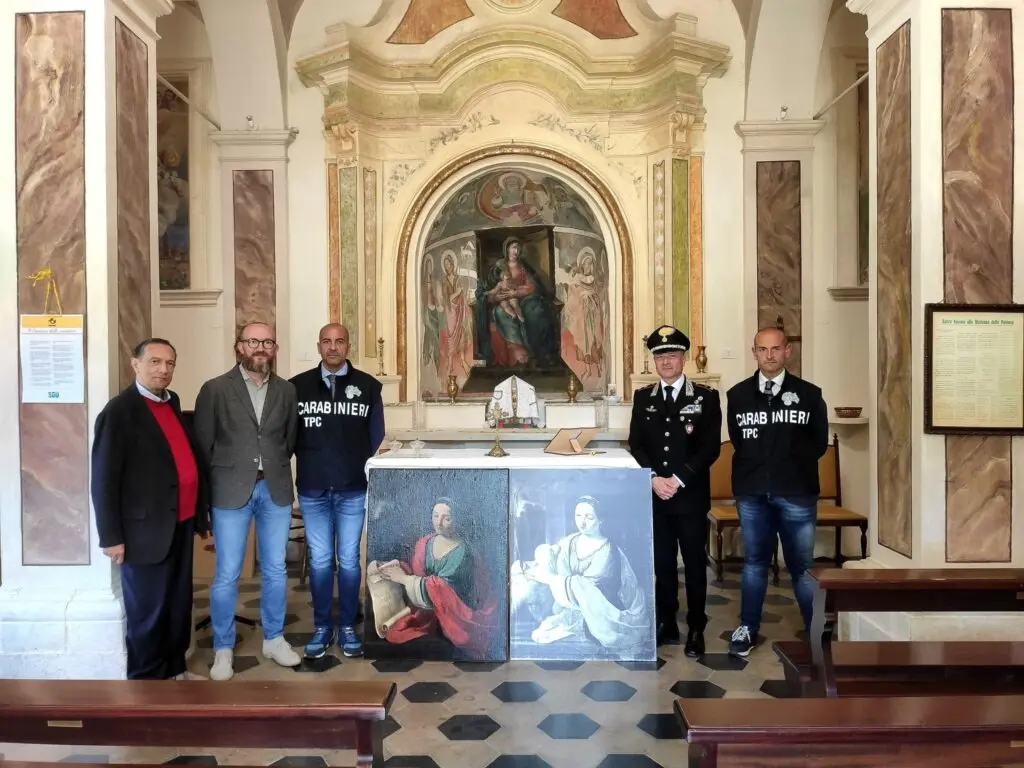
Operating amidst the sprawling, bustling aisles of the Mercanteinfiera—a renowned, four-decade-old antiques fair that draws exhibitors, collectors, and curious onlookers from every corner of Europe—officers from Italy’s elite art crime squad executed a routine yet high-stakes surveillance operation. Using standard digital cameras, they photographed hundreds of artifacts, canvases, and curiosities on display. Among them was an unassuming oil painting depicting a young woman holding a parchment scroll.
When those photographs were fed into a specialized artificial intelligence platform known as SWOADS (Stolen Works of Art Detection System), the algorithm did something the human eye could not. It pierced through two decades of physical alteration. It recognized that the unassuming portrait was, in fact, a heavily modified 17th-century depiction of Saint Agnese (Saint Agnes), which had been brazenly stolen from the remote Virgo Potens church in Sulmona, near L’Aquila, twenty years prior.
Read Also
The software’s triumph at the antiques fair is not an isolated success story; it represents the vanguard of a technological revolution spearheaded by the Carabinieri Command for the Protection of Cultural Heritage. Developed in-house by IT engineer and Carabinieri specialist Salvatore Rapicavoli, SWOADS has quietly revolutionized how law enforcement tracks down looted antiquities. To date, the system has successfully facilitated the recovery of more than 300 large-scale paintings and statues, alongside an astonishing 165,000 smaller artifacts—including ancient coins, historic letters, and rare medals—with a combined estimated market value exceeding $200 million.
This investigative report examines the chronology of the 2024 breakthrough, the inner workings of the SWOADS platform, the broader implications of AI in combating global art crime, and what the future holds for the preservation of humanity’s shared cultural heritage.
Detailed Chronology: From a 2004 Heist to the 2024 AI Breakthrough
The 2004 Theft at Virgo Potens
The story of the recovered Saint Agnese painting begins in the quiet mountainous region of Abruzzo, Italy. Sometime in 2004, the small, unassuming church of Virgo Potens in Sulmona fell victim to a brazen burglary. Among the items targeted by the thieves was a revered, centuries-old oil painting of Saint Agnese. At the time of its creation, the artwork followed classic iconographic traditions, depicting the young Christian martyr accompanied by a lamb—the traditional symbol of Saint Agnes, representing purity and innocence.
When the local diocese reported the theft to the local authorities, the painting was duly entered into the Carabinieri’s master database of stolen cultural property. Yet, as is tragically common with rural church thefts, the trail quickly went cold. Without a ransom demand, a tip from an informant, or a high-profile seizure, the painting slipped into the shadowy limbo of the illicit art market. For two decades, the congregation of Virgo Potens mourned the loss of their piece of local history, assuming the canvas had either deteriorated in a damp basement, been smuggled out of Italy entirely, or locked away permanently in an anonymous private vault.
The Evolution of SWOADS (2023)
Fast-forward nearly twenty years to 2023, a pivotal year for the Carabinieri Command for the Protection of Cultural Heritage. Recognizing that traditional database matching systems—which relied on exact textual descriptions, strict catalog numbers, or pristine visual likenesses—were increasingly inadequate against sophisticated art thieves, the squad integrated a secret weapon into its arsenal.
Salvatore Rapicavoli, a talented IT engineer, joined the art crime team with a singular mission: to build a system capable of bridging the gap between raw visual data and cold investigative leads. Rapicavoli engineered SWOADS (Stolen Works of Art Detection System), a proprietary artificial intelligence platform designed specifically to ingest, analyze, and cross-reference massive volumes of visual imagery against the world’s largest database of stolen art (the Leonardo database managed by the Carabinieri).
Unlike consumer-grade image recognition software, SWOADS was trained to look past surface-level anomalies. It was programmed to identify structural similarities, color palettes, proportions, and latent visual fingerprints that persist even when a painting undergoes intentional restoration, cleaning, or—in the case of the Saint Agnese portrait—malicious alteration.
The October 2024 Operation at Mercanteinfiera
In October 2024, Carabinieri officers deployed to the Mercanteinfiera in Parma, Italy. The fair, which has operated for over forty years, is a premier European destination for antique dealers, collectors, and enthusiasts. While the vast majority of commerce conducted at the fair is entirely legitimate, open-air antique markets and trade shows have historically served as attractive venues for traffickers attempting to "launder" illicitly acquired cultural property by blending it in with legal merchandise.
During their sweep of the exhibition halls, the undercover and uniformed officers captured hundreds of high-resolution digital photographs of various artworks on display. Following standard protocol, these images were uploaded directly into the secure portal connected to the SWOADS platform for real-time verification against active missing-art warrants.
The Match and the Mask: Unmasking Saint Agnese
Within moments of processing the images, the SWOADS algorithm flagged a compelling hit. The target was an oil painting featuring a young woman holding a parchment scroll.
To the human eye inspecting the canvas at the fair, the painting did not immediately appear to be a match for the missing 17th-century Saint Agnese. The most glaring discrepancy was right in front of the viewer: in the original 2004 police report and archival photographs, Saint Agnese was depicted cradling a gentle white lamb. In the painting exhibited at the 2024 Mercanteinfiera, however, that lamb had completely vanished. In its place, an unknown hand had meticulously painted over the animal, substituting it with a scroll inscribed with Latin text.
Art forgers and illicit dealers frequently alter paintings in this exact manner—modifying key iconographic attributes, changing background elements, or altering clothing—to bypass visual database checks and deceive prospective buyers who might check local stolen art registries.
Human investigators looking at the two side-by-side images might have dismissed the discrepancy as a mere coincidence or an entirely different artwork from the same era and school. SWOADS, however, looked deeper. The algorithm bypassed the superficial additions and analyzed the "hidden visual fingerprints" of the work: the precise distribution of color shades, the subtle contours of the young woman’s face, the fall of the drapery, and the rough silhouette of the compositional geometry. The mathematical alignment was undeniable.
Armed with this AI-generated intelligence, the Carabinieri intervened, securing the painting and initiating an investigation into how the canvas found its way to the exhibition floor. While the portrait has since been officially restored to the Diocese of Sulmona-Valva in a celebrated repatriation ceremony, the investigation into the network of thieves and dealers who handled the altered canvas over the preceding twenty years remains active.
Supporting Context & Metrics: The Scale of Global Art Crime and AI’s Impact
The Mechanics of Art Laundering
To understand why SWOADS is such a revolutionary tool, one must understand the tactics employed by modern art thieves. Stealing a famous painting from a secured museum is notoriously difficult; stealing religious artifacts, rural church paintings, and archaeological relics is, unfortunately, much easier.
Once an object is stolen, it enters a cooling-off period. Sophisticated criminal syndicates utilize several methods to clean the provenance of the item:
- The Alteration Technique: As demonstrated in the Saint Agnese case, modifying minor details—such as changing an animal, altering the color of a garment, or adding an inscription—disrupts legacy image-recognition software that relies on exact pixel matching or standard metadata.
- Cross-Border Smuggling: Moving an item across international borders obscures its paper trail, making it difficult for local authorities to trace its origin.
- The Gray Market Display: Exhibiting stolen goods at massive, fast-paced international trade fairs like Mercanteinfiera allows traffickers to test the waters, establishing contact with buyers who may not ask too many questions about an item’s provenance.
SWOADS by the Numbers
The integration of Salvatore Rapicavoli’s AI system has dramatically shifted the statistical landscape of art recovery in Italy. While exact operational algorithms remain classified for security reasons, public disclosures from investigative reports highlight the staggering scope of SWOADS’ success:
- 300+: The number of large-scale paintings and heavy statues recovered through AI-assisted detection.
- 165,000+: The staggering volume of small, high-value artifacts—including ancient Greco-Roman coins, illuminated manuscripts, historic letters, and military medals—identified and reclaimed.
- $200 Million+: The aggregate market value of cultural heritage assets successfully saved and repatriated since the platform’s full deployment.
These metrics underscore a vital reality: while high-profile masterpieces steal media headlines, the vast majority of stolen cultural property consists of smaller, highly portable artifacts that are easily traded on digital marketplaces and physical antique floors. SWOADS’ ability to process thousands of images simultaneously makes it uniquely suited to tackling this high-volume illicit trade.
Official Statements and Perspectives
The intersection of artificial intelligence and law enforcement has elicited widespread praise from cultural ministers, law enforcement commanders, and the religious communities whose stolen heritage has been restored.
Speaking on the operational capabilities of the Carabinieri Command, senior officials have repeatedly emphasized that artificial intelligence does not replace human police work; rather, it acts as an indispensable force multiplier.
"Technology allows us to see what our eyes are trained to miss," noted a representative close to the investigation. "When criminals attempt to mask their crimes by defacing or altering historical canvases, they alter the surface. But the underlying technique, the spectral palette of the original master, leaves a signature that machine learning can perceive across decades of separation."
The Diocese of Sulmona-Valva expressed profound gratitude upon the repatriation of the Saint Agnese portrait. In an official release detailing the handover ceremony, church authorities highlighted the emotional and spiritual significance of the painting’s return. For two decades, the empty space on the church wall served as a quiet reminder of a cultural wound. The return of the painting—healed of its physical alterations and restored to its original glory—closed a painful chapter for the local community.
Salvatore Rapicavoli, the mastermind behind the SWOADS platform, has remained relatively low-profile, focusing his efforts on refining the algorithm’s neural networks to recognize even more sophisticated methods of art forgery and modification. Colleagues within the Carabinieri have lauded his contributions as a masterclass in applying modern software engineering to ancient safeguarding missions.
Future Outlook: The Next Frontier in AI Art Protection
The success of the SWOADS platform at the Mercanteinfiera in October 2024 serves as a clear harbinger of the future of law enforcement within the cultural sector. As artificial intelligence models become increasingly sophisticated, their deployment in the fight against art trafficking is expected to expand exponentially.
1. Expanding Databases and International Cooperation
Art crime is inherently international. Stolen goods in Italy frequently end up in auction houses in London, private collections in New York, or freeports in Switzerland. Future iterations of systems like SWOADS are projected to interface directly with international databases, such as INTERPOL’s Stolen Works of Art Database and specialized registries in the United States and Asia. By creating a unified global neural network for stolen art detection, international law enforcement agencies can dramatically reduce the window of time traffickers have to launder goods.
2. Combating Deepfakes and Digital Forgery
As generative AI advances, law enforcement faces new threats: not only the physical alteration of existing masterpieces, but the creation of hyper-realistic digital forgeries and synthetic provenance documents. Future AI tools deployed by agencies like the Carabinieri will likely incorporate forensic authentication modules capable of analyzing canvas weave structures, pigment chemistry signatures via hyperspectral imaging, and cryptographic provenance ledgers (such as blockchain-based certificates of authenticity).
3. Real-Time Monitoring of Online Marketplaces
While physical fairs like Mercanteinfiera remain critical inspection points, the vast majority of illicit art and antiquities trade has migrated to the dark web and open e-commerce platforms. The next generation of art crime software is expected to automate the web-scraping and image-analysis process, continuously scanning auction sites, social media marketplaces, and classified ads for stolen items in real time.
Conclusion
The recovery of the 17th-century Saint Agnese painting stands as a monument to human ingenuity meeting technological innovation. For twenty years, the painting remained lost—its lamb replaced by a scroll, its history obscured by criminals who believed time and modification would grant them immunity. Yet, through the vision of engineers like Salvatore Rapicavoli and the vigilant execution of the Carabinieri, technology pierced the veil of deception. As SWOADS and similar platforms continue to evolve, purloined treasures across the globe are on notice: the algorithms are watching, and history is reclaiming its own.




Comments
Facebook App ID not configured. Please add it in the Customizer.