
Executive Overview
In a landmark legal development concerning the destruction of Ukraine’s cultural heritage, the Ukrainian Prosecutor General’s Office has officially charged a high-ranking Russian military commander in absentia. The indictment targets a Russian lieutenant general—who ironically hails from the very same Kharkiv Oblast that he later ordered to be attacked—for orchestrating a targeted missile strike against the Hryhoriy Skovoroda National Literary Memorial Museum in the spring of 2022.
The assault, which reduced large portions of the historic estate to rubble and ignited a devastating fire, has been classified by Ukrainian authorities not merely as collateral damage in an active combat zone, but as a deliberate war crime directed against a civilian cultural landmark. According to investigators, the accused commander, who currently leads Russia’s 6th Guards Air and Air Defense Forces Army, possessed precise intelligence confirming that the compound held zero military value. Despite this, he allegedly issued a direct combat order to annihilate the sanctuary dedicated to one of Ukraine’s most celebrated 18th-century philosophers.
This high-profile prosecution highlights a broader, systemic campaign directed against Ukrainian identity, history, and education. Since the onset of the full-scale Russian invasion, cultural institutions have been subjected to relentless bombardment, artillery duels, and targeted airstrikes. The case of the Skovoroda Museum has evolved into a potent symbol of resilience and devastation alike—embodying both the immense physical toll exacted upon Ukraine’s historical artifacts and the unwavering determination of Kyiv’s legal apparatus to secure accountability through international and domestic frameworks. As the war grinds on, this indictment serves as a critical milestone in establishing legal precedents for the willful destruction of cultural property during armed conflict.
Read Also
Detailed Chronology
The Spring 2022 Offensive and the Destruction of Skovorodynivka
The chronology of the catastrophe traces back to the early months of the full-scale invasion, when Russian forces advanced rapidly into the Kharkiv region, meeting fierce resistance from the Ukrainian Armed Forces. The village of Skovorodynivka, situated in the Bohodukhiv district of the Kharkiv Oblast, became a focal point of intense aerial and artillery activity as Russian forces sought to encircle regional hubs.
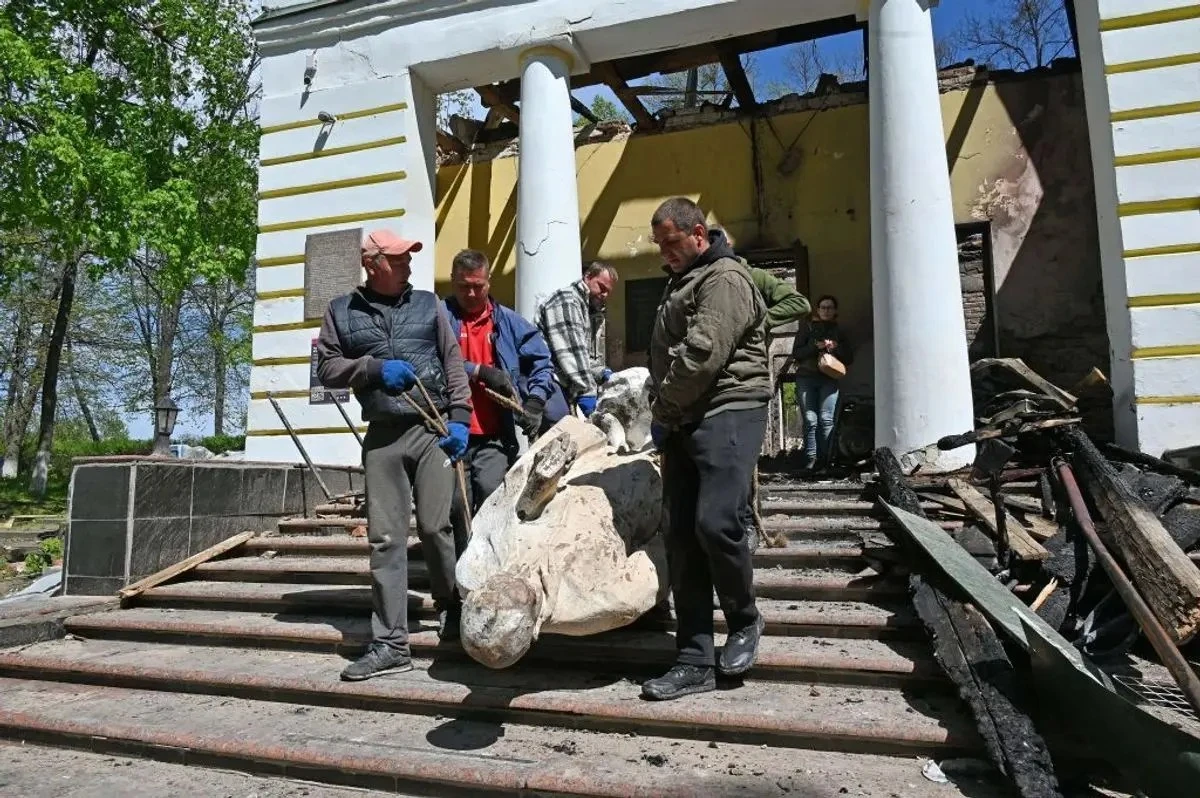
On the night of May 6 to May 7, 2022, the historical estate housing the Hryhoriy Skovoroda National Literary Memorial Museum was struck directly by a Russian missile. The impact triggered a massive fire that rapidly consumed the roof, interior woodwork, and invaluable archival materials housed within the historic walls. The blast left the central building largely hollowed out, though local first responders and museum staff managed to rescue a few select artifacts that had been preemptively hidden or were salvaged from the embers immediately following the strike.
The Investigation and the Identification of the Commander
In the months and years following the attack, Ukraine’s security services, alongside prosecutors and specialized war crimes units, painstakingly pieced together the chain of command responsible for the strike. Through intercepted communications, flight telemetry analysis, and military intelligence databases, investigators zeroed in on the specific aviation and air defense units operating in the sector.
The breakthrough in the case culminated in the recent decision by the Prosecutor General’s Office to formally charge the commander of Russia’s 6th Guards Air and Air Defense Forces Army. Investigators noted a grim irony in the suspect’s background: the lieutenant general is originally from the village of Chuhuiv, also located within the Kharkiv Oblast. Having grown up in the region, the commander was allegedly intimately familiar with the geographical and cultural significance of the landmarks he later targeted.
According to the filed charges, the general acted with premeditated intent. Prosecutors maintain that military reconnaissance reports presented to his command explicitly identified the Skovoroda estate as a civilian museum and a monument to Ukrainian philosophy and literature. By bypassing standard targeting protocols and ordering a precision strike on the location, the commander allegedly committed a grave breach of the Geneva Conventions and customary international humanitarian law regarding the protection of cultural property during wartime.
Supporting Context & Metrics
The Philosophical Legacy of Hryhoriy Skovoroda
To fully grasp the magnitude of the loss at Skovorodynivka, one must understand the profound cultural weight carried by Hryhoriy Skovoroda. Born in 1722, Skovoroda was a towering figure of the Ukrainian Enlightenment, a poet, composer of liturgical music, and a wandering philosopher often dubbed the "Ukrainian Socrates."
Skovoroda’s philosophy emphasized personal freedom, self-knowledge, spiritual independence, and an egalitarian rejection of worldly materialism and serfdom. He spent the final years of his life residing at the estate in Skovorodynivka, working, teaching, and writing some of his most influential philosophical dialogues. He passed away on the property in 1794, and his grave—marked simply with the famous epitaph “The world tried to catch me, but didn’t”—became a site of pilgrimage for intellectuals, writers, and citizens seeking to connect with the roots of Ukrainian independent thought.
When the museum was struck, the shockwaves reverberated across the global academic and cultural communities. The attack was widely interpreted not merely as an act of physical destruction, but as a symbolic assassination of Ukrainian philosophical heritage—an attempt to sever the living thread connecting modern Ukrainians to their historical forebears.
A Systematic Assault: Statistics on Damaged Cultural Heritage
The destruction of the Skovoroda Museum is far from an isolated incident. Rather, it forms a primary data point in a vast, documented matrix of cultural erasure executed by Russian forces across Ukraine.
Data compiled by the Ukrainian Ministry of Culture and Strategic Communications reveals a staggering toll on the nation’s historical and institutional landscape. As of September 2026, the ministry’s monitoring systems have verified that 2,161 cultural heritage sites and 2,665 cultural institutions have sustained varying degrees of damage or total destruction since February 24, 2022.
This devastating ledger encompasses:
- Libraries and Archives: Thousands of rare manuscripts, local history collections, and modern literary works burned or looted, particularly in occupied territories such as Mariupol, Kherson, and parts of the Donbas.
- Museums and Art Galleries: Historical artifacts, archaeological treasures, and fine art collections systematically targeted, bombed, or illicitly transferred across the border into the Russian Federation.
- Religious Architecture: Hundreds of centuries-old wooden churches, majestic cathedrals, mosques, and synagogues reduced to rubble by indiscriminate shelling and precision airstrikes alike.
- Monuments and Memorials: Statues, architectural ensembles, and public markers dedicated to prominent Ukrainian cultural and historical figures systematically defaced or demolished in occupied zones.
International bodies, including UNESCO, have repeatedly condemned these actions, noting that the intentional targeting of cultural property violates the 1954 Hague Convention for the Protection of Cultural Property in the Event of Armed Conflict, to which both Ukraine and the Russian Federation are state parties.
Official Statements
Presidential and Ministerial Condemnations
In the immediate aftermath of the May 2022 strike, Ukrainian leadership was swift to condemn the deliberate nature of the attack. President Volodymyr Zelensky addressed the nation and the international community with visible anguish, highlighting the absurdity and malice of targeting a philosopher’s memorial.
"Last night, the Russian army deployed one of its missiles to destroy the Hryhorii Skovoroda Museum in the Kharkiv Region," President Zelensky stated in a national address. "A missile—to destroy a museum. They didn’t even have any military logic; they targeted history itself."
Following the announcement of the formal indictment against the Russian lieutenant general, the Prosecutor General’s Office released a detailed statement outlining the legal basis for the charges. The statement emphasized the premeditated nature of the crime, cutting through any claims of battlefield error or technical malfunction.
"The general knew for certain that he was attacking not a military target, but a monument of Ukrainian culture," the prosecutor general wrote in the official indictment briefing. "Intelligence data, satellite imagery, and reconnaissance feeds confirmed the non-military status of the estate. Despite this, he gave the direct combat order to destroy it, fulfilling an overarching agenda of cultural devastation."
International Reactions and Legal Perspectives
Global legal experts and human rights organizations have praised the Ukrainian prosecutor’s office for pursuing accountability at the highest levels of the military hierarchy. While trying a high-ranking Russian officer in absentia presents obvious enforcement challenges—given that the accused remains within the borders of the Russian Federation and protected by state apparatus—legal scholars argue that such indictments serve crucial long-term functions.
First, they establish an immutable evidentiary record that can be utilized by international tribunals, such as the International Criminal Court (ICC), or specialized hybrid courts established to prosecute the crime of aggression and war crimes committed in Ukraine. Second, these warrants place travel restrictions on the accused officers, effectively trapping them within Russia or allied states willing to shield them, as Interpol red notices and bilateral arrest warrants render international travel an immediate liability.
Future Outlook
Prospects for Accountability and Restitution
As the war stretches into its fifth year, the landscape of international justice regarding cultural heritage destruction is undergoing a profound evolution. The case against the Russian lieutenant general for the bombing of the Hryhoriy Skovoroda National Literary Memorial Museum will likely serve as a foundational precedent for future prosecutions of military commanders who weaponize destruction against civilian heritage.
Legal analysts anticipate that Ukrainian prosecutors will continue to build similar dossiers against commanders across all branches of the Russian armed forces—navigating the complexities of command responsibility, superior orders, and intentional destruction of civilian objects. Furthermore, international coalitions are actively laying the groundwork for post-war reconstruction and reparations frameworks. Discussions are already underway regarding how frozen sovereign assets of the Russian Federation might be legally redirected to fund the literal rebuilding of damaged cultural institutions, including the Skovoroda estate.
The Rebirth of Skovorodynivka
Despite the devastation wrought in the spring of 2022, the spirit of Hryhoriy Skovoroda has proven remarkably resilient. Even as emergency services battled the flames, local caretakers, historians, and volunteers vowed that the museum would rise again.
Plans for the meticulous reconstruction of the estate have been drafted, relying on pre-war architectural blueprints, digital 3D scans of the interior, and surviving fragments of the original structure. While the physical rebuilding process will take years—and must contend with the ongoing security realities of the Kharkiv region—the institutional resolve remains unbreakable.
The ongoing legal battle to hold the responsible Russian commander accountable is inextricably linked to this physical restoration. Just as the prosecution seeks to penalize the perpetrators of cultural annihilation in a court of law, the reconstruction of Skovorodynivka stands as a defiant architectural testament to the endurance of Ukrainian culture. It signals to the world that no matter how many missiles are deployed to erase history, the foundational ideals of freedom, self-knowledge, and human dignity championed by Skovoroda—and embodied by modern Ukraine—cannot be bombed into oblivion.




Comments
Facebook App ID not configured. Please add it in the Customizer.