
Executive Overview
Satyajit Ray’s 1970 cinematic study of moral complacency and class privilege, Days and Nights in the Forest (Aranyer Din Ratri), has returned to the forefront of international film scholarship following a meticulous 4K digital restoration. Long restricted to damaged archival prints and substandard home-video transfers, the film’s newly restored master—available for streaming on the Criterion Channel ahead of a definitive physical release on September 29th—re-establishes Ray’s mid-career work as a high-water mark of modern Asian cinema.
Based on the 1968 autobiographical novel by Bengali author Sunil Gangopadhyay, Days and Nights in the Forest charts the rustic excursion of four young men from Kolkata who retreat to the rural district of Palamu for a holiday of uninhibited leisure. What begins as a jaunty escape from city life rapidly devolves into a sharp disquisition on privilege, systemic exploitation, and psychological exposure. Armed with wealth, education, and unearned entitlement, the quartet views the countryside as an open canvas for casual dissipation and local poverty as a resource for cheap labor. However, a sequence of romantic interactions and sharp social collisions dismantles their urban swagger, leaving them morally exposed and quietly humbled.
By blending the structural logic of classical melodrama with an analytical, almost anthropological detachment, Ray constructs a work of profound social critique. The restoration—spearheaded by international preservation bodies with support from contemporary filmmakers including Wes Anderson—allows audiences to reassess a film that sits at the precise intersection of cinematic modernism, post-colonial self-scrutiny, and timeless human observation.
Read Also
Detailed Chronology
[1968] Sunil Gangopadhyay publishes autobiographical novel 'Aranyer Din Ratri'
  │
[1970] Satyajit Ray releases film adaptation amid mid-career artistic expansion
  │
[1970s–2010s] Film enters canon; circulation limited by print degradation
  │
[2023–2024] 4K digital restoration completed with international preservation support
  │
[2024] Premiere on Criterion Channel; Blu-ray/DVD release set for Sept 29th
From Page to Screen: The Genesis (1968–1970)
In 1968, poet and novelist Sunil Gangopadhyay published Aranyer Din Ratri, a fictionalized recounting of personal travels through the forest regions of Bihar (now Jharkhand). Ray, who had spent the late 1950s and 1960s moving between sweeping realist epics (The Apu Trilogy), historical dramas (The Music Room), and contemporary urban studies (The Big City, The Hero), recognized the novel’s dramatic potential.
Released in 1970, the film adaptation marked a pivot toward an incisive examination of Kolkata’s educated middle class (bhadralok). Ray maintained the literary framework of the original text—underlining it early on when two characters reminisce about a literary journal they once edited—while subjecting the characters’ dialogue and impulsive behaviors to rigorous cinematic scrutiny.
The Narrative Arc: A Step-by-Step Breakdown
[Kolkata Departure] → [Arrival & Bribery at Palamu] → [Exploitation of Rural Labor]
                                                                │
[Return to City] ← [The Picnic Memory Game] ← [Interactions with Gentry]- The Drive into Palamu: The narrative opens in media res as four men drive away from Kolkata. Ashim (Soumitra Chatterjee), an arrogant executive who planned the trip, sits at the wheel. Beside him is Shekhar (Rabi Ghosh), an unemployed, hyperactive jester who hides his socio-economic insecurity behind cynicism. In the back seat sit Sanjoy (Subhendu Chatterjee), a soft-spoken literary aspirant, and Hari (Samit Bhanja), a hot-tempered athlete nursing a wounded ego. Sanjoy reads aloud from a guidebook that exoticizes the regional women of Palamu, instantly framing the group’s gaze as predatory and voyeuristic.
- The Violation of Local Norms: Upon arrival at a remote government rest house, the group discovers they lack the mandatory reservation. Rather than turning back, they use financial intimidation and emotional leverage on the low-income guesthouse watchman, effectively coercing him into breaking regulations for cash. Quipping in English, "Thank God for corruption," they set a pattern of transactional entitlement. They immediately press a local villager, Lakha, into domestic servitude.
- The Nightlife and Labor Dynamics: Eager to "go slumming," the quartet visits a country liquor shop, where they are surprised to find local tribal women drinking publicly. Duli (Simi Garewal), a bold local woman, approaches the men for money. The following day, the men hire several local women, including Duli, as day laborers to perform menial tasks. One woman is instructed to operate a hand-pulled ceiling fan (punkah wallah) while Duli sweeps the floors, under the watchful, predatory eye of Hari.
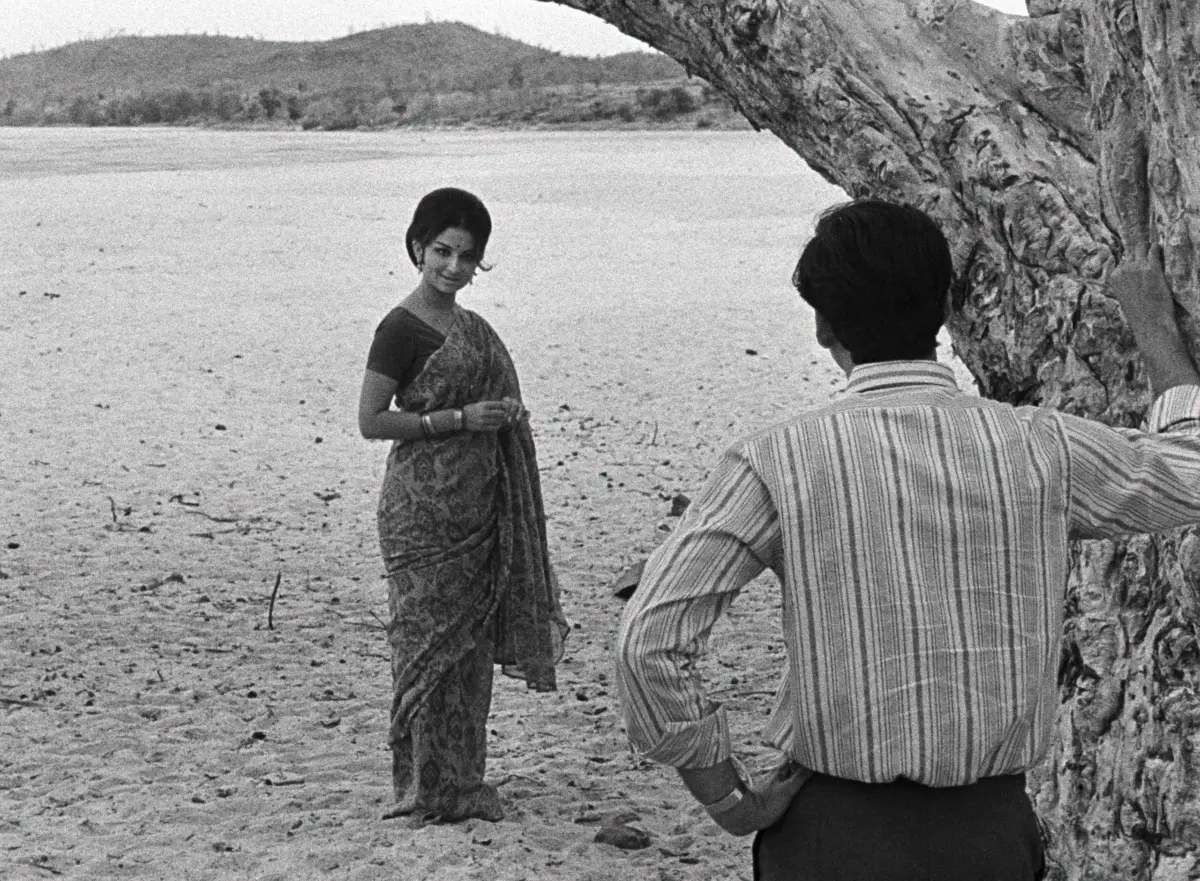
- Encounter with the Local Gentry: Seeking companionship beyond the local working class, the men wander onto a nearby estate and spot two women playing badminton: Rini (Sharmila Tagore), an elegant, well-read woman of deep intellectual composure, and her widowed sister-in-law, Jaya (Kaberi Bose), who cares for her young son while enduring profound social isolation. The women invite the city dwellers into their home, introducing them to Rini’s father, the landowner Sadashiv (Pahari Sanyal).
- The Climax at the Picnic: The narrative reaches its thematic peak during a woodland picnic, where the group plays a memory game. The structured game reveals the hidden tensions, intellectual disparities, and emotional vacuums within the group. Subsequent private encounters—Ashim’s verbal duel with Rini, Jaya’s unfulfilled attempt at physical intimacy with Sanjoy, and Hari’s aggressive, class-bound encounter with Duli in the forest—bring the holiday to an uncomfortable halt.
- The Silent Departure: Shaken by moral exposure and emotional defeat, the four men pack their bags and head back to Kolkata, carrying physical and psychological souvenirs of a trip that shattered their illusions of superiority.
Supporting Context & Metrics
The Sirkian Character Framework
To analyze the internal dynamics of the group, film scholars often turn to the melodrama theories of Hollywood director Douglas Sirk, who categorized characters as either "immovable" (monolithic identity, unyielding surface) or "split" (divided within themselves, tormented by hidden pasts). Ray structures his central quartet along a remarkably similar axis:
                          ┌─────────────────────────┐
                          │ Character Typology Matrix│
                          └────────────┬────────────┘
                                       │
            ┌──────────────────────────┴──────────────────────────┐
            ▼                                                     ▼
  [Immovable Characters]                                [Split Characters]
  • Ashim (Soumitra Chatterjee)                         • Sanjoy (Subhendu Chatterjee)
    - Unified identity, cool arrogance                    - Torn between duty and ambition
  • Shekhar (Rabi Ghosh)                                • Hari (Samit Bhanja)
- Unreflective jester, cynical surface - Suppressed shame, explosive violence- The Split Characters: Hari and Sanjoy represent internal division. Through brief, targeted flashback sequences, Ray shatters their posturing. Hari claims he dumped his city girlfriend out of pride, but the flashback reveals she rejected him. Sanjoy projects quiet intellectual dignity, yet his flashback exposes his deep-seated anxiety over his dependence on his employer’s family.
- The Immovable Characters: Ashim and Shekhar present unified facades. Ashim operates as the undisputed leader of the group, confident in his class privilege, while Shekhar functions as the comic relief who dismisses romantic involvement as "bourgeois" distraction. Yet, over the course of the film, both men’s unyielding identities are exposed as masks for insecurity.
Socio-Economic Asymmetry Metrics
Ray systematically maps out the socio-economic hierarchies present in late-1960s India, illustrating how class and geographic origin dictate social interactions:
| Social Stratum | Representative Characters | Primary Motivations | Cinematic Treatment |
|---|---|---|---|
| Urban Elite (Bhadralok) | Ashim, Sanjoy, Hari, Shekhar | Escape, self-indulgence, status validation | Framed through wide shots showing intrusion into spaces; analytical camera tracking. |
| Rural Landed Gentry | Sadashiv, Rini, Jaya | Cultural preservation, intellectual stimulation, coping with isolation | Framed in enclosed, cultured interiors with books and modern artifacts. |
| Rural Working Class / Indigenous | Duli, Lakha, Guesthouse Watchman | Economic survival, daily wage labor | Filmed with stark realism; camera captures their physical labor and vulnerability to exploitation. |
Official Statements and Theoretical Frameworks
Critical Appraisal of Ray’s Distance and Empathy
Ray’s directional technique in Days and Nights in the Forest has long been celebrated for its balance between detached observation and deep psychological intuition. Cinema scholars note that Ray refrains from heavy-handed moral judgment, choosing instead to let the characters’ actions expose their flaws.
"Ray’s critical distance from the characters is as crucial to the movie’s emotional power as is his wide-ranging empathy. The movie’s anecdotal aspect both abstracts and expands the drama, eliding straightforward plot mechanisms so that crisscrossing relationships form an intellectual map of underlying social forces."
— Film Studies Analysis, Criterion Restoration Retrospective
The Melodramatic Mechanics: Ray and the Western Canon
While Ray is frequently linked to Italian Neorealism due to his debut Pather Panchali (1955), Days and Nights in the Forest highlights his mastery of formal melodrama. By using intense close-ups set against expansive natural backdrops, Ray transforms intimate conversational dynamics into major ideological confrontations.
The film’s visual language relies heavily on framing techniques that underscore isolation:
- The Bar Tracking Shot: During the nocturnal drinking scene, Ray’s camera glides from character to character, lingering briefly on each face to emphasize psychological isolation within a crowded, chaotic room.
- Dual Close-ups Against the Sky: During the confrontation between Ashim and Rini, Ray uses low-angle close-ups framed against a stark sky, elevating a personal disagreement into a sculptural, high-stakes standoff.
Visual Composition Strategy:
[Low-Angle Sky Frame] ──> Emphasizes emotional distance & moral confrontation
[Bar Sequence Tracking] ──> Emphasizes individual isolation amidst group revelry
The Wes Anderson Connection and Preservation Efforts
The 4K restoration of Days and Nights in the Forest was championed by American director Wes Anderson, a longtime admirer of Ray’s body of work. Anderson’s visual style and thematic choices bear clear traces of Ray’s influence:
Ray's Influence on Wes Anderson's Oeuvre:
┌──────────────────────────────────────────┐    ┌──────────────────────────────────────────┐
│ Days and Nights in the Forest (1970)    │    │ Wes Anderson Adaptations                 │
├──────────────────────────────────────────┤    ├──────────────────────────────────────────┤
│ • Memory game scene at the picnic        │ ──>│ • Scientific memory game in Asteroid City│
│ • Urban elite traveling rural landscape  │ ──>│ • India-bound train journey in Darjeeling│
└──────────────────────────────────────────┘    └──────────────────────────────────────────┘
The memory game sequence in Days and Nights in the Forest—where participants sit in a circle, sequentially reciting famous names—serves as a direct blueprint for a similar memory game played by teenagers in Anderson’s Asteroid City (2023). In both films, the formal parameters of a simple parlor game build underlying emotional tension, turning a playful pastime into a moment of self-revelation.
Future Outlook and Legacy
The release of the 4K restoration marks a turning point in the accessibility of Satyajit Ray’s middle-period work. For decades, global film study centered primarily on his early output—notably The Apu Trilogy (1955–1959) and Charulata (1964). The restoration of Days and Nights in the Forest encourages a broader evaluation of Ray’s evolving aesthetic during the political and social unrest of the late 1960s and 1970s.
Key Milestones for the Restored Feature:
- Streaming Premiere: Currently available on the Criterion Channel, offering global high-definition access.
- Physical Media Release: Scheduled for September 29th on Blu-ray and DVD via The Criterion Collection, complete with archival interviews, scholarly commentaries, and documentary features on the restoration process.
- Archival Impact: Ensures long-term digital preservation of Ray’s original 35mm camera negative, safeguarding the film against permanent chemical degradation.
As contemporary film studies increasingly grapple with themes of post-colonial identity, class disparity, and environmental exploitation, Days and Nights in the Forest remains strikingly modern. Ray’s non-judgmental yet unflinching portrait of four young men returning home—shaken by their experiences yet uncertain if they have gained real wisdom—continues to challenge audiences, serving as a timeless warning against the perils of unexamined privilege.





Comments
Facebook App ID not configured. Please add it in the Customizer.