
Executive Overview
Paris, France — In an incident that blends the absurd with a serious breach of institutional protocols, two visitors to the Musée du Louvre were taken into custody on Saturday after successfully hanging unauthorized artworks inside the illustrious Salle des États. The gallery, renowned globally as the permanent home of Leonardo da Vinci’s Mona Lisa, serves as one of the most heavily trafficked and scrutinized cultural chambers on Earth.
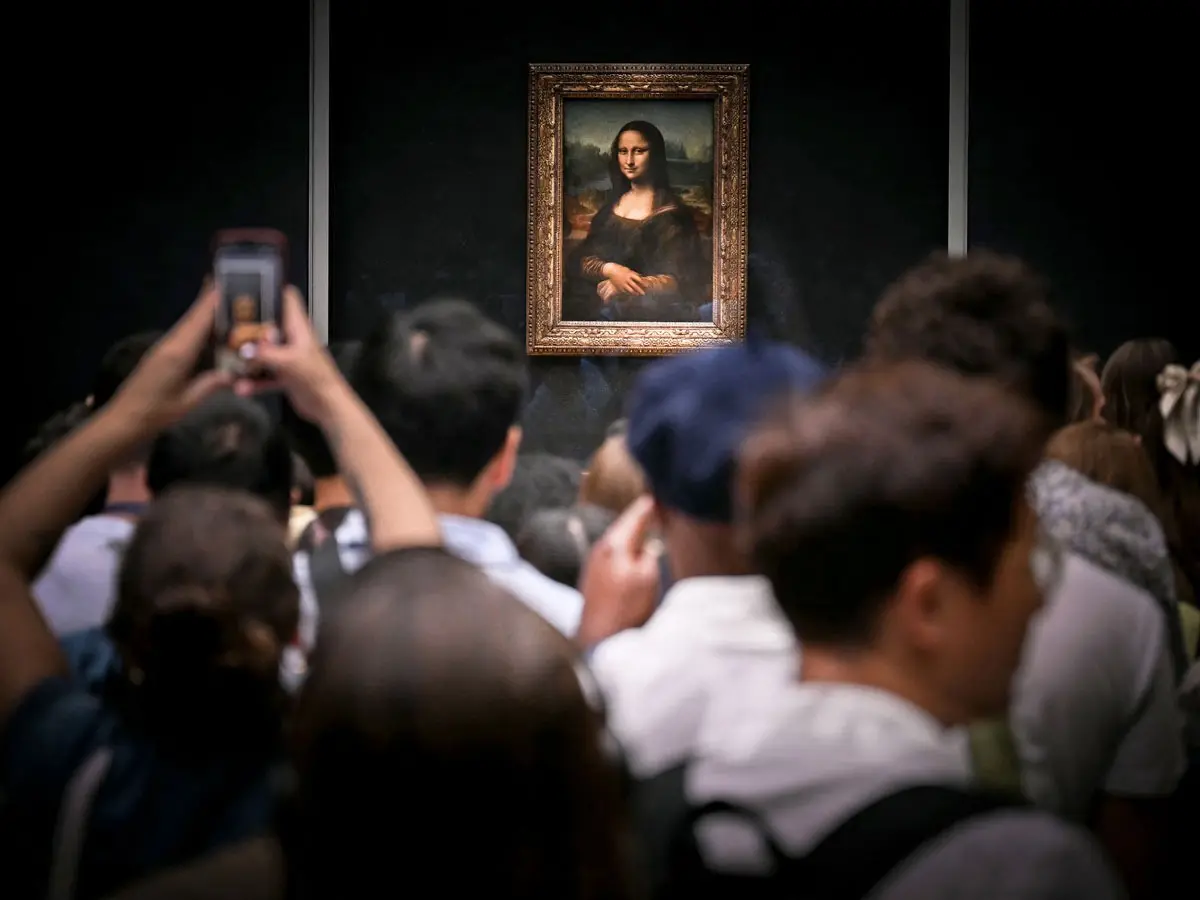
According to Agence France-Presse (AFP), citing authoritative police sources, the two German nationals utilized standard adhesive tape to mount two small canvases—each measuring approximately 11.8 by 15.7 inches—directly onto the historic walls of the room. One of the guerrilla-style installations depicted an individual in a full suit of armor, while the companion piece featured the two suspects alongside an unidentified woman. Fortunately, the Mona Lisa itself, which commands perpetual throngs of tourists from the moment the museum opens until it closes its doors, sustained no damage during the stunt.
While the unauthorized exhibition was swiftly halted by the Louvre’s internal security teams before local law enforcement formally arrested the perpetrators for criminal damage to public property, the bizarre stunt has triggered global headlines. Far from being viewed as a harmless prank—an excuse the suspects reportedly gave to police investigators, claiming they did it simply "for fun"—the episode has struck a raw nerve within the upper echelons of European cultural administration.
Read Also
The security breach arrives at a precarious psychological and operational juncture for the Louvre. Over the past year, European museums have found themselves on acute, continuous high alert. However, institutional anxieties have historically stemmed from the threat of professional thieves orchestrating brazen multi-million-dollar thefts rather than casual visitors attempting unauthorized performance art or impromptu gallery takeovers.
This latest security lapse lands in the immediate shadow of a catastrophic $102 million crown jewel heist from the nearby Galerie d’Apollon, a scandal that exposed deep-seated vulnerabilities within the institution, forced the resignation of its former leadership, and plunged the world’s most-visited museum into a protracted identity and structural crisis. As the Louvre prepares to embark on a staggering €1 billion ($1.2 billion) modernization project—including a dedicated subterranean entrance and viewing hall for the Mona Lisa—the weekend’s events serve as a stark, embarrassing reminder that before the museum can reinvent its future, it must urgently secure its present.
Detailed Chronology of the Salle des États Incident
The events of Saturday afternoon unfolded in a space that is arguably the most intensely monitored interior in the international art world. The Salle des États, located within the Denon Wing of the Louvre, welcomes tens of thousands of visitors daily. Security in the chamber is typically multi-layered, consisting of uniformed guards, plainclothes personnel, a dense network of closed-circuit television (CCTV) cameras, and protective laminated bulletproof glass encasing the Renaissance masterpiece.
According to preliminary reports from law enforcement and museum officials, the two German nationals—whose identities have been withheld in accordance with French privacy laws, which typically restrict full name disclosure to initials—managed to bypass the dense crowds and heightened vigilance of the gallery guards. Carrying the two small, modestly framed canvases concealed within personal bags or clothing, the pair identified a vulnerable section of wall space away from the immediate line of sight of stationary guards.
Utilizing ordinary adhesive tape, the visitors affixed the two 11.8-by-15.7-inch works directly to the museum’s historic wall surface. The thematic content of the guerrilla installation appeared to be a satirical or personal homage: one painting showcased a solitary suspect clad in a traditional suit of armor, while the second depicted the two suspects posing alongside a woman.
The installation remained on the wall long enough for fellow tourists to notice, capture photographs, and alert floor staff. Within minutes, the Louvre’s internal security team intervened, detaining the two individuals on-site without physical resistance. The unauthorized canvases were promptly stripped from the walls, and the suspects were transferred to the custody of the Paris police department.
During subsequent interrogations, the suspects offered a nonchalant explanation for their actions, telling investigators that the stunt was executed purely "for fun." Despite the casual motive, French prosecutors are treating the breach with severe institutional seriousness. The suspects face formal charges of intentional damage to cultural heritage and public property.
When contacted by ARTnews and international syndicates for comment regarding the precise timeline of the detection, the efficacy of the guards on duty, and potential protocol reviews, representatives for the Louvre declined to issue an immediate response, reflecting the museum’s current posture of tight-lipped crisis management.
Supporting Context & Metrics: A Museum Under Siege
To understand why the impromptu hanging of two small canvases by foreign tourists has triggered such a fierce institutional reaction in Paris, one must examine the traumatic sequence of security failures and financial strains that have plagued the Louvre over the preceding twelve months.
For the better part of a year, museums across France and the broader European Union have operated under an elevated threat matrix. While geopolitical tensions and activist disruptions—such as soup-throwing and glue-based protests targeting climate change—have dominated headlines regarding gallery security, the Louvre’s primary nightmares have materialized from classic, high-stakes criminality.
Nearly a year ago, the Louvre suffered an architectural and reputational catastrophe: a meticulously planned daylight heist in which roughly $102 million worth of historic French crown jewels were looted from the Galerie d’Apollon. The gallery, situated a short walk from the Salle des États, was breached during operating hours, stunning cultural historians and laying bare the reality that the museum’s vast physical footprint presents monumental security vulnerabilities. The stolen regalia, deeply tied to the nation’s imperial history, has yet to be fully recovered, casting a permanent shadow over the museum’s curatorial legacy.
The fallout from the Galerie d’Apollon robbery was swift and comprehensive. Shortly after the heist, a confidential government audit was leaked to the press, delivering a scathing indictment of the Louvre’s protective infrastructure. The audit characterized the museum’s overarching security apparatus as "outdated and inadequate," highlighting systemic administrative paralysis marked by "repeated postponements of the scheduled modernization of security systems."
The political pressure proved insurmountable for the museum’s administration. In February, Laurence des Cars—who had made history as the first woman to serve as the president-director of the Louvre—tenders her resignation amid mounting scrutiny over the institution’s structural decay. Her departure signaled an administration in freefall, and she was replaced the very next day by Christophe Leribault, who inherited a museum grappling simultaneously with public skepticism, infrastructural decay, and surging post-pandemic tourism volumes.
The operational reality facing Leribault was laid bare during the summer months when the newly appointed president-director delivered a sobering testimony before the French Senate. Leribault bluntly warned lawmakers that the Louvre was operating "at the end of its ropes," cautioning that "urgent building issues are piling up, and we are facing a massive investment challenge."
While Leribault assured the Senate that his administration was addressing "the necessary emergencies head-on"—specifically highlighting plans to overhaul perimeter video surveillance by January—the weekend’s tape-and-canvas stunt demonstrates that internal human surveillance and physical access controls remain remarkably porous, even within the museum’s most prized galleries.
Official Statements and Institutional Accountability
The juxtaposition of a multi-million-dollar crown jewel heist with a couple of tourists sticking amateur paintings to a wall with adhesive tape highlights a profound crisis of institutional authority at the Louvre.
Following the leak of the government audit and the subsequent resignation of Laurence des Cars, the French Ministry of Culture has faced intense questioning from parliamentarians regarding the stewardship of national treasures. The pivot in leadership, moving from des Cars to Christophe Leribault, was designed to signal a clean break with bureaucratic inertia and a renewed commitment to institutional modernization.
However, Leribault’s early tenure has been characterized by crisis management rather than artistic celebration. His testimony to the French Senate in July was notable for its unvarnished candor, marking a rare public admission by a major national museum director that state funding and infrastructure are failing to keep pace with the demands of modern mass tourism.
"We are at the end of our ropes," Leribault told the Senate committee, pointing to an accumulation of deferred maintenance, aging climate-control systems, and antiquated security grids that leave vast galleries vulnerable to both sophisticated criminal syndicates and opportunistic pranksters.
The Ministry of Culture has yet to issue a formal statement specifically addressing Saturday’s incident in the Salle des États, likely waiting for the completion of the police investigation involving the two German nationals. Nevertheless, internal sources suggest that the breach has triggered an emergency review of floor-level security protocols. Specifically, museum administrators are examining how visitors were able to introduce unauthorized hardware—even simple adhesive tape and frames—into a room where bag checks and ticket validation are theoretically rigorous.
Art security experts have been quick to weigh in on the implications of the event. While acknowledging that the Mona Lisa was never in physical danger, analysts note that the psychological impact of the breach is severe. In an era where cultural institutions rely heavily on public trust and the perception of impenetrable security, the ability of two casual visitors to alter a gallery wall unchecked—even for a matter of minutes—undermines the authoritative aura that museums strive to project.
Future Outlook: The "New Louvre Renaissance" and Structural Overhaul
Even as the Louvre grapples with immediate security lapses and public relations fallout, the institution’s long-term survival hinges on a massive, highly anticipated infrastructural transformation known as the "New Louvre Renaissance."
For years, critics and curators have pointed out that the current architectural configuration of the Louvre is fundamentally unsuited to the sheer volume of visitors it attracts. The concentration of millions of annual tourists rushing toward a single destination—Leonardo da Vinci’s Mona Lisa in the Salle des États—creates chronic bottlenecks, degrades the visitor experience, and strains security and crowd-control personnel to their absolute limits.
To permanently address these systemic pressures, the French government and museum leadership greenlit a comprehensive modernization and expansion initiative projected to exceed €1 billion ($1.2 billion). The cornerstone of this master plan is the creation of a dedicated, subterranean exhibition space exclusively for the Mona Lisa. The proposed 33,000-square-foot expansion will feature its own independent entrance, completely decoupled from the historic pathways of the main palace, thereby diffusing crowd congestion and allowing for state-of-the-art environmental and security controls.
The path to realizing this ambitious vision has not been without friction. Earlier this year, the renovation plans were temporarily put on pause amid budgetary reviews and bureaucratic debates. However, momentum resumed in May when the Louvre officially selected the architecture and design team tasked with bringing the "New Louvre Renaissance" to life. The chosen studios are now tasked with drafting blueprints that harmonize cutting-edge 21st-century security architecture with the delicate historic fabric of the former royal palace.
In the interim, museum leadership is forced to manage a precarious transition period. With perimeter video surveillance upgrades slated for completion in January and broader structural renovations scheduled to roll out over the coming years, the Louvre remains a giant caught between two eras: burdened by an aging, 20th-century security infrastructure and striving to meet the hyper-connected, high-risk demands of the 21st century.
Saturday’s bizarre incident in the Salle des États, while ultimately harmless in its physical outcome, functions as an invaluable diagnostic tool. It underscores the reality that upgrading high-tech perimeter cameras and building multi-million-dollar subterranean wings will mean little if the everyday, boots-on-the-ground vigilance of gallery supervision remains compromised. As Christophe Leribault and his administration steer the museum toward its billion-euro future, the message from the gallery floor is unmistakable: the Louvre must secure its present before it can successfully build its renaissance.





Comments
Facebook App ID not configured. Please add it in the Customizer.