
Executive Overview
The peer review system—the foundational bedrock of academic validation and scholarly trust—is confronting an unprecedented existential threat. As generative artificial intelligence (GenAI) technologies rapidly evolve, permeating nearly every sector of professional life, academic publishers find themselves deeply divided over how to govern the use of AI tools by manuscript referees.
A stark philosophical and operational chasm has opened across the landscape of scholarly publishing. On one side, massive commercial publishing houses like Springer Nature and Wiley are adopting pragmatic, regulated frameworks that permit peer reviewers to leverage artificial intelligence, provided they adhere to transparency mandates and risk-assessment guidelines. On the other side, university presses and specialized academic journals are drawing hard boundaries. Institutions such as Oxford University Press, the University of Chicago Press, and select independent journals like Ergo enforce strict, zero-tolerance prohibitions, barring the upload of confidential manuscripts or the generation of AI-assisted reader reports.
Beneath these fractured guidelines lies a sprawling grey area: a vast multitude of prestigious scholarly journals—particularly within the humanities and philosophy—that maintain complete radio silence on the matter, offering no explicit policies whatsoever. This regulatory vacuum exposes profound vulnerabilities. It threatens authorial confidentiality, undermines intellectual property rights, and invites a future where scholars can no longer be certain whether their decades of rigorous research are being evaluated by seasoned human peers or synthesized by algorithms.
Read Also
As the academic community races toward a reality where machine-generated text is virtually indistinguishable from human writing, the questions multiply. How can publishers enforce restrictive policies in an era of ubiquitous AI? What recourse remains for authors who suspect their work has been summarily dismissed by a chatbot? And can the traditional institution of peer review survive the integration of artificial intelligence without losing its soul?
Detailed Chronology and the Evolving Policy Landscape
The integration of artificial intelligence into academic publishing did not happen overnight. For years, publishers grappled primarily with the ethical implications of authors utilizing large language models to draft or polish manuscripts. However, as generative tools became more sophisticated, attention inevitably shifted to the other side of the scholarly equation: the peer reviewers. These overextended academics, often volunteering their time amidst heavy teaching and research loads, began turning to AI tools to summarize texts, check citations, and draft evaluation reports.
Responding to this grassroots shift, major publishers began formalizing their stances, creating a fragmented regulatory map:
- The Early Adopters of Regulation (2023–2024): Recognizing that outright bans would likely be ignored or driven underground, major commercial entities began crafting frameworks for safe AI integration. Springer Nature emerged early with a philosophy centered on the premise that "the key question is not whether AI is used, but how it is used." This led to the development of structured risk-assessment models for reviewers.
- The Wiley Pivot: Wiley similarly chose a path of regulated disclosure, instructing referees to "Use AI responsibly: Apply best practices and properly disclose AI use in manuscripts and peer review." However, recognizing the inherent dangers of data leakage, Wiley coupled this with traditional confidentiality warnings, even as it began researching secure, proprietary technologies to bridge the gap between AI utility and data security.
- The Traditionalist Backlash (2024–2026): As commercial publishers opened the door to AI, university presses and independent journals moved swiftly to slam it shut. Oxford University Press (OUP) established firm rules emphasizing that reviewers are selected strictly for their human expertise and independent judgment, making the uploading of any portion of a project proposal or manuscript to a GenAI tool a direct violation of policy.
- The Strict Prohibitionists: The University of Chicago Press adopted an even more uncompromising stance. Their guidelines explicitly mandate unassisted evaluations, banning AI not just for writing reports, but prohibiting the input of data into any external tool—even those boasting zero-retention privacy guarantees—out of profound respect for authorial intellectual property.
- The Independent Resistance: Specialized publications have gone even further. Ergo, a prominent open-access philosophy journal, explicitly forbids referees from using AI in any capacity, warning reviewers not to enter text into AI systems even for auxiliary tasks like checking text or utilizing writing-assistance filters.
Supporting Context & Metrics: The Philosophy Gap and Enforcement Dilemmas
While high-profile publishers and select journals have scrambled to publish comprehensive guidelines, an alarming proportion of the academic ecosystem remains entirely unequipped. A significant number of top-tier journals—particularly in the humanities, literary studies, and theoretical philosophy—operate without a single written word regarding AI use in their referee guidelines.
Authors submitting to these prestigious outlets are operating in the dark. They are expected to trust that the anonymous peers evaluating their life’s work are human scholars engaging in deep, empathetic intellectual discourse, yet the journals offer no policy guarantees to back up that expectation.
This policy vacuum creates severe operational and ethical challenges:
1. The Enforcement Crisis
Even where strict rules exist, enforcement is a monumental hurdle. Journal editors are typically underfunded, overworked academics managing vast portfolios of submissions. They lack forensic tools robust enough to consistently differentiate between a sophisticated, human-edited reviewer report and a well-prompted large language model output. Without reliable detection mechanisms, anti-AI policies risk becoming toothless paper tigers, routinely skirted by overwhelmed reviewers looking to cut corners.
2. The Finality of Editorial Decisions
Compounding the enforcement issue is the traditional appeals structure of academic publishing. Many prestigious journals maintain strict finality clauses regarding editorial decisions. For instance, the renowned philosophy journal Mind states unequivocally in its general instructions: "The decision of the Editors on the acceptability of any manuscript is final. The Editors will not enter into correspondence with authors on any submission that is not accepted for publication."
This creates an alarming Kafkaesque scenario. If an author receives a formulaic, logically flawed referee report that bears all the hallmarks of generative AI, and the handling editor subsequently rejects the paper based on that report, the author has virtually no formal recourse. Are reasonably suspicious authors simply out of luck? And more importantly, should they be?
Official Statements and Industry Frameworks
A closer examination of the policies implemented by major publishing houses reveals contrasting institutional philosophies regarding trust, risk, and technological adoption.

Springer Nature: The Risk-Assessment Approach
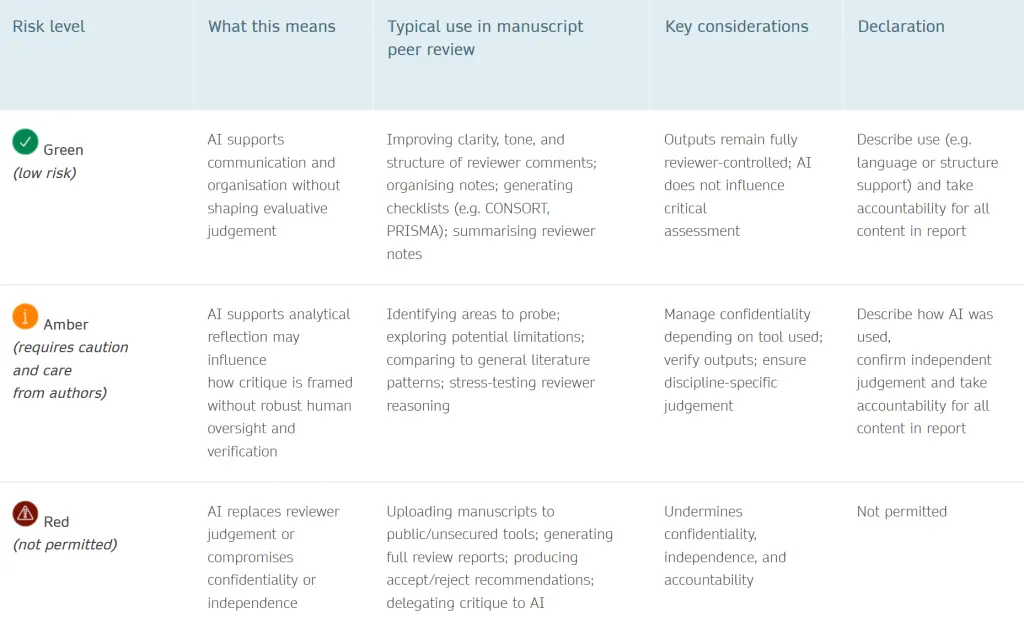
Springer Nature has attempted to bring systematic methodology to the chaos through its proprietary "AI Risk Assessment Framework for AI Use in Peer Review." Rather than treating AI as an absolute evil or an unmitigated good, Springer categorizes tasks based on potential harm. Under this model, tasks involving data privacy breaches or critical intellectual evaluation fall into high-risk zones where AI is strictly forbidden, while minor grammatical assistance or structural summarization of non-confidential elements may be approached with caution and disclosure. The publisher summarizes its core ethos succinctly:
"The key question is not whether AI is used, but how it is used."
Wiley: Balancing Caution with Innovation
Wiley’s guidelines reflect a transitional state in publishing technology. The publisher explicitly informs its referees:
"Use AI responsibly: Apply best practices and properly disclose AI use in manuscripts and peer review."
Simultaneously, Wiley maintains a rigid stance on confidentiality, warning that manuscripts under review are strictly proprietary and must not be uploaded to external AI technologies, in full or in part. However, recognizing the friction this creates for tech-forward reviewers, Wiley has signaled that it is actively developing proprietary, secure technological approaches that will expand AI capabilities for reviewers while maintaining absolute confidentiality behind closed corporate firewalls.
Oxford University Press: The Human Expertise Standard
Taking a more conservative line, OUP relies heavily on the irreplaceable nature of human cognition. Their policy explicitly notes:
"OUP selects peer reviewers for their expertise in the field and requires them to evaluate content based on their expert judgement alone. It is prohibited to upload project proposals and manuscripts, in part or in whole, into a GenAI tool for any purpose."
University of Chicago Press: The Absolute IP Defense
The University of Chicago Press frames its policy around the sacred trust between author and publisher, protecting intellectual property from the moment of submission:
In peer review, we require unassisted evaluations and expressly prohibit the use of AI tools in writing readers’ reports. Out of respect for the author’s intellectual property, peer reviewers should not copy any portion of a manuscript or a proposal, nor the reader’s report itself, into an AI tool, even one that promises not to retain data.
Future Outlook: Preparing for an Indiscernible Tomorrow
The current fractured state of academic publishing is unsustainable. As generative artificial intelligence models grow exponentially more capable, the linguistic and analytical markers that currently allow sharp-eyed editors to occasionally spot machine-generated text will vanish entirely. We are rapidly hurtling toward a future where writing produced by artificial intelligence will be fundamentally indiscernible from the finest human scholarship.
To navigate this precipice without collapsing the fragile ecosystem of peer review, the academic community must take decisive, systemic action:
- Universal Standardization: The fragmented patchwork of publishing guidelines must give way to standardized, industry-wide norms. Authors deserve transparency, regardless of whether they submit to an open-access mega-journal or a niche humanities quarterly.
- Redefining Recourse: Publishers must re-evaluate rigid "final decision" clauses in light of technological disruption. If an author provides credible, substantive evidence that a peer review report was synthetically generated in violation of stated policy, journals must establish an appeal mechanism to re-adjudicate the submission.
- Investment in Proprietary Infrastructure: Rather than banning tools that overworked academics will inevitably attempt to use covertly, publishers should follow Wiley’s lead in developing secure, internal, zero-retention AI environments designed specifically to assist reviewers safely without leaking proprietary research into public training models.
- Cultural Realignment: The crisis of AI in peer review is ultimately a symptom of a deeper systemic pressure: the relentless demand for academic output. Reviewers are overburdened, under-compensated, and rushed. True reform cannot rely on policy prohibitions alone; it requires addressing the root causes of academic burnout that drive scholars to seek algorithmic shortcuts in the first place.
The stakes could not be higher. If peer review degenerates into a hollow, automated exchange where machines critique machines, the fundamental currency of scientific and humanistic truth—human trust—will be permanently devalued. The time for hand-wringing has passed; academia must proactively design the guardrails for its own digital future before that future dictates terms to it.




Comments
Facebook App ID not configured. Please add it in the Customizer.