
Executive Overview
In the upper echelons of contemporary visual art, where minimalism and digital ephemera have long vied for dominance, the victory of a maximalist abstractionist serves as a resounding testament to the enduring power of material craftsmanship. Kerstin Brätsch, the celebrated German-born painter renowned for her kaleidoscopic color palettes, immersive environments, and fearless interrogation of traditional mediums, has been officially named the winner of the 2027 Zurich Art Prize.
Co-sponsored by the esteemed Museum Haus Konstruktiv in Zurich and the global financial powerhouse Zurich Insurance Company Ltd., this annual accolade stands as one of the most generous and career-defining honors in the European contemporary art landscape. Brätsch’s victory brings with it a substantial financial package totaling roughly $160,000. This includes an unrestricted cash prize of approximately $37,000 and a production budget of roughly $123,000 dedicated entirely to the realization of a major, highly anticipated solo exhibition at the Museum Haus Konstruktiv, scheduled to open its doors to the public in June 2027.
For Brätsch, whose career spans nearly two decades of rigorous international exhibition, the award highlights her distinct ability to bridge the gap between historical craft and contemporary conceptual installation. Known equally for her vibrant, fluid oil paintings on translucent panels and her large-scale, site-specific interventions, Brätsch challenges the boundaries of how art is made, experienced, and inhabited. Her practice actively subverts the solitary myth of the artist in the studio, relying instead on deep, collaborative dialogues with master artisans—ranging from glassblowers to traditional stucco marmo practitioners.
Read Also
As the contemporary art world shifts its gaze toward Zurich in anticipation of her 2027 exhibition, this win marks a pivotal chapter in Brätsch’s storied trajectory. It validates her decades-long commitment to revitalizing old-world techniques through a hyper-modern, speculative lens, cementing her status as one of the most influential painters and installation artists of her generation.
Detailed Chronology: The Evolution of a Visionary Practice
Formative Years and Academic Foundations
Born in Hamburg, Germany, Kerstin Brätsch’s artistic education spanned two major cultural capitals: New York City and Berlin. Immersed in these vibrant, contrasting urban environments during the late 1990s and early 2000s, Brätsch developed an aesthetic sensibility that synthesiszed the gritty spontaneity of street culture with the intellectual rigor of institutional critique.
Her academic training laid the groundwork for a deeply experimental approach to painting. Rather than treating the canvas as a flat, inert surface to be inscribed with pigment, Brätsch began to view painting as a dynamic, environmental medium capable of spilling out into architectural space. Today, she passes on this radical philosophy to the next generation of creators as a professor of painting at the University of Fine Arts in Hamburg, cultivating a pedagogical environment that encourages material experimentation and cross-disciplinary collaboration.
Two Decades of Global Exhibition
Over the past twenty years, Brätsch’s work has traversed the globe, appearing in prestigious institutional spaces across Europe and North America. Her recent institutional footprint includes sweeping solo and group presentations in cultural hubs such as Porto, Bonn, Oslo, Rome, and Munich.
A defining moment in her career arrived with her inclusion in the 59th Venice Biennale in 2022, curated by Cecilia Alemani. Within the international exhibition, Brätsch’s contributions stood out for their luminous intensity and structural complexity. It was around this period that her collaborative ethos gained widespread critical acclaim. Discussing her reliance on historical fabrication methods—such as stucco marmo (a traditional technique for imitating marble using pigmented plaster, glue, and soap), stained glass, and complex marbling—Brätsch offered a succinct manifesto for her collaborative methodology in an interview with ARTnews:
"Sometimes, to build an image, you need four hands, two belonging to an artisan and two to the artist."
This philosophy directly challenges the romanticized notion of artistic autonomy. By enlisting the specialized skills of generational craftsmen, Brätsch infuses contemporary abstract art with a lineage of deep material history, creating surfaces that feel both ancient and radically futuristic.
Current Interventions and Public Installations
Brätsch’s artistic output extends far beyond the traditional gallery wall, manifesting as immersive, site-specific installations that radically alter public and institutional spaces. Three major projects currently anchor her international presence:
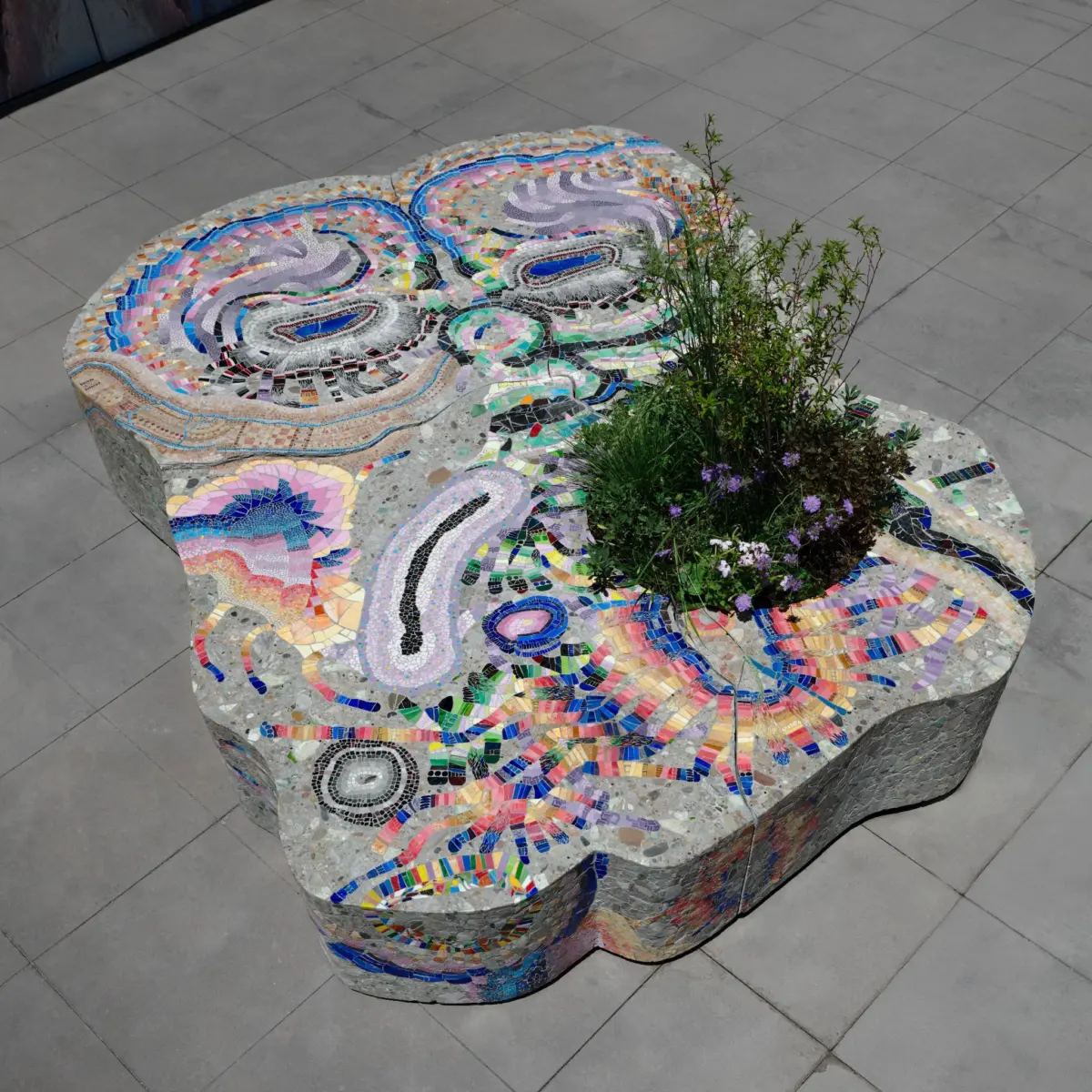
- Fossil Psychic Stone Mimicry (Aspen Art Museum, through March 2027): Perched on the roof of the Aspen Art Museum, this site-specific installation comprises a series of four mosaic benches integrated directly with living alpine flora. The work creates a poetic dialogue between hard, industrial mosaic surfaces and organic, living ecosystems, inviting museum-goers to pause and reflect on the intersection of nature and human artifice.
- MIMIKRY (Fridericianum, Kassel, through early 2027): Transforming the rotunda and café area of one of Germany’s most historic contemporary art institutions, MIMIKRY envelops visitors in a total work of art (Gesamtkunstwerk). Featuring vibrant marbled wallpaper, custom-designed window curtains, translucent room dividers, and sculptural tables, the installation turns a functional public space into a psychological and aesthetic labyrinth.
- BAUBAU (Gropius Bau, Berlin): Demonstrating her commitment to inclusive, multi-generational audience engagement, BAUBAU is an immersive children’s play space at Berlin’s renowned Gropius Bau. Chock-full of Brätsch-designed wall coverings, raw building materials, bespoke crafts, and wearable costumes, the space encourages children to physically interact with and inhabit her maximalist design language.
Supporting Context & Metrics: The Zurich Art Prize Landscape
To fully understand the significance of Brätsch’s win, one must examine the pedigree and economic scale of the Zurich Art Prize itself. Established in 2007 by the Museum Haus Konstruktiv and Zurich Insurance Company Ltd., the prize was designed to honor international contemporary artists who make a critical, groundbreaking contribution to the discourse surrounding constructivist, concrete, and conceptual art.
Prize Breakdown and Institutional Support
- Total Financial Commitment: ~$160,000 USD
- Direct Unrestricted Cash Award: ~$37,000 USD
- Exhibition Production Budget: ~$123,000 USD
- Exhibition Venue: Museum Haus Konstruktiv, Zurich, Switzerland
- Exhibition Launch Date: June 2027
This robust funding model is precisely what makes the Zurich Art Prize one of the most coveted institutional honors globally. While many prizes offer prestige without adequate financial backing, leaving artists to scramble for production funds, the Zurich Art Prize provides a guaranteed, fully financed institutional platform. The $123,000 production grant allows artists like Brätsch to realize ambitious, large-scale, and technically demanding projects that might otherwise be financially prohibitive.
A Storied Legacy of Winners
Brätsch joins a formidable roster of contemporary visionaries who have shaped the trajectory of modern art over the past two decades. The inaugural prize was awarded to sound and visual artist Carsten Nicolai in 2007. In the years since, the award has recognized some of the most innovative minds working at the intersection of architecture, sculpture, and conceptual abstraction.
Recent laureates include:
- Rosa Barba (2026): Celebrated for her cinematic installations and structural film interventions.
- Kapwani Kiwanga (2022): Known for her socially engaged, material-driven installations exploring power, history, and architecture.
- Robin Rhode (2018): Renowned for his street art, photography, and multidisciplinary performance narratives.
By entering this lineage, Brätsch secures her place not only as a master painter, but as a pivotal figure in the ongoing evolution of constructivist and spatial art.
Official Statements and Critical Reception
The announcement of Brätsch as the 2027 laureate has triggered an outpouring of critical acclaim from arts administrators, curators, and cultural critics across Europe. The selection committee, comprising international curators and representatives from both the Museum Haus Konstruktiv and Zurich Insurance Company Ltd., praised Brätsch for her fearless approach to color, scale, and collaboration.
In an official statement released by the museum, a spokesperson for the selection jury noted:
"Kerstin Brätsch pushes the boundaries of what abstract painting can achieve in the twenty-first century. Her ability to translate the fluid, psychological states of human emotion into monumental architectural installations—while simultaneously honoring the deep traditions of European craftsmanship—makes her an exemplary recipient of the Zurich Art Prize. We eagerly anticipate the transformative vision she will bring to the Museum Haus Konstruktiv in 2027."
Art critics have long championed Brätsch’s refusal to conform to prevailing trends of austere minimalism. Writing in art journals and exhibition catalogues, critics have frequently highlighted how her works function as psychological thresholds. Her use of translucent glass panels, for instance, allows natural light to activate the painted surfaces, transforming static galleries into shifting environments of color and shadow.
Furthermore, her collaborative methodologies have been lauded as a necessary corrective to the cult of the individual genius. By crediting and working alongside master artisans, Brätsch re-establishes artmaking as a communal, social act—a theme that resonates deeply with the core tenets of constructivism championed by the Museum Haus Konstruktiv.
Future Outlook: What to Expect in June 2027
As the art world looks ahead to the summer of 2027, anticipation is already reaching a fever pitch for Brätsch’s upcoming solo exhibition at the Museum Haus Konstruktiv. While specific details of the exhibition remain under wraps as the artist begins her residency and production phase, curators hint that the project will synthesize the various threads of her career thus far.
Visitors can expect a multi-sensory environment that merges monumental abstract painting with site-specific architectural interventions. Given her recent successes with MIMIKRY in Kassel and Fossil Psychic Stone Mimicry in Aspen, the Zurich exhibition is expected to challenge traditional modes of viewing art, encouraging audiences to move through, around, and within the artworks rather than merely observing them from a distance.
For Museum Haus Konstruktiv, the exhibition represents a major cultural milestone, reinforcing Zurich’s status as a global capital for cutting-edge contemporary art and critical spatial practice. For Kerstin Brätsch, the 2027 Zurich Art Prize is both a celebration of a remarkable two-decade career and a springboard into an even more ambitious, experimental future. As she prepares her brushes, gathers her collaborative network of artisans, and conceptualizes her grand architectural takeover of the Swiss institution, one thing is certain: the world of contemporary abstraction will never look the same.

Comments
Facebook App ID not configured. Please add it in the Customizer.