

Executive Overview
Fifteen years have passed since the untimely death of British singer-songwriter Amy Winehouse, yet her monumental cultural footprint, tragic narrative, and singular aesthetic continue to haunt the contemporary imagination. Her enduring mystique forms the emotional and conceptual core of Nothing Personal, a sweeping, meticulously researched solo exhibition by artist Alex Margo Arden. Currently occupying three thoughtfully curated rooms at the Nicoletta Fiorucci Foundation in London, the exhibition avoids the standard biographical traps of traditional museum retrospectives. Instead of leaning on institutional loans or relics authenticated by a celebrity estate, Arden has constructed an intricate labyrinth of simulacra—hundreds of meticulously sourced, manufactured, and reconstructed objects that mirror the material culture of Winehouse’s domestic life.
Spanning a five-year forensic investigation of pixelated archival imagery, newspaper clippings, magazine spreads, and digital ephemera, Arden’s project challenges the public’s consumption of celebrity tragedy. By painstakingly recreating items ranging from fan-signed ballet slippers left outside the singer’s Camden home to undelivered birthday cards, complete home library inventories, custom scent diffusers, and domestic board games, the artist presents a deeply human counter-narrative. Nothing Personal rejects the tabloid-driven caricature of the "party girl" in favor of an intimate, introspective portrait of an avid reader, puzzle enthusiast, and domestic creator. Through the strategic use of absence, spatial voids, and sensory triggers like perfume and acrylic numbering cubes, Arden poses profound questions about memory, privacy, and the ethics of public excavation.
Detailed Chronology: The Five-Year Evolution of Nothing Personal
The genesis of Nothing Personal can be traced back to 2021, long before the first object was ever fabricated or acquired for display. For Arden, the process began not as an artistic whim, but as a slow, archival excavation. Sifting through low-resolution images of Amy Winehouse captured by paparazzi, printed in broadsheets, or preserved in fashion glossies, the artist began cataloging the material possessions that framed the singer’s private existence.
Read Also
Phase One: The Digital Archival Scavenger Hunt (2021–2024)
Between 2021 and 2024, Arden operated less like a traditional sculptor and more like an archival detective. Working from pixelated visual evidence, she mapped out the objects that populated Winehouse’s living spaces—most notably her home at 2 Jeffrey’s Place, where she composed her Grammy Award-winning masterpiece, Back to Black. This phase required an obsessive level of scrutiny. For instance, when tracking down titles for the singer’s library, Arden’s commitment to historical accuracy led her to purchase up to twenty different editions of a single book. She systematically compared typography, cover art, spine widths, and paper textures to ensure the replica matched the exact publication variant glimpsed in historical photographs.
Phase Two: Olfactory and Material Recreation (2024–2026)
As the material archive expanded, Arden began integrating sensory elements into the conceptual framework. Developed between 2024 and 2026, the artwork Perfume said to have belonged to Amy Winehouse [I-IV] introduced a dynamic olfactory dimension to the gallery space. Rather than treating scent as a static display item, Arden engineered a custom dispenser programmed to cycle through fragrances reportedly worn by the singer.
Concurrently, the artist finalized her physical installations, culminating in major sculptural works completed for the 2026 exhibition debut. These included Library (2026), a monumental shelving unit housing dozens of recreated texts, Same Otherwise (2026), a reconstruction of the Jeffrey’s Place fireplace mantle, and Display Identification Cubes (2026), an installation of one thousand acrylic museum placards that act as structural markers of absence and inventory.
Phase Three: The London Opening at the Nicoletta Fiorucci Foundation (Summer–January 2026)
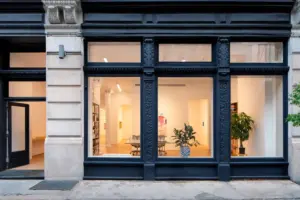
Opening in the late summer, marking a poignant milestone fifteen years after Winehouse’s passing, Nothing Personal welcomed the public into a tripartite installation at the Nicoletta Fiorucci Foundation. Scheduled to run through January 23, the exhibition has since drawn critical acclaim for its haunting interrogation of celebrity archiving, tactical empathy, and the friction between public myth-making and private reality.
Supporting Context & Metrics: The Anatomy of a Simulacra
To fully grasp the critical weight of Nothing Personal, one must examine the metrics and methodologies that underpin Arden’s curation. The exhibition is built upon an exhaustive collection of parallel objects—replicas that sidestep the institutional fetishization of authentic relics in favor of atmospheric accumulation.

The Library of an Introspective Mind
At the heart of the first room sits Library (2026), a towering white shelving unit that challenges the tabloid reduction of Winehouse’s intellect and mental state. Among the dozens of volumes meticulously hunted down and assembled by Arden are:
- Vladimir Nabokov’s memoir, Speak Memory
- The New Classic 1000 Recipes, a well-thumbed culinary guide
- Manuals and treatises on marriage and domestic life
- Biographies spanning cultural icons such as David Beckham, Bob Dylan, Carole King, Marilyn Monroe, and Audrey Hepburn
- A Weight Watchers guidebook, which cultural commentators frequently weaponized against Winehouse in life to fuel narratives regarding her heavily scrutinized eating disorders.
By presenting these texts as a collective ecosystem rather than isolated items, Arden strips away their sensationalist potential. "In isolation, these objects can be used to really push specific narratives about her," Arden noted during her walkthrough with ARTnews. "What I’m proposing in the artwork is that as a collection, this gives us really good insight."
Reconstructing Jeffrey’s Place: Same Otherwise
Moving into the second gallery space, visitors encounter Same Otherwise (2026), a faithful reconstruction of the fireplace mantle from 2 Jeffrey’s Place. Arden painstakingly replicated the layout that sheltered Winehouse during her creative zenith:
- Framed issues of British Vogue
- Vintage comic book pages from Betty and Veronica
- A decorative mirror featuring an inset portrait of Marilyn Monroe
Crucially, however, Arden introduced deliberate voids. Where Winehouse once kept intimate, framed photographs of family and friends, Arden left empty spaces. These intentional gaps transform the fireplace from a mere historical set-piece into a meditation on grief. As the artist explained, "The gaps speak to the feeling of things being present and missing always."
Olfactory Traces and Domestic Solitude
The sensory architecture of the exhibition is further elevated by Perfume said to have belonged to Amy Winehouse [I-IV] (2024–2026). The gallery air shifts subtly over the course of the exhibition’s run. Beginning with Chanel No.5 emitted via a custom-built dispenser, the scent will periodically rotate to capture other fragrances historically associated with the singer, including Thierry Mugler’s Alien, Vera Wang Princess, and Givenchy’s Hot Couture.
Further reinforcing this domestic interiority is Jigsaw (2026), a quiet installation comprising stacked puzzle boxes featuring imagery from The Simpsons, The Beatles, and the classic film Casablanca. The inclusion of these time-consuming pastimes paints a vivid portrait of a woman capable of deep introspection and solitary focus—a stark departure from the frantic, substance-fueled nightlife projected by the British press.
Official Statements & Critical Perspectives
The theoretical scaffolding of Nothing Personal relies heavily on the tension between documentation and erasure. This methodology is directly underscored by Arden’s recurring use of acrylic numbering systems.
In her earlier 2022 exhibition, All Clear, Arden utilized numbered print-outs placed beside mundane domestic objects—brooms, ladders, woven baskets—evoking the clinical, objective detachment of a crime scene investigation or a forensic audit. In Nothing Personal, this motif evolves into Display Identification Cubes (2026), comprising one thousand acrylic ice cubes designed to mimic museum museum label vitrines.

However, rather than anchoring an object to a definitive historical fact, many of these transparent cubes sit empty or mark spaces where information, context, or physical items are entirely missing.
"This show is a really personal insight into Amy," Arden shared in an interview with ARTnews, defining the items on display as "parallel objects." She elaborated on the psychological function of her acrylic markers, noting, "They draw attention to spaces where things are absent, but they also mark spaces where things have once been."
Art critics have noted that Arden’s approach subverts the necrophilic impulse of modern celebrity culture. Rather than unearthing bones for public consumption, the artist constructs a protective barrier of replicas. By substituting authentic relics with industrial simulacra, Arden protects Winehouse’s ghost from total commodification while still honoring the deep emotional resonance of her material legacy.
Future Outlook: The Legacy of Nothing Personal
As Nothing Personal maintains its residency at the Nicoletta Fiorucci Foundation through January 23, its broader implications for contemporary art and biographical curation are already coming into focus.
The exhibition arrives at a time when cultural re-evaluations of 2000s celebrity culture are at an all-time high. Documentaries, biopics, and posthumous releases frequently struggle to balance commercial exploitation with respectful tribute. By choosing the path of conceptual art and painstaking mimicry, Alex Margo Arden has carved out a new blueprint for how artists can engage with cultural icons who died prematurely under the predatory glare of the media.
The meticulousness of Arden’s five-year endeavor signals a shift toward slow, investigative art-making—one that values the psychological weight of the archive over rapid, superficial consumption. Whether Nothing Personal will travel to international institutions following its London closing remains to be seen, but its conceptual impact is undeniable. It leaves behind a lasting reminder that even fifteen years after her passing, Amy Winehouse’s interior life remains vast, layered, and fundamentally uncatchable—forever echoing in the spaces between the things we see and the things that have vanished.

Comments
Facebook App ID not configured. Please add it in the Customizer.