
Executive Overview
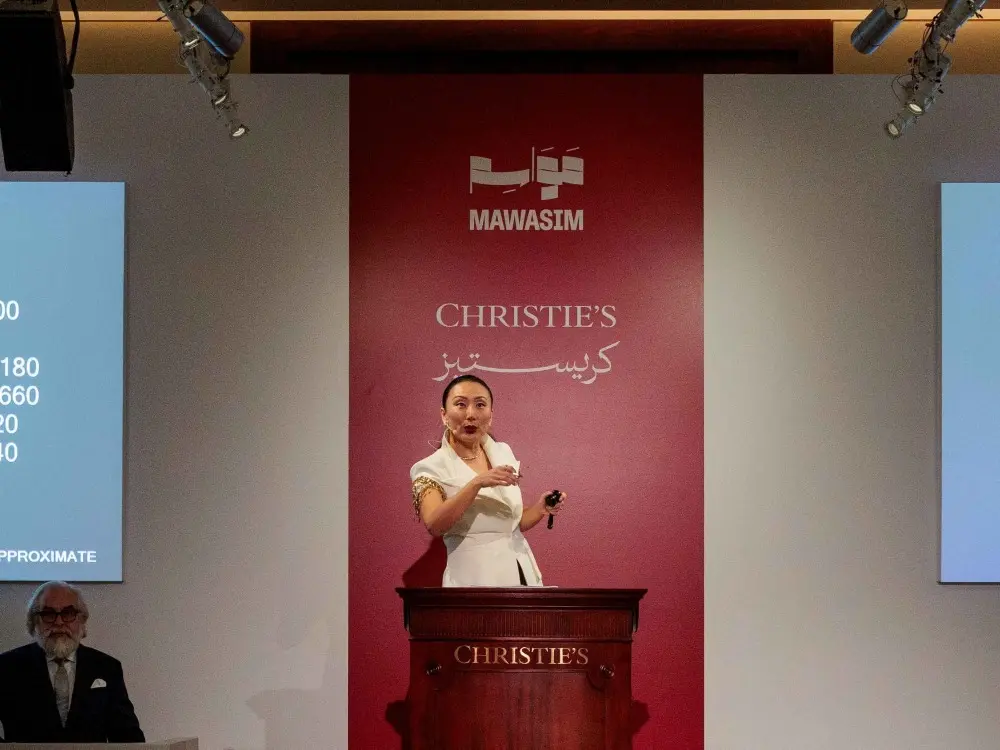
In a landmark event for the international art market, Christie’s hosted its debut fine art sale in Abu Dhabi on Sunday, titled “MAWASIM: 20 Years of Modern and Contemporary Middle Eastern Art.” Commemorating two decades of the auction house’s presence and pioneering operations in the United Arab Emirates (UAE), the high-profile evening sale achieved an impressive total of $8.94 million. Held at the sophisticated Abu Dhabi Edition hotel, the auction brought together an extraordinary roster of masterworks by prominent artists hailing from the Middle East and North Africa (MENA) region.
The event was more than a celebratory anniversary; it served as a powerful economic bellwether for the region’s cultural infrastructure. With a stellar sell-through rate of 88.2 percent—where only eight out of 68 offered lots failed to find buyers—the auction underscored the robust health, liquidity, and evolving sophistication of the Gulf’s fine art ecosystem. Furthermore, the evening shattered previous boundaries by establishing new auction records for nine distinct artists, drawing a remarkably youthful demographic of buyers, and integrating global blue-chip modernism with regional heritage through high-profile preview exhibitions.
As the international art world increasingly pivots toward polycentric markets, Christie’s Abu Dhabi debut confirms that the UAE capital is no longer just a destination for blockbuster museum franchises like the Louvre Abu Dhabi and the upcoming Guggenheim, but a thriving, primary-tier commercial marketplace capable of sustaining multi-million-dollar fine art auctions.
Read Also
Detailed Chronology of the Evening Sale
The auction room at the Abu Dhabi Edition hotel crackled with palpable anticipation on Sunday evening as collectors, international dealers, museum directors, and regional patrons gathered for the milestone event. The atmosphere reflected the culmination of 20 years of cultivating relationships, educating collectors, and establishing a formalized secondary market for MENA modern and contemporary art.
The bidding war of the night—and the undisputed star of the auction—was commanded by the late Iranian master Monir Shahroudy Farmanfarmaian. Her dazzling 2006 mirrored-mosaic masterpiece, Variations on the Hexagon, captured the room’s attention immediately. Estimated conservatively between $150,000 and $250,000, the work sparked a fierce, seven-minute bidding frenzy between room and telephone bidders. Ultimately, the geometric masterwork commanded a staggering $844,800 (inclusive of buyer’s premium fees—a standard metric applied to all figures cited herein). The triumph of Farmanfarmaian’s work coincides with a broader global re-evaluation of her oeuvre, underscored by her current major retrospective at the Moderna Museet in Stockholm.
Following closely behind was a formidable lineup of historical and contemporary heavyweights:
- Fahrelnissa Zeid’s hypnotic and vibrant Composition (1948–49) realized $524,800, comfortably surpassing its low estimate of $500,000. Zeid, a pivotal figure in modern Turkish and international abstraction, continues to experience surging global demand.
- Faisel Laibi Sahi’s narrative-rich canvas Baghdad Café (The Coffee Shop) (2016) outperformed expectations to achieve $512,000, beating its $400,000 low estimate and setting a new benchmark for the artist.
- Ali Banisadr’s cosmic, densely populated allegorical landscape Homo Deus (2018) brought in $512,000, brushing tightly against its aggressive high estimate of $550,000.
The momentum continued across diverse mediums and generations, reflecting a meticulously curated catalog that balanced historical gravitas with contemporary urgency. Out of the 68 lots presented to the global buying pool, an astounding 60 found new homes, resulting in a robust 88.2 percent sell-through rate that seasoned auctioneers recognize as a sign of exceptionally healthy market demand.
Supporting Context & Metrics: Breaking Records and Demographic Shifts
Beyond the headline-grabbing totals, the structural metrics of the "MAWASIM" sale reveal profound shifts in collector behavior and geographic wealth distribution. Most notably, the auction redrew the career trajectories of nine foundational and contemporary artists by establishing brand-new personal auction records.
The artists who achieved historic highs at the podium include:
- Jellal Ben Abdallah
- Paul Guiragossian (whose monumental 1958–59 canvas Noces [Wedding] nearly conquered its lofty $500,000 high estimate, selling for $486,400)
- Faisel Laibi Sahi
- Juliana Seraphim
- Nabil Kanso
- Samia Halaby
- Rami Farook
- Fatma Lootah
- Afra Al Dhaheri
These record-breaking prices validate decades of artistic production from the region, signaling that institutional validation is increasingly translating into commercial validation on the secondary market.
A Younger, More Global Collector Base
Perhaps the most telling data point released by Christie’s post-sale analysis pertains to the demographic makeup of the buyers. In an industry traditionally dominated by legacy collectors and older demographics, the Abu Dhabi sale proved remarkably youthful. Christie’s reported that over 30 percent of registered bidders were Millennials or Gen Z collectors.
This generational shift points to an emerging class of tech-savvy, globally minded young professionals and inheritors within the GCC (Gulf Cooperation Council) region who are eager to invest in cultural assets that reflect their own heritage and modern identities. Furthermore, 37 percent of all participants in the sale were entirely new to Christie’s, demonstrating that the auction successfully expanded the total addressable market rather than merely recycling existing clients.
Bridging East and West: The New York Previews
Demonstrating confidence in the maturity of the Abu Dhabi collecting base, Christie’s took the strategic liberty of previewing three museum-tier masterpieces ahead of their upcoming marquee evening sales in New York. Displayed prominently at the Abu Dhabi Edition hotel alongside the "MAWASIM" lots, these works offered local collectors an intimate viewing experience typically reserved for major financial capitals like London, New York, or Hong Kong.
The museum-grade traveling highlights included:
- Wassily Kandinsky’s pioneering abstraction Betonte Ecken (1923), carrying a colossal pre-sale estimate of $60 million to $80 million.
- Mark Rothko’s sublime Untitled (1968), estimated between $10 million and $15 million.
- Pablo Picasso’s striking portrait Tête de femme (1939), estimated between $12 million and $18 million.
By placing works of this magnitude in the heart of Abu Dhabi, Christie’s not only incentivized localized bidding but also symbolically positioned the UAE capital as an equal node in the global art market network.
Official Statements: Industry Leaders Weigh In
The resounding success of the auction prompted reflection from the highest echelons of Christie’s leadership. In a joint official statement, Ridha Moumni, Christie’s Chairman of Middle East and Africa, and Marie-Claire Thijsen, Head of Sale and Specialist at Christie’s UK and UAE operations, offered a joint assessment of the evening’s milestones:
"The breadth of bidding across the sale demonstrates the international interest this category has achieved today. Its scale reflects the depth of the region’s art sector and its capacity to support a major sale of this kind."
Industry analysts have echoed these sentiments, noting that while Christie’s and other international auction houses have historically relied on regional sales held in London or Dubai, the decision to launch a dedicated, high-tier fine art evening sale in Abu Dhabi marks a maturation of local market infrastructure. The synergy between regional wealth generation, state-backed cultural initiatives, and private collector interest has created an environment where multi-million-dollar transactions can occur organically on the ground.
Future Outlook: The Evolution of the MENA Art Market
As the dust settles on Christie’s $8.94 million Abu Dhabi debut, stakeholders are already looking toward the horizon. The success of "MAWASIM: 20 Years of Modern and Contemporary Middle Eastern Art" is unlikely to be a localized anomaly; rather, it serves as a foundational milestone for the next decade of cultural commerce in the Middle East.
Institutional Foundations and Commercial Growth
The UAE has spent the better part of the last twenty years constructing a world-class cultural framework. From the establishment of Saadiyat Island’s cultural district—home to Louvre Abu Dhabi, the forthcoming Zayed National Museum, and Guggenheim Abu Dhabi—to dynamic grass-roots initiatives in Dubai, Sharjah, and Riyadh, the institutional prestige of the region has never been higher.
What has historically lagged behind this institutional growth, however, is a deep, fluid secondary commercial market. Sunday’s auction decisively proves that the commercial market is catching up to the institutional appetite. When nearly 40 percent of bidders are new to the auction house, and nearly a third represent the under-40 demographic, it signals a self-sustaining ecosystem that will continue to cultivate domestic and international patronage for generations.
What Lies Ahead
Looking forward, international auction houses will undoubtedly look to replicate and expand upon Christie’s Abu Dhabi blueprint. We can anticipate more frequent high-value sales hosted directly within the GCC, greater integration of digital bidding infrastructure tailored to younger regional demographics, and an ongoing cross-pollination of blue-chip Western art with foundational MENA masterpieces.
Ultimately, Christie’s 20th-anniversary celebration in Abu Dhabi was more than a retrospective glance at past achievements. It was a clear-eyed declaration of intent: the Middle East is no longer merely a burgeoning frontier market, but an established, essential pillar of the global art economy.




Comments
Facebook App ID not configured. Please add it in the Customizer.