
EXECUTIVE SUMMARY
In an era defined by rapid media consumption and fleeting digital narratives, literature occasionally pierces through the noise with startling, unsettling precision. A recent publication in Guernica Magazine has brought international attention to a haunting new poetic work that blurs the boundaries between grief, psychological dissociation, and the chilling normalization of unthinkable trauma.
The piece, featuring a poem by acclaimed Hungarian writer Anna T. Szabó, translated into English by Ági Bori, and accompanied by the evocative textile and sculptural art of Melissa Monroe, presents a harrowing vignette of a domestic space unhinged by tragedy. The poem chronicles a man who, following an unspecified catastrophe that has claimed the lives of his wife and seemingly his young daughter, moves through a mechanized routine of mourning, denial, and eerie preservation.
Read Also
Far from a conventional thriller, the work operates in the liminal space of psychological shock. It examines how human consciousness attempts to process the unprocessable—fastidiously caring for a deceased spouse, dressing a lifeless child, and attempting to deliver her to school as the clock strikes seven. This comprehensive report explores the literary mechanics of the poem, the backgrounds of its creators, the thematic weight of translation across cultural and linguistic divides, and the broader psychological implications of portraying domestic trauma through verse.
I. EXECUTIVE OVERVIEW: THE LITERARY EVENT
The appearance of Szabó’s translated poetry in a prominent literary journal marks a significant cross-cultural exchange, introducing English-speaking audiences to a voice deeply embedded in Central European literary traditions. Yet, the work itself immediately arrests the reader through its stark subject matter.
The narrative voice follows an unnamed protagonist who engages in actions that oscillate between agonizing grief and dissociative unreality:
He ties the strap on his left hand, as he had seen
his grandfather do it during his childhood, then
puts the knocked-down lamp back in its place,
covers up his dead wife with fastidious care,
and raises the shutters in the kitchen.
The juxtaposition of generational memory (tying a strap in the manner of a grandfather) with domestic debris (a knocked-down lamp) and catastrophic finality (a dead wife) establishes a tone of chillingly mundane surrealism. The protagonist does not scream, collapse, or call emergency services; instead, he administers order to a disordered universe. He regulates light by raising the kitchen shutters, preparing the stage for an even more profoundly disquieting encounter within the children’s bedroom.
II. DETAILED CHRONOLOGY: A MORNING UNMOORED
To fully understand the psychological architecture of the poem, one must examine its strict temporal progression. The narrative unfolds like a silent film, capturing micro-movements that defy logical human behavior while remaining tethered to the tragic momentum of habit.
Step One: Restoring Order to the Ruins
The poem opens with an act of inheritance and repair. The protagonist’s gesture of tying a strap on his left hand is an involuntary invocation of the past, an instinctive reach for muscle memory when present reality collapses. The restoration of the lamp—an object knocked over in a struggle, a fall, or an emotional tempest—represents the fundamental human urge to right that which has been destabilized.
Yet, this veneer of normalcy is immediately undermined by the presence of his deceased wife. He covers her up with "fastidious care," an action that reads simultaneously as profound tenderness and a pathological refusal to confront the finality of death. By covering her, he conceals the trauma, tucking the horror away beneath blankets before turning his attention to the domestic machinery of the morning: opening the kitchen shutters to let the daylight in. The sunlight, ironically, does not bring warmth or awakening; it merely illuminates the stage upon which a deeper delusion is about to unfold.
Step Two: The Illusion of Life
The narrative shifts to the children’s bedroom, where the atmosphere softens before pivoting sharply into the macabre:
He opens the door to the children’s bedroom,
and quietly pulls the floral curtain to the side,
sunlight pours in. He turns around, he bends down.
But she is breathing, he thinks. He cradles
the dead little girl, dresses her nicely,
puts her in the car seat, carefully buckles her in,
takes her to school. It’s seven o’clock.
The psychological crux of the poem rests entirely within three words: "she is breathing, he thinks." Here, the boundary between physiological reality and protective delusion dissolves entirely. The mind, incapable of absorbing the permanent loss of a child, manufactures a sensory hallucination. He thinks she is breathing because the alternative requires an existential annihilation he cannot yet survive.
With heartbreaking meticulousness, he performs the paternal rituals of a normal morning: he cradles her, dresses her in clean clothes, secures her in the car seat, and buckles her in for the morning commute. The final line—"It’s seven o’clock"—anchors this psychological freefall to the rigid tyranny of the clock. The world outside continues its relentless forward march, entirely unaware that a father is driving a corpse to a place of learning, trapped inside a private, inescapable purgatory.
III. SUPPORTING CONTEXT & METRICS: THE CREATIVE FORCES BEHIND THE WORK
To appreciate the gravity of the piece, one must examine the pedigree and artistic philosophy of the individuals responsible for its creation and dissemination.

Anna T. Szabó: A Literary Titan of Central Europe
Born in 1972 in Transylvania, Romania, Anna T. Szabó stands as one of the most prominent figures in contemporary Hungarian literature. Her career spans multiple genres and generations of readers:
- Poetry & Prose: She has published eleven volumes of poetry for adults, eight books for children, and four acclaimed short story collections.
- Accolades: Her literary contributions have been recognized with numerous prestigious prizes. She is an elected member of the Széchenyi Academy of Letters and Arts, a constituent body of the Hungarian Academy of Sciences.
- Public Engagement: Beyond her books, Szabó is a prolific essayist, journalist, and lecturer. Her verse frequently crosses over into the public sphere, utilized as lyrics by various musical performers.
- Personal Life: She resides near Budapest with her husband, the celebrated novelist György Dragomán.
Szabó’s writing frequently probes the intersections of family, historical trauma, memory, and psychological endurance. This poem exemplifies her capacity to distill monumental grief into minimalist, razor-sharp stanzas.
Ági Bori: Bridging Linguistic Realities
Translation is never a mere mechanical substitution of words; it is an act of profound cultural and emotional transposition. Ági Bori, who is originally from Hungary and has lived in the United States for over thirty years, serves as the vital conduit between Szabó’s Hungarian syntax and the English-speaking literary landscape.
Bori’s translations and original writings have appeared in an extensive array of prestigious literary journals and magazines, including The Baffler, Words Without Borders, Asymptote, The Rumpus, and 3:AM. As a translation editor at the Los Angeles Review, Bori champions literature that challenges borders and expands aesthetic consciousness. Her rendering of Szabó’s poem retains the stark, unadorned cadence of the original Hungarian, ensuring that the emotional chill of the narrative remains uncompromised.
Melissa Monroe: The Visual Counterpart
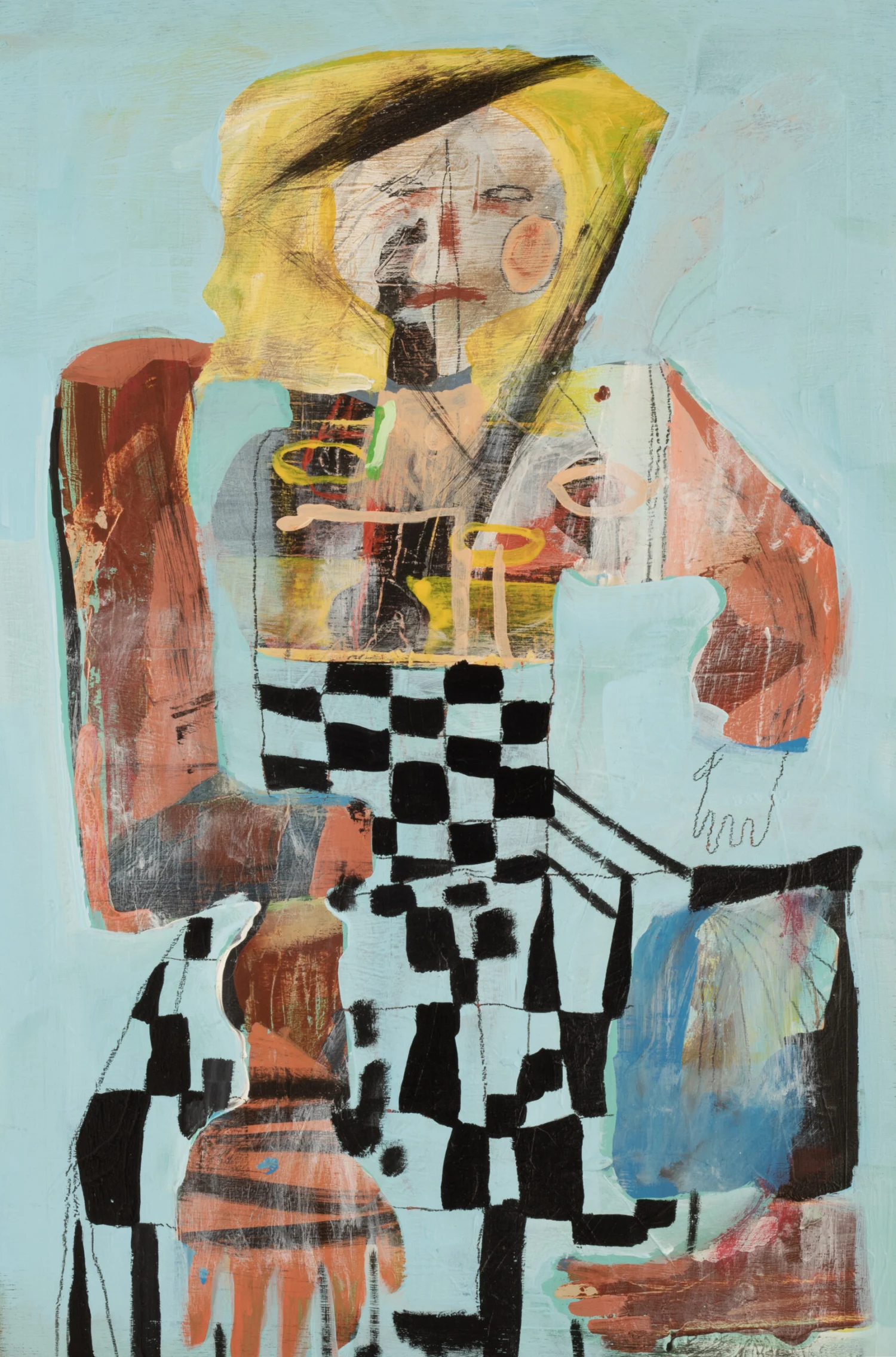
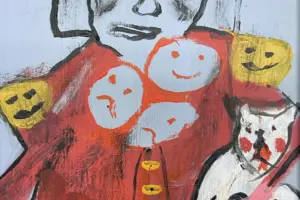
Accompanying the text is the striking visual art of Melissa Monroe, a self-taught multidisciplinary artist who has worked full-time in textiles, sculpture, and acrylic painting for over a decade. Monroe’s work explores the raw intensity of existence:
"My work explores the intensity of being alive. I transform emotion into sculptural forms that slow time and inspire wonder. All the work becomes a mask—radiating beauty while holding life’s harsher truths. Hidden in color and play, I am vibrating just under the surface, where sadness, love, and joy all exist together."
Since 2021, Monroe has expanded her repertoire into handmade rugs and textiles, integrating her painterly background with structural abstraction. Her artistic philosophy—that sadness, love, and joy coexist within a single, vibrating surface—serves as a visual thematic mirror to Szabó’s poem. The artwork accompanying the piece acts not merely as an illustration, but as a textural extension of the trauma and beauty intertwined within the text.
IV. THEMATIC ANALYSIS: TRAUMA, DISSOCIATION, AND THE DOMESTIC SPACE
The resonance of Szabó’s poem lies in its subversion of the domestic sphere. Traditionally viewed as a sanctuary from the harsh realities of the external world, the home in this narrative becomes a theater of silent devastation.
The Architecture of Denial
Psychologists have long documented denial not merely as a character flaw or a failure of courage, but as an acute psychological defense mechanism—a cognitive shock absorber designed to prevent immediate ego fragmentation. When the protagonist convinces himself that his daughter is breathing, he is engaging in the ultimate protective fiction.
The poem explores the mechanics of this fugue state through physical labor. By focusing entirely on micro-tasks—tying a strap, righting a lamp, covering a body, pulling a curtain, buttoning a dress, fastening a seatbelt—the protagonist constructs a scaffolding of routine to keep the crushing weight of reality at bay. The tragedy is heightened precisely because these actions are performed with tenderness and care. There is no malice here, only a broken mind desperately attempting to maintain the integrity of a world that has already ended.
The Transposition of Grief in Contemporary Art
The collaboration between Szabó, Bori, and Monroe highlights a broader movement in contemporary literature and art: an unyielding willingness to confront the darkest corners of human experience without offering easy redemptive arcs. In an era marked by collective anxieties, global displacement, and private isolations, art increasingly turns toward the exploration of psychological survival.
By presenting grief not as a theatrical explosion of tears, but as a quiet, mechanized march toward the school drop-off zone at seven in the morning, the creators force the reader to bear witness to the terrifying resilience of human habit in the face of absolute loss.
V. FUTURE OUTLOOK: THE LEGACY OF TRANSLATED TRAUMA IN DIGITAL LITERARY SPACES
As this piece circulates through platforms like Guernica, its reception underscores the evolving role of international literature in digital spaces. Works that transcend linguistic boundaries are no longer confined to academic print runs; they ignite cross-cultural conversations about empathy, mental health, and the limits of narrative representation.
Expanding Horizons for Central European Literature
The inclusion of writers like Anna T. Szabó in major American journals heralds a broader appreciation for the distinct literary traditions of Central and Eastern Europe—regions historically marked by historical displacement, political turbulence, and deep psychological introspection. Through the meticulous work of translators like Ági Bori, these narratives find a receptive, global audience.
The Evolution of Multidisciplinary Storytelling
Furthermore, the integration of textual poetry with Melissa Monroe’s sculptural and textile artistry points toward a future where literary publishing increasingly embraces multimedia and cross-disciplinary curation. By pairing a devastating poem about domestic tragedy with tactile, mask-making, and sculptural abstractions of emotional intensity, publishers create a holistic sensory experience that lingers long after the reader has closed the browser tab.
Ultimately, the publication of this work stands as a testament to the enduring power of art to articulate the unspeakable. It reminds us that even within the darkest recesses of human grief, poetry, translation, and visual art can forge a bridge across the abyss, allowing us to bear witness to the fragile, fractured machinery of the human heart.

Comments
Facebook App ID not configured. Please add it in the Customizer.