
Executive Overview
In the contemporary literary landscape, few emerging voices capture the tension between the sacred and the secular with quite the meticulous vigilance of MJ Gomez. A poet whose work is simultaneously grounded in ancient traditions and alert to the pulse of the twenty-first century, Gomez has quickly established himself as a formidable talent. His acclaimed 2023 poetry chapbook, Love Letters from a Burning Planet (Variant Literature), showcases a writer deeply attuned to the sonic architecture of language. Through precise musicality, Gomez interrogates themes of masculinity, memory, and the undulating weight of personal history.
Beyond his output as a page poet, Gomez’s footprint extends into mentorship and pedagogy, where he works with high school and early-career writers through organizations such as SUNHOUSE and Young Poets Workshops. In these spaces, he advocates for a rigorous approach to craft—one that prioritizes breath, silence, and structural intentionality over the superficial trappings of the so-called "teen poet" aesthetic.
This profile examines Gomez’s artistic evolution, charting his navigation of doubt within a lifelong Islamic framework, his transition from urban abstraction to concrete sensory observation following a relocation to Tbilisi, Georgia, and his evolving philosophy on publication, mentorship, and the lifelong marathon of poetic practice.
Read Also
Detailed Chronology and Artistic Evolution
To understand the trajectory of MJ Gomez’s work, one must examine the progression of his creative output from early web-based publications to physical chapbooks and international relocations.
The Formative Years and Early Publications
Gomez’s journey into publishing began during his late teens, an era he now views with a mixture of fondness and critical distance. Like many young writers who find themselves swept into the digital literary ecosystem, Gomez experienced the intoxicating rush of early acceptances. However, he has since developed a more complicated relationship with the conventions often demanded of young writers.
Reflecting on his earliest work, Gomez notes the paradox of putting oneself out there at age nineteen:
"It’s a blessing and a curse to put yourself out there so young. I’ve seen many poets succumb to the mind-numbing secretary work that is trying to get oneself published. Emails, cover letters, rejection after rejection building up—it’s all very exhausting, and an utterly different discipline to the pure practice of writing poetry itself."
The Craft of Love Letters from a Burning Planet (2023)
The release of Love Letters from a Burning Planet marked a significant maturation in Gomez’s approach to lyricism. The collection draws heavily from traditional forms, most notably the ghazal, which serves as a structural anchor for the volume’s opening and informs its overarching meter and rhyme scheme.
Rather than relying on conventional punctuation, Gomez often utilizes white space as an active agent within his poems. In pieces like "Study of Daylight"—which borrows its opening line from poet Kaveh Akbar—Gomez strips away traditional markers of grammar to induce a sense of breathless, frantic energy. The resulting enjambments force the reader’s eye to skate over line breaks, letting disparate images bleed into one another.
This deliberate tonality was also shaped by the stylistic touchstones of Sonia Sanchez, Ocean Vuong, and Richard Siken. By studying the live performances and page architectures of these writers, Gomez sought to capture a free-flowing, visceral voice that remains tightly tethered to emotional truth.
The Geographic Shift: From City Streets to Tbilisi
A pivotal moment in Gomez’s recent artistic evolution has been his geographic relocation from an urban environment to Tbilisi, Georgia, for his university studies. This move fundamentally altered his relationship with the natural world.
In earlier works, such as the widely discussed piece "Litany in Which I Am Tired of Waiting for Judgement Day" (published in Shō Poetry Journal), Gomez grappled with an urban environment composed of street cats, date palms, and asphalt. He describes this phase as an attempt to adore his surroundings without embellishment, battling the internal insecurity of feeling his inner world was "not poetic enough."
However, living in Tbilisi—a city defined by an abundance of integrated nature, prolonged rainstorms, and sprawling wildlife sanctuaries—has shifted his aesthetic toward concrete sensory detail. The abstract musings of Love Letters have given way to tangible observations of snow, weather, and physical geography, reinforcing his developing thesis that the natural world is not separate from the human experience, but rather a mirror for it.
Supporting Context & Metrics: The Mechanics of Modern Mentorship
Gomez’s transition from student of the craft to mentor—primarily through guest workshops with SUNHOUSE and Young Poets Workshops—has provided him with a unique vantage point on how the next generation of writers engages with poetry.
Mentoring the Next Wave
When working with high school-aged writers, Gomez’s pedagogy departs from traditional top-down instruction. Instead, he focuses on foundational mechanics, emphasizing that every element of a poem possesses multiple functional uses.
A central pillar of his workshops involves the manipulation of silence. Drawing on Kaveh Akbar’s collection Pilgrim Bell, Gomez instructs students on how nonstandard grammar, deliberate period placement, and calculated line lengths can break phrases into stuttering fragments. This slows the reader’s pace, allowing for unexpected juxtapositions of imagery.
Dismantling the "Teen Poet" Style
Gomez has been vocal about his reservations regarding the stylistic homogenization often found in contemporary youth poetry. He defines the "teen poet" style through the over-reliance on a narrow vocabulary of immediate, high-stakes signifiers—blood, bullets, mothers, fathers—borrowed uncritically from celebrated contemporary models.
While acknowledging the empowering nature of finding relatable work early in life, Gomez urges emerging writers to move beyond broad shorthand:
"Poetry is an incredibly intentional art. Every word and every silence conveys something to the reader. I personally try to interrogate every decision I make in a poem: Why break the line here? Why use this word, instead of another? Why should this poem be in quatrains, and not another form?"
Furthermore, he cautions against the trap of writing exclusively for publication. Referencing insights from poet Gabrielle Bates, Gomez views publication not as the definitive seal of success, but merely as another stage in the revision process—a way to see one’s work reflected through the eyes of an audience.
Official Statements & Perspectives: Faith, Doubt, and Prayer
Perhaps the most intricate terrain Gomez navigates in his poetry and personal philosophy is the intersection of faith, religious identity, and artistic creation.
The Architecture of Doubt
As a born Muslim, Gomez’s relationship with his faith is characterized by a constant push and pull between orthodoxy and existential questioning. In his poem "LAPSE" (published in Anti-Heroin Chic), he confronts the vastness of divine forgiveness and the human tendency to mistake mercy for debt.
Gomez notes that religious upbringing often implicitly teaches adherents to fear doubt, treating skepticism as an adversary to be suppressed. However, Gomez views doubt as an inherent manifestation of human curiosity:
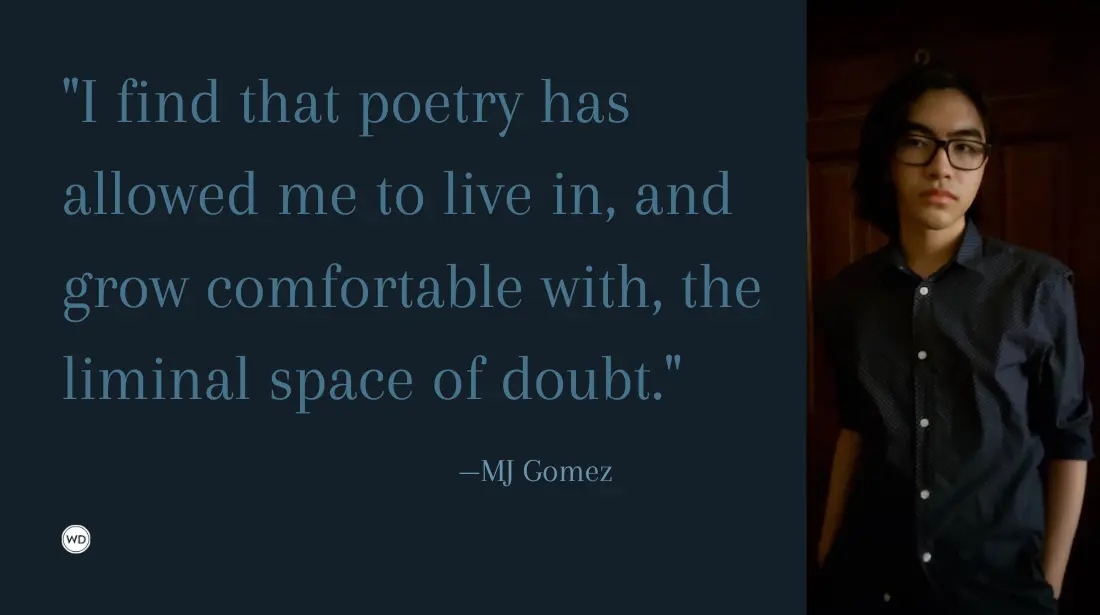
"A child asks, if God’s all-powerful and all-loving, why do bad things still happen to us? It’s a valid question, and yet many of us seek to silence that child… But all that does is drive that seed deeper into the dirt. I find that poetry has allowed me to live in, and grow comfortable with, the liminal space of doubt."
This comfort with liminality is reflected in "LAPSE," which emerged not from a cinematic crisis of faith, but from the anticlimactic realization that an emotional return to religious practice does not suspend the mundane responsibilities of daily life. The poem forced him to confront the reality of living on without immediate cosmic validation.
Poetry as a Secular Analog to Prayer
Articulating his definition of personal faith, Gomez adopts a pragmatic yet deeply hopeful stance:
"When I say I believe in God, it’s mostly to say: I’ve read the texts, experienced the highs and lows of being a person of faith, and after all that, I still think that this is the best way to live my life… I hope that this world, in all its contradictions and horrors, was made with love in mind."
This perspective informs his view of the creative process itself. Gomez draws a direct parallel between the act of writing and the act of prayer: just as the faithful reach out to an unseen deity in hopes of an answer, poets dispatch words into the void, trusting that readers will animate them with new life. In Gomez’s view, both acts constitute a daily, shared resurrection.
Future Outlook
As Gomez looks beyond the reception of Love Letters from a Burning Planet, his creative horizons continue to expand across international borders and new structural formats.
Current Projects in Progress
Gomez is currently at work on a substantial new manuscript—envisioned either as a second chapbook or his first full-length collection. The project represents a departure from the existential weight of his debut, adopting a more conversational and epistolary structure.
Every poem in the emerging collection opens with the address, "Dear [ ]", utilizing initials to designate a sprawling series of letters directed toward a dear friend with whom he has lost touch. What began as a check-in has since matured into an expansive meditation on:
- Platonic love across distance
- The geopolitical reality of oppressive borders
- The distinct grief associated with leaving one’s homeland
Long-Term Trajectory
In an era that often demands rapid output and instant digital validation from young artists, MJ Gomez remains a proponent of the long game. By prioritizing rigorous self-interrogation over algorithmic visibility, and by treating poetry as a lifelong endurance sport rather than a fleeting teenage milestone, Gomez is quietly building a body of work defined by integrity, technical mastery, and an unflagging curiosity about what it means to inhabit a complex world.
Whether through his workshop mentorship, his transnational observations in Tbilisi, or his ongoing dialogue with the divine, Gomez continues to demonstrate that the truest poetic acts are born not of certainty, but of a willingness to stand in the open air and listen.


Comments
Facebook App ID not configured. Please add it in the Customizer.