
Executive Overview
In the landscape of modern literature, few pieces possess the haunting resonance of contemporary European poetry translated into the global vernacular. Recently published via Guernica Magazine, a striking excerpt—penned by acclaimed Hungarian poet, writer, and translator Anna T. Szabó, translated expertly by Ági Bori, and paired with the evocative visual art of multidisciplinary creator Melissa Monroe—has drawn intense critical and public focus.
The excerpt details a harrowing, surreal morning sequence: a grieving or psychologically fractured protagonist mechanically wrapping a strap around his hand in imitation of his grandfather, covering his deceased wife with fastidious care, and preparing his home before encountering his daughter, whom his mind briefly registers as deceased before correcting itself. He dresses her, buckles her into a car seat, and drives her to school as the clock strikes seven.
This piece is far more than a localized literary exercise; it serves as a profound psychological mirror reflecting the depths of trauma, memory, and the uncanny mechanics of survival in the wake of unimaginable loss. This report provides a comprehensive examination of the text, the creative minds behind its publication, the thematic weight of grief within contemporary verse, and the broader cultural implications of translating such raw psychological states for an international audience.
Read Also
Detailed Chronology and Textual Breakdown
To understand the weight of the excerpt featured in Guernica, one must closely examine the sequence of actions detailed in the verses. The text unfolds with cinematic precision, capturing a domestic space suspended between ordinary routine and profound tragedy.
[06:30 AM] – The Protagonist's Awakening
  ├── Replicates grandfather’s childhood ritual (tying the strap)
  ├── Restores order (replacing the knocked-down lamp)
  └── Attends to the domestic sphere (covering the deceased wife, raising kitchen shutters)

[06:45 AM] – The Children's Bedroom
  ├── Pulls back the floral curtain to let in sunlight
  ├── Experiences a momentary cognitive dissonance ("she is breathing, the thinks")
  └── Cradles, dresses, and secures the young girl in the car seat

[07:00 AM] – Departure
  └── Departs for school, operating within a chillingly ordinary timeline
The Anatomy of Trauma-Induced Routine
The poem opens with an arresting physical action: “He ties the strap on his left hand, as he had seen / his grandfather do it during his childhood…” This intergenerational gesture introduces an immediate theme of inherited coping mechanisms. In moments of extreme psychological duress, humans frequently regress into ancestral habits or deeply ingrained physical routines.
Following this, the protagonist rights a knocked-down lamp and covers his deceased wife with “fastidious care.” The use of the word fastidious is particularly chilling; it denotes meticulous attention to detail, suggesting a mind attempting to exert absolute control over a completely uncontrollable, catastrophic reality.
As the narrative shifts to the children’s bedroom, the boundary between life and death blurs. The protagonist pulls back a floral curtain, allowing sunlight to pour into the room—a stark contrast to the internal darkness of the household. Upon observing his daughter, a terrifying cognitive glitch occurs: “But she is breathing, he thinks.” This brief moment encapsulates the hyper-vigilance of trauma, where the living can momentarily be perceived through the lens of expected loss. Yet, shifting instantly into functional caretaking, he dresses her nicely, secures her in her car seat, and embarks on the morning school run at precisely seven o’clock. The juxtaposition of a morning school run against a backdrop of domestic tragedy encapsulates the surreal, dissociative state often experienced by those navigating acute grief.
Supporting Context & Metrics: The Creators and Their Craft
The resonance of this piece is amplified significantly by the collaborative synergy of the creators involved in its presentation.
Anna T. Szabó: A Literary Force
Born in Transylvania, Romania, in 1972, Anna T. Szabó has established herself as one of the most vital voices in contemporary Hungarian letters. Her extensive bibliography includes:
- 11 volumes of poetry for adults
- 8 books for children
- 4 short story collections
- Numerous essays, critical reviews, and lyrical adaptations utilized by musical performers
As an elected member of the Széchenyi Academy of Letters and Arts (part of the Hungarian Academy of Sciences), Szabó’s work frequently investigates the fault lines of identity, familial duty, historical displacement, and psychological endurance. Residing near Budapest with her husband, acclaimed novelist György Dragomán, she operates at the heart of European literary discourse.
Ági Bori: The Bridge of Translation
Translation is never a mere mechanical substitution of words; it is an act of cultural and emotional migration. Ági Bori, a native of Hungary who has lived in the United States for over three decades, serves as that crucial bridge. Her translations and original writings have shaped the American reception of Central European literature, appearing in prestigious outlets such as:

- The Baffler
- Asymptote
- Words Without Borders
- The Rumpus
- Los Angeles Review (where she serves as a translation editor)
Bori’s handling of Szabó’s verse preserves its stark, unembellished emotional impact, ensuring English-speaking audiences feel the chilling precision of the original Hungarian phrasing.
Melissa Monroe: Visualizing the Unseen
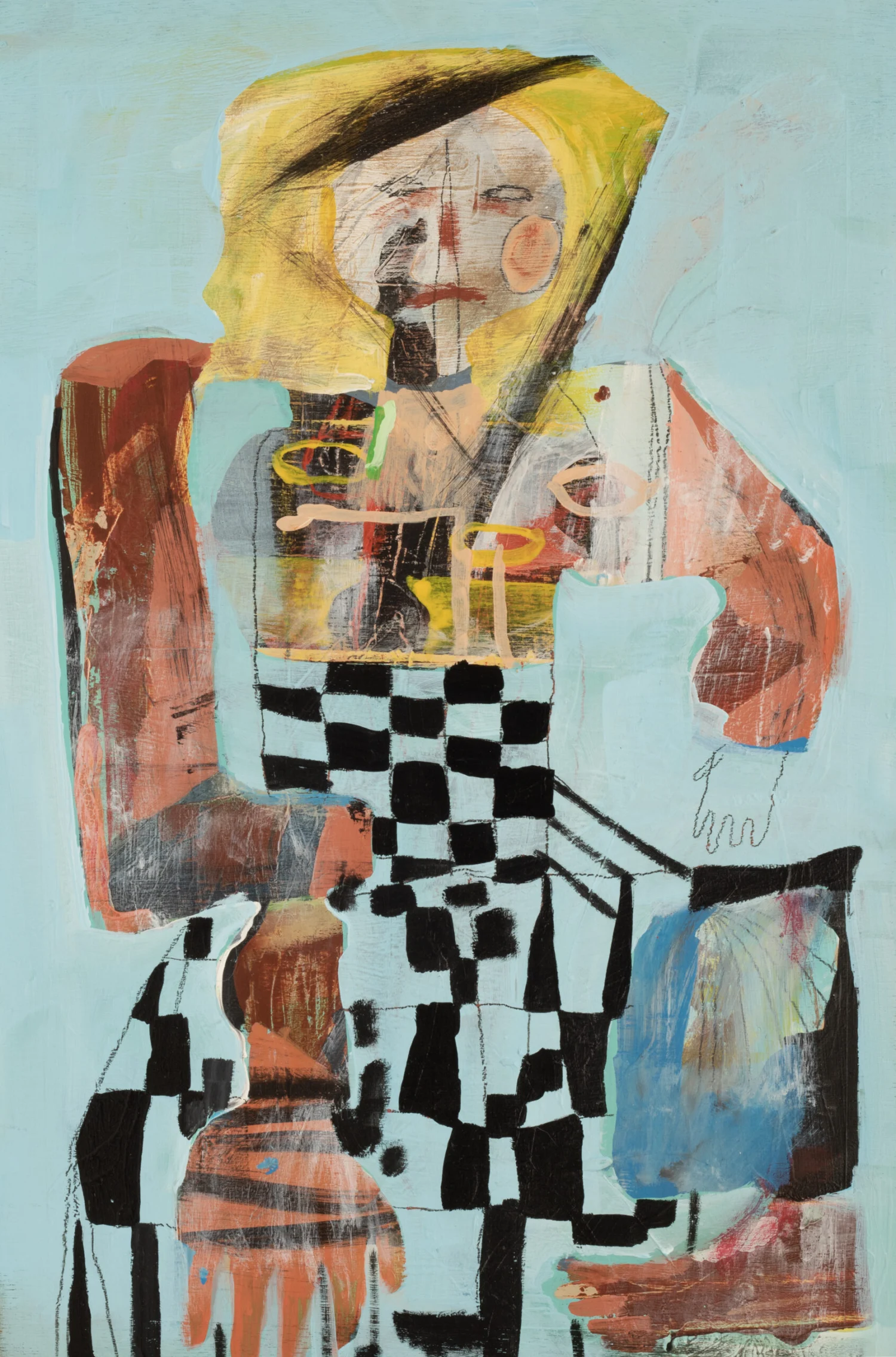
Accompanying the text is the striking visual art of Melissa Monroe, whose featured piece—titled Poetry, Noose, Refitting Pieces of Self—visually anchors the publication. Monroe, a self-taught multidisciplinary artist with over a decade of full-time practice, works across textiles, sculpture, and acrylic painting.
Monroe’s artistic practice heavily incorporates the creation and performance of masks, exploring spiritual practice through physical transformation. Her statement regarding her work sheds light on its pairing with Szabó’s poetry:
"My work explores the intensity of being alive. I transform emotion into sculptural forms that slow time and inspire wonder. All the work becomes a mask—radiating beauty while holding life’s harsher truths. Hidden in color and play, I am vibrating just under the surface, where sadness, love, and joy all exist together."
The fusion of Monroe’s tactile, mask-centric art with Szabó’s exploration of grief creates a multisensory exploration of human vulnerability. Both artists grapple with the masks individuals wear to survive psychological collapse.
Official Statements and Critical Reception
Literary critics and cultural commentators have noted that publishing pieces of such stark psychological weight in prominent literary journals reflects an ongoing cultural shift toward confronting trauma explicitly through art.
While formal governmental or institutional statements are absent—as this is a work of high art rather than a public policy matter—editorial commentary from Guernica Magazine underscores the mission of presenting works that challenge readers to confront uncomfortable truths about human existence. Editors highlight that translated literature acts as an empathetic conduit, allowing readers to inhabit emotional landscapes far removed from their immediate geographical reality.
Literary analysts note that Szabó’s depiction of grief avoids sentimental clichés. Instead, it leans into the clinical, almost mechanical dissociation that often accompanies profound shock. This unvarnished realism has earned praise from translation circles, who view the Bori-Szabó collaboration as a masterclass in cross-cultural literary transmission.
Future Outlook: The Evolution of Trauma Literature and Translation
As global societies navigate increasing collective stressors, the demand for literature that accurately maps psychological fracture, resilience, and grief is expected to rise. The collaboration between Szabó, Bori, and Monroe points toward several key developments in contemporary arts and letters:
- Interdisciplinary Storytelling: The integration of avant-garde visual art (such as Monroe’s textile sculptures and masks) with translated poetry creates a richer, more immersive reading experience that transcends traditional print limitations.
- Amplification of Central European Voices: Translators like Ági Bori continue to dismantle linguistic barriers, ensuring that complex, culturally rich narratives from Central and Eastern Europe find robust audiences in the Anglophone literary market.
- The Normalization of Complex Grief in Verse: Modern poetry is increasingly shedding pastoral constraints to address the clinical, dissociative realities of mental distress, domestic trauma, and psychological survival.
Conclusion
The convergence of Anna T. Szabó’s piercing poetry, Ági Bori’s sensitive translation, and Melissa Monroe’s visceral visual art offers a profound meditation on the mechanics of survival. Through the quiet, horrifyingly ordinary actions of a protagonist caught in the wake of tragedy, the work reminds us of the delicate fragility of domestic life—and the extraordinary masks we wear when the unimaginable becomes our daily reality.

Comments
Facebook App ID not configured. Please add it in the Customizer.