
By Global Entertainment Desk
Published: October 15, 2026
Executive Overview
The 31st edition of the Busan International Film Festival (BIFF), widely acknowledged as Asia’s premier cinematic showcase, concluded on a high note on Thursday, marked by critical breakthroughs, heavy-hitting international juries, and a historic reconfiguration of global film pathways. Iranian master filmmaker Majid Majidi claimed the festival’s most coveted honor—the top prize in its newly minted international competition section—for his poignant socioeconomic drama, Midday Meal.
Beyond the prestige of winning Asia’s largest film event, Majidi’s victory carries monumental industry weight. Under recently revised Academy of Motion Picture Arts and Sciences guidelines, the triumph guarantees Midday Meal automatic eligibility for consideration in the International Feature Film category at the Academy Awards. This rule change bypasses traditional, bureaucratic national selection committees, directly elevating Busan to the elite tier of qualifying festivals alongside historic European heavyweights like Cannes, Berlin, and Venice.
Read Also
This year’s festival was a triumphant return to scale, drawing over 200,000 visitors and deploying a massive programming grid of 315 films—representing the festival’s largest official selection lineup since 2019. Headlined by an international jury chaired by legendary Chinese director Zhang Yimou, the 31st BIFF reaffirmed its dual identity as both a fierce incubator for regional talent and an increasingly powerful node in the global awards season pipeline. From honorific tributes to trailblazing women in cinema to high-stakes competition entries, the 2026 edition has permanently altered the trajectory of Asian cinema on the world stage.
Detailed Chronology: From Grand Opening to Awards Night
Launching the 31st Edition: Intimacy and Scale
The 31st Busan International Film Festival commenced under a banner of cautious optimism and artistic ambition. Setting an intimate, contemplative tone for the massive 10-day event, the festival opened with the world premiere of South Korean director Kim Jong-kwan’s The Table: Day and Night. A delicate, deeply atmospheric exploration of human connection, the film signaled a thematic preference among programmers for nuanced, character-driven narratives, even as the festival itself expanded to record-breaking proportions.
Throughout the week-long event, audiences flooded Haeundae-gu and the Cinema Center, pushing attendance past the 200,000 mark. Organizers scheduled 315 total films across various sections, with 246 officially selected titles forming the backbone of the festival. This staggering volume demonstrated not only post-pandemic recovery but also the sheer resilience and output of the global cinematic community, particularly across East, South, and West Asia.
The Competition Landscape and the Yimou Jury
The centerpiece of the festival remains its newly established international competition section. Inaugurated only last year to elevate BIFF from a premiere showcase into a competitive festival of the highest global order, this year’s iteration featured a fiercely contested lineup of 13 titles. The selection represented a diverse cross-section of global storytelling, including a formidable trio of home-grown South Korean features that vied for the top honors against international heavyweights.
Evaluating this rich tapestry was a high-profile international jury led by none other than legendary Chinese filmmaker Zhang Yimou. Known globally for masterpieces like Raise the Red Lantern, Hero, and To Live, Zhang brought a rigorous, uncompromising artistic standard to the deliberation room. Alongside fellow international film professionals, the jury spent days dissecting the 13 contenders before ultimately awarding the festival’s highest accolade to Majid Majidi’s Midday Meal.
The Emotional Awards Ceremony
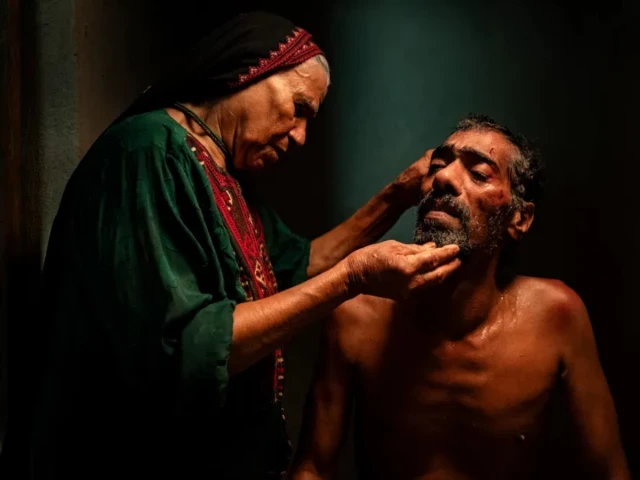
When Midday Meal was announced as the winner of the top prize, the auditorium erupted in applause. The film—a searing yet tender narrative about a schoolteacher in an impoverished Iranian village who is driven to desperate measures of smuggling just to keep his educational institution afloat—resonated deeply with the jury for its humanist core and unflinching social critique.
Accepting the award via an interpreter, a visibly moved Majidi dedicated his win to his family and his homeland.
"I think it’s thanks to the love and energy my mother gave me before she passed away a few months before filming began," Majidi said, his voice thick with emotion.
He expanded his remarks into a broader, resonant socio-political commentary, praising the resilience of the Iranian people. Despite enduring decades of compounding hardships—including ongoing geopolitical conflicts with the United States, punishing legal and economic sanctions, and severe domestic shortages impacting everyday life, including basic access to medicine—the spirit of ordinary Iranians, Majidi asserted, has "never given up."
Supporting Context & Metrics: A Paradigm Shift for the Oscars
The Academy’s Rule Revolution
To fully understand the magnitude of Majidi’s victory at BIFF, one must examine the fundamental structural shifts enacted by the Academy of Motion Picture Arts and Sciences earlier this year in May.
Historically, the race for what was once known as the "Best Foreign Language Film" Oscar operated under a notoriously rigid framework: each sovereign country’s government-backed or Academy-approved selection committee was permitted to submit precisely one official national entry. This bottleneck frequently resulted in political maneuvering, the exclusion of masterworks due to bureaucratic oversights, and an over-reliance on local institutional gatekeepers.
However, in a sweeping modernization of its bylaws, the Academy overhauled the qualification landscape. Under the updated regulations, winning the top prize at one of six designated, elite international film festivals now grants a film immediate, automatic eligibility for consideration in the International Feature Film category.
By joining the ranks of Cannes, Berlin, Venice, and a select few others, the Busan International Film Festival has been formally codified as an equal partner in shaping the global cinematic canon. For Midday Meal, this means the grueling, often uncertain domestic selection process in Iran is bypassed entirely. The film walks away from South Korea with a golden ticket straight to the preliminary consideration stages of the Academy Awards, dramatically leveling the playing field for Asian auteurs outside the traditional European festival circuit.
Festival Metrics at a Glance
The 2026 edition of BIFF broke records across multiple operational vectors, cementing its financial and cultural health:
- Total Films Screened: 315 features and shorts.
- Official Selections: 246 titles, marking the largest curated lineup since 2019.
- Competition Contenders: 13 international features vying for the top prize.
- Total Visitors: Over 200,000 attendees, reinforcing Busan’s status as a premier public-facing cinematic celebration.
- Geographical Spread: Representation spanning dozens of countries, with a heavy emphasis on Asian co-productions and emerging regional voices.
Official Statements and Industry Honors
Celebrating Industry Titans: Michelle Yeoh and Ann Hui
While the competition section dominated the headlines, the 31st BIFF also took deliberate steps to honor living legends who have fundamentally reshaped the grammar of global cinema and championed underrepresented voices.
The prestigious Asian Filmmaker of the Year award was presented to Oscar-winning Malaysian actress Michelle Yeoh. Coming off a historic awards season run for Everything Everywhere All at Once, Yeoh’s presence in Busan underscored her enduring status as a bridge between Asian cinema and Hollywood prestige. In her acceptance and subsequent masterclasses, Yeoh reflected on the grueling perseverance required to carve out a multi-decade career that spans Hong Kong action masterworks to global blockbuster dominance.
Simultaneously, veteran Hong Kong auteur Ann Hui was honored with the Camellia Award in recognition of her monumental contributions to empowering women both in front of and behind the camera. Hui, a leading figure of the Hong Kong New Wave and a three-time winner of the Hong Kong Film Award for Best Director, delivered a powerful message on the necessity of institutional support for female creators navigating patriarchal studio systems across Asia.
The Voice of the Jury and Auteurs
Reflecting on the state of global cinema during the festival’s closing press conference, jury president Zhang Yimou emphasized the shifting paradigms of storytelling in the digital age. He lauded the competition entries for maintaining a tactile, human-centric focus in an industry increasingly obsessed with technological spectacle.
"True cinema lives in the specific struggles of human beings, no matter how remote the village or how complex the political backdrop," Zhang remarked. "Majid Majidi’s work reminds us why we sit in dark rooms together to watch light move across a screen: to feel the weight of another person’s dignity."
Future Outlook: The Road to the Oscars and Beyond
What Midday Meal Means for the Future of BIFF
Majidi’s victory with Midday Meal marks a watershed moment for the Busan International Film Festival. By successfully integrating a high-stakes, Oscar-qualifying competition section, BIFF has effectively shed its historical designation as merely a regional marketplace and premiere hub. It is now an active kingmaker on the international awards circuit.
For Asian filmmakers, this evolution is transformative. Historically, securing an Oscar run required validation from Western European gatekeepers in Cannes or Venice. Now, an auteur working within Asia can premier, compete, and secure a direct path to the Academy Awards entirely within an Asian ecosystem. This institutional shift is expected to draw even heavier industry attendance, larger acquisition budgets, and fiercer competition for slots in future BIFF lineups.
Navigating Geopolitical Artistry
As Midday Meal prepares for its upcoming international rollout and the rigorous campaign trail leading toward the Academy Awards, the film stands as a testament to the enduring power of art under duress. Majidi’s frank acknowledgment of Iran’s political and economic trials highlights the inextricable link between geopolitical friction and artistic expression.
As the dust settles on the bustling shores of Haeundae, the 31st Busan International Film Festival leaves behind a clear mandate for the future: cinema across Asia is not merely surviving global turbulence; it is defining the vanguard of international artistic excellence. With its new Oscar-qualifying muscle and an unwavering commitment to humanistic storytelling, BIFF enters its fourth decade not just as Asia’s premier festival, but as a central pillar of the global cinematic universe.





Comments
Facebook App ID not configured. Please add it in the Customizer.