
Executive Overview
The intersection of contemporary art, photographic copyright, and the lucrative commercial machinery of the global art market has once again landed in a federal courtroom. Veteran rock music photographer Justin Thomas has filed a high-stakes copyright infringement lawsuit in the U.S. District Court for the Southern District of New York. The defendants read like a who’s who of the fine art establishment: acclaimed American painter Elizabeth Peyton, powerhouse mega-gallery David Zwirner, and premier auction house Sotheby’s.
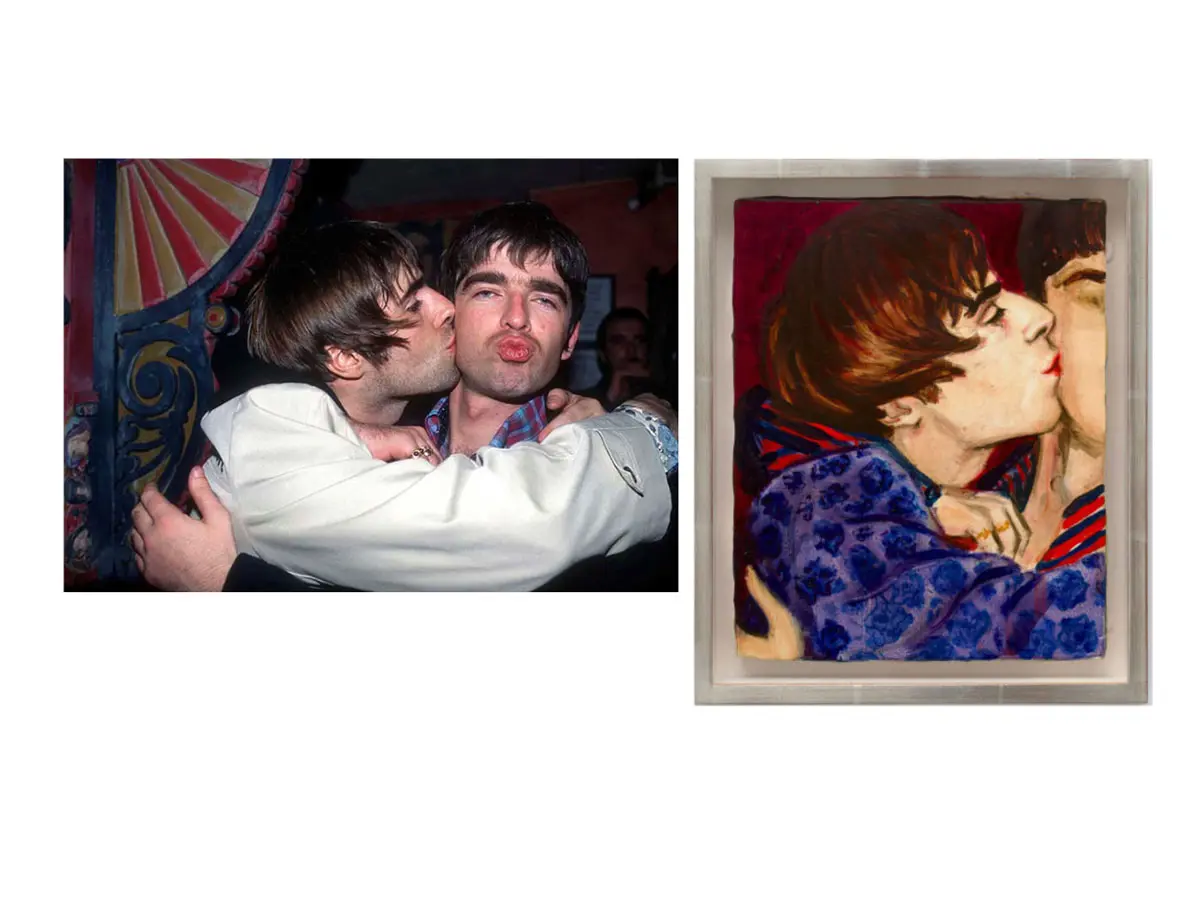
At the heart of the litigation is a 1996 painting by Peyton titled Earl’s Court (Liam + Noel), which depicts Liam and Noel Gallagher—the notoriously volatile frontmen of the legendary British Britpop band Oasis—sharing a rare, affectionate embrace. The painting recently commanded a staggering $1,920,000 at a Sotheby’s contemporary art auction in New York.
Justin Thomas, who spent decades documenting the raw underbelly of punk, rock, and Britpop culture, contends that Peyton’s multi-million-dollar work is nothing more than a "slavish copy" of his original 1995 photograph taken at an after-party in London. The lawsuit challenges the legal boundaries of appropriation art, raising critical questions about where artistic transformation ends and copyright infringement begins. Furthermore, the complaint pulls back the curtain on the delicate, and sometimes duplicitous, administrative choreography between auction houses, galleries, and creators when provenance intersects with intellectual property rights.
Read Also
With significant financial implications for all parties involved—and a troubling history of similar copyright disputes trailing the artist—this legal battle promises to become a landmark case testing the limits of fair use, derivative works, and transformative painting in the 21st-century art market.
Detailed Chronology of Events
To understand the gravity of the legal claims brought forward by Justin Thomas, it is necessary to trace the timeline of the image, from a fleeting moment backstage in 1995 to a federal courtroom nearly three decades later.
1995: The Genesis in London
In 1995, during the height of the Britpop phenomenon, rock photographer Justin Thomas attended an after-party in London’s Earls Court. Amidst the chaos and post-concert revelry, Thomas captured a fleeting, emotionally charged moment between Oasis brothers Liam and Noel Gallagher. Known globally as much for their explosive, public sibling rivalry as for their anthemic music, the brothers were caught on camera locked in an embrace. This display of genuine brotherhood and tenderness was a distinct anomaly in the media narrative surrounding the band, making the photograph an instant historical artifact of rock-and-roll lore.
1996: The Creation of the Painting
Capitalizing on the cultural ubiquity of Oasis and the striking visual composition of Thomas’s photograph, American painter Elizabeth Peyton produced Earl’s Court (Liam + Noel) in 1996. Painted in her signature dreamy, stylized, and intimate aesthetic, the artwork rendered the Gallagher brothers’ embrace on canvas, utilizing the photograph as its direct visual blueprint.
April 2024: The Sotheby’s Inquiry
Nearly thirty years later, as the painting headed to the auction block, representatives for Sotheby’s reached out to Justin Thomas—who now resides in Spain. According to court filings, a Sotheby’s representative contacted the photographer to request permission to license his 1995 image for an online catalog, describing its intended use as a "comparative illustration on a digital webpage essay." The message explicitly assured Thomas that the photograph itself was not up for sale.
Trusting the representation, Thomas initially quoted a licensing fee of $2,000. However, internal communications reveal that after a week of discussions, Sotheby’s abruptly removed the photograph from its online catalog at the request of the artist’s representative. Negotiations continued, and the auction house haggled the photographer down by $500, ultimately settling on an adjusted licensing fee of $1,500.
May 2024: The Auction and the Discovery
Buoyed by the booming market for contemporary figurative painting, Earl’s Court (Liam + Noel) went under the hammer at Sotheby’s in New York in May 2024, easily clearing its pre-sale estimate of $1,500,000 to $2,000,000 to fetch a remarkable $1,920,000.
It was only after the dust settled on the auction—and subsequent to his financial haggling with Sotheby’s—that Thomas discovered his photograph had served as the unauthorized foundational source for the million-dollar painting. In the plaintiff’s view, the eleventh-hour removal of his photograph from Sotheby’s digital catalog was not a routine administrative edit, but rather a deliberate attempt by the gallery and the auction house to obscure the painting’s true origins and sidestep intellectual property accountability.
August–September 2024: Legal Action Filed
Following the discovery, legal counsel for Thomas prepared the complaint. Filed in the Southern District of New York, the lawsuit formally targets Elizabeth Peyton for direct copyright infringement, David Zwirner Gallery for publishing, reproducing, and distributing infringing promotional works, and Sotheby’s for profiting from the auction and distribution of the illicit derivative work.
Supporting Context & Metrics: The Art Market, Photography, and Fair Use
The lawsuit filed by Justin Thomas is situated at a precarious crossroads between the protection of creators’ intellectual property and the historical traditions of appropriation art.
The Mechanics of Appropriation Art
Elizabeth Peyton is globally celebrated for her intimate, delicate portraits of cultural figures, rock stars, royalty, and historical icons, ranging from Kurt Cobain and Napoleon Bonaparte to members of the British royal family. Peyton has frequently worked from pre-existing source material, including magazine spreads, album covers, and journalistic photographs. She has often defended her methodology by stating that she does not seek to create traditional portraits, but rather personal "pictures of people."
In the legal realm, however, translating a photographic image onto a painted canvas invites heavy scrutiny. Under United States copyright law, the holder of a photograph holds exclusive rights to authorize derivative works. Thomas’s legal team argues that Peyton’s painting does not cross the threshold into transformative fair use. Instead, the complaint asserts:
"The painting is just a slavish copy of the copyrighted work. She copies the captured iconic moment, the famous feuding Gallagher brothers in a kiss. She copies the theme, the brutish rock stars caught being tender. The only transformation is the medium itself, and Peyton’s slight cropping of the copyrighted work and adding different coloring and brushwork."
Legal scholars note that this language directly targets the legal test established by recent Supreme Court jurisprudence, most notably the landmark Andy Warhol Foundation for the Visual Arts, Inc. v. Goldsmith decision. In that ruling, the Supreme Court held that when a secondary work shares the same commercial purpose and aesthetic utility as the original work (such as licensing a photograph of Prince for magazine illustration versus an artistic silk-screen based on the same photo), the case for "transformative use" weakens significantly.
A Pattern of Accusations
This is not an isolated incident for Elizabeth Peyton. The current lawsuit echoes two nearly identical legal challenges from British punk photographer Dennis Morris.
- The 2014 Dispute: Morris accused Peyton of unlawfully reproducing his photographs of members of the iconic punk rock band the Sex Pistols. That case was ultimately resolved out of court, with Peyton’s legal representatives maintaining that the work constituted fair use while denying liability.
- The 2016 Dispute: Morris again targeted Peyton over her painting John Lydon, Destroyed (1994), which was pulled directly from a scheduled Sotheby’s auction following formal legal objections.
The recurrence of these allegations suggests a systematic reliance by the artist on third-party photographic archives without prior clearance or compensation—a practice that historically ran rampant in the contemporary art world but is facing heightened legal pushback in the digital age.
The Economics of the Dispute
To understand the financial dimensions of the case, one must examine the valuation and distribution chain:
- The Source Photograph: Originally captured in 1995 as an ephemeral journalistic capture, later serving as the centerpiece for Thomas’s retrospective book, How Does It Feel? — Oasis 1995-2002, published by Hanging Around Books. Thomas now lives and works in Spain, continuing a 35-year career documenting acts like The Clash, Prince, The Rolling Stones, and Iggy Pop.
- The Secondary Market Valuation: When art advisor Todd Levin publicly shared images of the painting and the photograph on social media during the May 2024 Sotheby’s sale, he noted that he had previously accessed the painting in 1998 for a modest $12,000. Over twenty-six years, the piece appreciated in value by over 15,900%, culminating in the $1,920,000 sale price at Sotheby’s.
- The Licensing Dispute: The breakdown in trust was exacerbated by what Thomas’s legal filing frames as corporate bad faith—haggling over a nominal $500 discount on a $2,000 licensing fee while simultaneously facilitating the public sale of a $2 million work derived from the very same image.
Official Statements and Industry Reactions
As of the time of publication, neither David Zwirner Gallery nor Sotheby’s has issued a formal public statement or responded to multiple media inquiries regarding the allegations laid out in the Southern District of New York.
However, the art advisory community and legal experts have been vocal on social media and digital arts platforms. Art advisor Todd Levin’s public commentary on Instagram—highlighting the side-by-side comparison of Thomas’s photograph and Peyton’s painting—has served as a primary exhibit in discussions regarding how openly the art world has acknowledged the painting’s photographic origins for decades.
Legal commentators specializing in art law have noted that the inclusion of both the blue-chip gallery (David Zwirner) and the auction house (Sotheby’s) as co-defendants is a calculated legal strategy. By targeting not just the artist but the commercial entities responsible for the reproduction, exhibition, and monetary realization of the infringing work, the plaintiff is seeking to choke off the commercial channels that monetize unauthorized derivatives.
Future Outlook and Legal Implications
The lawsuit filed by Justin Thomas against Elizabeth Peyton, David Zwirner, and Sotheby’s has the potential to send shockwaves through the contemporary art market.
- Stricter Scrutiny on Appropriation Art: If the Southern District of New York rules in favor of Thomas, contemporary artists who rely heavily on documentary and journalistic photography as source material will face immense pressure to secure formal, upfront licensing agreements. The era of treating published photographs as a free public domain for painters may be drawing to a close.
- Liabilities for Galleries and Auction Houses: By holding David Zwirner and Sotheby’s liable for distributing, publishing, and auctioning the work, the lawsuit serves as a warning shot to the commercial infrastructure of the art world. Auction houses and galleries may soon be forced to implement rigorous provenance and copyright-clearing protocols before accepting works derived from pre-existing photographic assets.
- Potential for Settlement: Given the high profiles of the defendants and the financial stakes involved, legal analysts suggest that the parties may ultimately pursue an out-of-court settlement, mirroring the resolution of Elizabeth Peyton’s 2014 dispute with Dennis Morris. However, given the explicit nature of the current complaint and the clear refusal to quietly absorb the grievance, Thomas and his legal counsel may push for a judicial precedent that clarifies the financial rights of photographers in the fine art ecosystem.
As this legal drama unfolds in federal court, it serves as a stark reminder that the immortalization of rock royalty—from the volatile Gallagher brothers to the punk icons of the 1970s—carries legal and financial debts that can no longer be ignored behind the veil of artistic transformation.


Comments
Facebook App ID not configured. Please add it in the Customizer.