
Executive Overview
“When you listen to a song for the first time, it is like swallowing a whale.”
Scrawled in a familiar, hurried handwriting across the gallery wall, this arresting metaphor sets the conceptual framework for Björk’s latest institutional venture. The Icelandic pop icon, visionary, and perpetual avant-garde outlier has long maintained a singular, often confounding relationship with the apparatus of recorded music. Yet, as she clarifies in the same handwritten text, her artistic identity remains strictly anchored in sound: "I don’t think of myself as a visual artist… Everything I do comes from a sonic point of view. This is something I have called ‘sonic symbolism,’ sound made visual, a reverse synesthesia."
This manifesto comes to life at the National Gallery of Iceland in Reykjavík, where Björk has unveiled a focused, emotionally resonant, and collaborative exhibition serving as a centerpiece for the citywide Reykjavík Arts Festival. The exhibition arrives nearly a full decade after her notoriously polarizing, heavily criticized 2015 mid-career retrospective at New York’s Museum of Modern Art (MoMA)—a disastrous outing that exposed the pitfalls of translating pop-avant-garde iconography into a traditional museum framework.
Read Also
By contrast, the Reykjavík presentation is a masterclass in scale, intimacy, and controlled ambition. Rather than positioning herself as an overextended polymath attempting to conquer every medium simultaneously, Björk presents herself as a musical matriarch and a deeply collaborative creature. The exhibition revolves around three core pillars: an entirely new, mind-melting immersive commission titled Nerve Bloom, and two deeply personal, retrospective video-and-sound installations based on tracks from her 2022 studio album, Fossora, which grapple with the 2018 passing of her mother, environmental activist Hildur Rúna Hauksdóttir.
Running concurrently with a dedicated showcase of sculptural and masked works by her longtime collaborator James Merry, this exhibition proves that when Björk’s sonic symbolism is allowed to breathe within her native cultural landscape, it transcends the "tacky" and "infantilizing" critiques of her past and achieves genuine transcendence.
Detailed Chronology & Exhibition Breakdown
The Specter of MoMA (2015) and the Retreat to Scale
To fully understand the triumph of Björk’s exhibition at the National Gallery of Iceland, one must confront the ghost of her 2015 MoMA retrospective. That exhibition was universally panned by major art critics. In The New York Times, Roberta Smith memorably condemned elements of the show as "tacky," "disappointing," and "ludicrously infantilizing." While the critical blowback was largely directed at MoMA’s curatorial missteps rather than Björk herself, the damage to her exhibition ambitions was palpable.
The experience taught the artist a valuable lesson in curation and scale. In Reykjavík, Björk has deliberately kept expectations and spatial footprints in check. Instead of a sprawling, chronologically confused retrospective attempting to summarize a decades-long career, she has curated a localized, deeply atmospheric space that honors specific emotional weights and recent creative breakthroughs.
Nerve Bloom (2026): The Crown Jewel of Sonic Symbolism
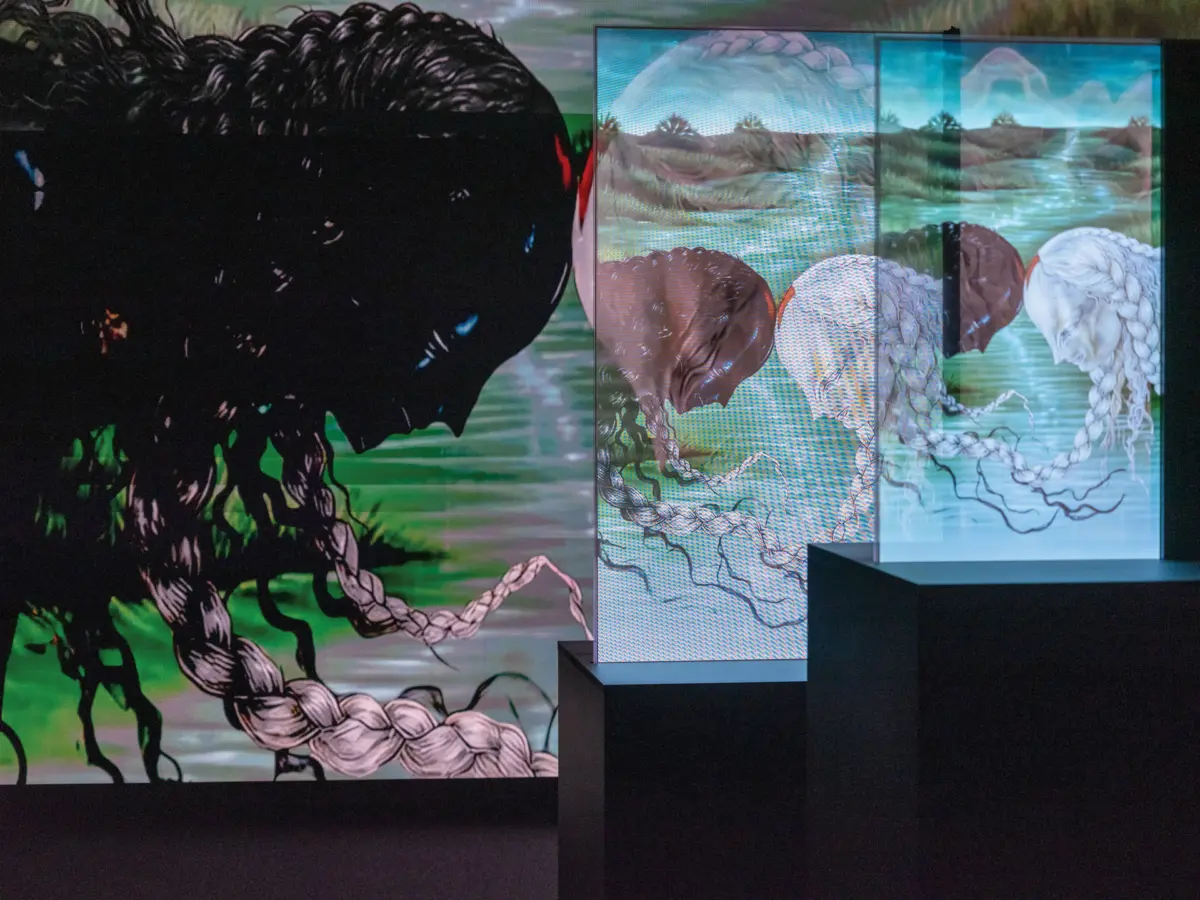
The most fully realized and mesmerizing work in the exhibition is housed in a dedicated room reserved for Nerve Bloom, a newly minted song commissioned specifically for the show. To bring the track into visual reality, Björk collaborated with painter Natalia Kleszczewska and 3D graphics designer Natalie Liu.

The visitor’s journey begins at a small, unassuming screen resting on a pedestal. Here, a digital display introduces two animated, plant-like figures that slither, wrap, and intertwine around each other. Grown from a virtual root system yet propelled by fibrous, humanoid muscles, these digital entities establish a biological, hypnotic movement vocabulary.
This hybridization intensifies as the viewer steps further into the gallery. Two floor-to-ceiling screens completely subsume the physical space, introducing the majestic, unsettling presence of horses. These creatures blur the line between realism and fantasy, their heads slowly rising and falling in an alternating dance of tense stare-downs and submissive deference.
Simultaneously, a soundscape of plangent piano chords and skittering, minimalist percussion envelops the room. Over this sonic bed, Björk’s unmistakable voice coos softly:
“I bow, I bow / This is appreciation / Of all the sensations / You are brought to me / Neurons glowing.”
The result is a mind-melting amalgam of folkloric psychedelia. It is an aesthetic firmly rooted in a naturalistic, organic past yet violently projected into an otherworldly, digital future. Painterly textures coalesce seamlessly with cutting-edge digital effects, proving that music can be nobly served by visuals, and vice versa.
Sorrowful Soil and Ancestress: Grieving in Surround-Sound
Moving deeper into the exhibition, the tone shifts from futuristic abstraction to profound, ancestral grief. Both remaining presentations are drawn from Fossora (2022) and serve as elegiac tributes to Hildur Rúna Hauksdóttir, Björk’s mother, who passed away in 2018.
“Sorrowful Soil” is arguably the emotional apex of the gallery experience. Inspired by Janet Cardiff’s canonical 2001 sound art installation The Forty Part Motet, this iteration features a radical new acoustic arrangement. The members of the supporting choir were recorded using isolated microphones, rendering each individual voice startlingly distinct.
The acoustic marvel is delivered via 30 high-fidelity speakers elevated on stands to exact ear-level within an elliptical gallery space. In her wall text, Björk notes with characteristic whimsy: "It turns out that speakers are human… or sound-puppets."
At one end of the ellipse, a massive screen loops the original music video. In it, Björk sits stoically upon a rock against the raw, apocalyptic backdrop of Fagradalsfjall as lava flows freely. Her voice cuts through the volcanic hum with unforgettable lyrics:
“In a woman’s lifetime / She gets 400 eggs / But only two or three nests” and “You did well / You did your best.”

Adjacent to this installation lies “Ancestress,” a track written a mere two weeks after her mother’s passing. The song scrambles the senses with poetic precision: "You see with your own eyes / But hear with your mother’s." Projected at an epic scale in a gallery wrapped in a rich red textile woven with the actual musical score of the song, the video documents a ritualistic funeral procession led by Björk through a rugged Icelandic valley.
Supporting Context & Metrics
The Reykjavík Arts Festival and James Merry’s Companion Showcase
The National Gallery exhibitions do not exist in a vacuum; they form the beating heart of the expansive, citywide Reykjavík Arts Festival, which stretches its cultural tendrils far into the remote regions of Iceland.
Occupying a complementary gallery space within the National Gallery is an extensive exhibition dedicated to James Merry. Merry is the British-born, Iceland-based textile artist and embroidery designer responsible for the elaborate masks, headpieces, and jewelry worn by Björk during her recent concert tours and music videos—including Sorrowful Soil and Ancestress.
While Merry’s exhibition features standalone projects—such as intricate masks inspired by pagan fertility figures and sculptures informed by rigorous archaeological research—its core focus is his symbiotic relationship with Björk. Merry was initially hired as Björk’s personal assistant in 2009, six years before he began creating the wearable art that catapulted him to international renown.
Creative Symbiosis and Curatorial Balance
In a shared exhibition catalog, the curator describes the dual presentations as “discrete yet intertwined,” highlighting the intense creative entanglement between Björk, Merry, and the broader artistic community in Iceland.
In a published conversation within the catalog, Merry reflects on their working dynamic: "My masks were never meant to completely obscure Björk, more like to blur her edges and bring other archetypal aspects into focus."
This sentiment encapsulates the redemption of Björk’s gallery career. At MoMA, the curatorial drive was to package Björk as an all-encompassing, self-contained deity—a strategy that backfired. In Reykjavík, by embracing her role as part of a collaborative ecosystem alongside Kleszczewska, Liu, and Merry, Björk steps back from the edge of artistic hubris. She allows her collaborators to blur her edges, resulting in a show that feels grounded, generous, and profoundly human.
Official Statements & Critical Reception
While the exhibition opened to glowing local acclaim and enthusiastic coverage across international art publications, critical comparisons to the 2015 MoMA disaster have been unavoidable.

Art critics have been quick to praise the modesty and acoustic precision of the National Gallery layout. Where MoMA attempted to shoehorn a living pop icon into a static, historical archive, the National Gallery of Iceland treats Björk’s work as a living organism—one that breathes with the geothermal energy of its homeland and the communal warmth of its creators.
"The hybridization intensifies farther into the gallery, where two floor-to-ceiling screens subsume the space… It is the most fully realized work in an exhibition whose ambitions are otherwise much more measured, and understandably so." — Exhibition Review Excerpt
"My masks were never meant to completely obscure Björk, more like to blur her edges and bring other archetypal aspects into focus." — James Merry, Catalog Conversation
Future Outlook
The success of Björk’s Reykjavík exhibition marks a critical turning point in how pop stars navigate the hallowed halls of fine art institutions. By abandoning the blockbuster-scale pretensions that doomed her New York outing, Björk has charted a sustainable, dignified path forward for multimedia performance art.
Looking ahead, cultural analysts and curators anticipate that the collaborative methodologies established in Nerve Bloom—specifically the integration of localized acoustic design, 3D digital creature-generation, and somatic spatial choreography—will influence future iterations of contemporary art-music hybrids. While it remains to be seen whether Nerve Bloom or the Fossora speaker installations will travel to international museums, the cautious consensus is that Björk’s art is most potent when tethered to the geographic, emotional, and cultural topography of Iceland.
In subverting the traditional museum space through "sonic symbolism," Björk has proven that she no longer needs to swallow whales to make an impact. Instead, she invites her audience to step inside the acoustic waves, listen with their mother’s ears, and watch the neurons glow.


Comments
Facebook App ID not configured. Please add it in the Customizer.