
Executive Overview
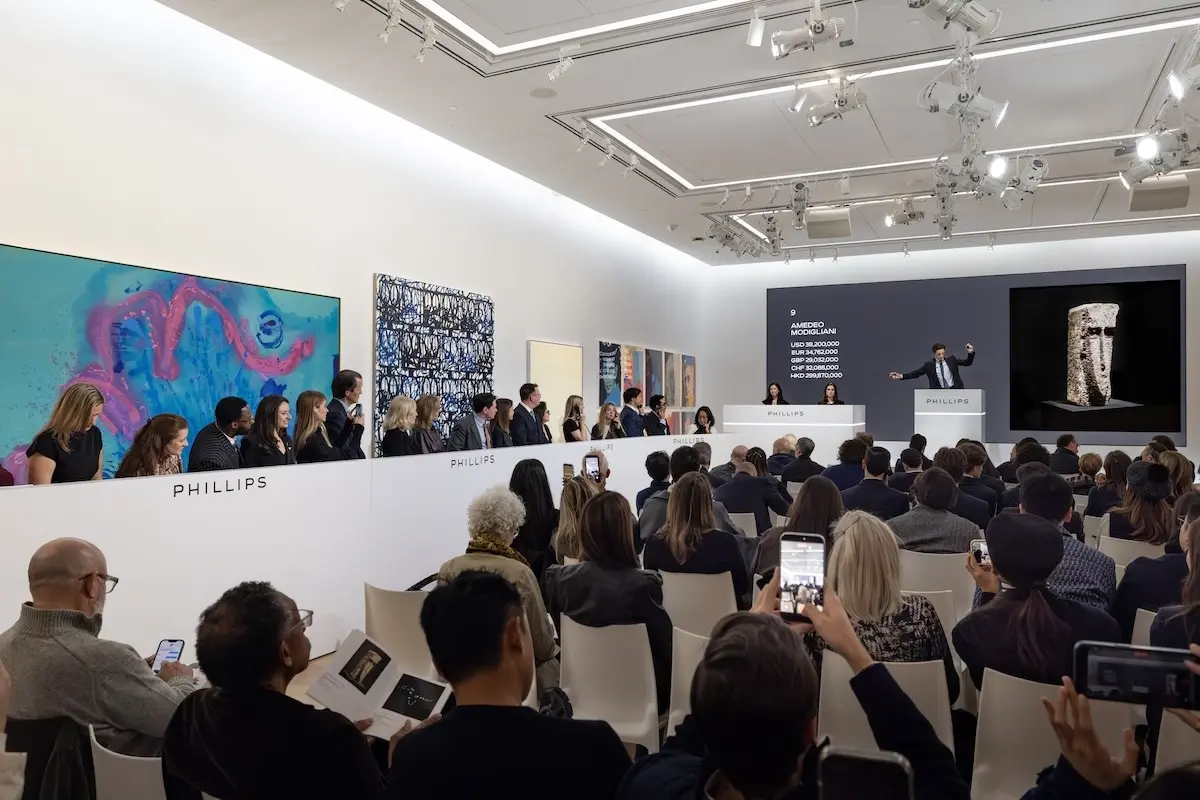
In the high-stakes theater of the global art market, perception often dances a delicate tango with reality. On a crisp Tuesday night at its Park Avenue headquarters in New York, Phillips hosted its Modern and Contemporary Evening Sale, securing a headline-grabbing total of $104.4 million including fees across just 22 lots. The auction was decisively anchored by a crowning achievement: Amedeo Modigliani’s rare 1911–12 limestone sculpture Tête, which shattered expectations to command a stellar $44.6 million.
For an auction house that has navigated a tumultuous few months—marked by cost-cutting measures, a dramatic restructuring of senior leadership in August, and broader macroeconomic uncertainties—the night offered a much-needed narrative of triumph. Touted by leadership as a 55 percent year-over-year increase compared to the equivalent 2025 sale, the auction posted an enviable 95 percent sell-through rate by lot and an exceptional 99 percent sell-through rate by value, with only a single lot withdrawn prior to the event and a mere solitary casualty going unsold.
Yet, as seasoned market watchers and industry analysts well know, headline figures rarely tell the whole story. A closer examination of the math reveals that while Phillips delivered a resilient performance, the evening’s meteoric rise was heavily dependent on its blockbuster Italian consignment. Strip away the $44.6 million generated by Tête, and the auction’s aggregate take drops to $59.8 million—spread across 20 lots, compared to the 31 lots that generated $67.3 million in 2025.
Read Also
Nevertheless, credit where credit is due: Phillips’s specialists successfully secured a museum-quality consignment that outperformed its presale estimates, setting the tone for an evening defined by a familiar contemporary motif—the relentless, uncompromising "flight to quality." Amid a broader New York marquee auction week that saw mixed results across rival powerhouses Sotheby’s and Christie’s, Phillips proved that when armed with top-tier inventory, nimble auction houses can still command the room and ignite fierce competitive bidding.
Detailed Chronology of the Evening
The atmosphere inside Phillips’s Park Avenue saleroom on Tuesday evening was charged with anticipation. Entering the autumn marquee season, the mid-tier auction house carried the weight of intense industry scrutiny. Following significant executive departures over the summer—including global head of contemporary art Jonathan Crockett and deputy chairman Miety Heiden—every move Phillips made was being interpreted as a referendum on its future trajectory under its current leadership structure.
The Modigliani Phenomenon
The auction’s trajectory was permanently altered well before the first gavel fell, thanks to the securing of Amedeo Modigliani’s Tête (1911–12). Estimated conservatively at $28 million to $35 million, the limestone sculpture of an elongated, stylized female head represents the pinnacle of Modigliani’s rare sculptural output. With fewer than 30 sculptures known to exist by the artist—most of them housed in international museum collections—the appearance of Tête on the open market was nothing short of an art-historical event.
When auctioneer Henry Highley opened bidding, the room instantly fell into a breathless hush. Telephone bidders and room participants engaged in a brisk, methodical climb. As bids scaled past the $35 million high estimate, tension mounted. Ultimately, the hammer fell at a final price of $44.6 million with fees, instantly cementing itself as the undisputed crown jewel of Phillips’s autumn campaign and single-handedly securing nearly 43 percent of the evening’s total revenue.
Blue-Chip Anchors and Strong Performers
Following the adrenaline rush of the Modigliani, the auction maintained a steady, disciplined cadence. Phillips specialists had curated a lean, highly selective catalog of just 22 lots, designed to minimize exposure to softer market segments while maximizing buyer enthusiasm.
Among the standout performances of the night was David Hockney’s monumental eight-panel group portrait, David, Celia, Stephen and Ian, London 1982. The expansive canvas, capturing a quintessential gathering of the artist’s inner circle in August 1982, landed comfortably within its presale expectations of $10 million to $15 million, ultimately fetching $12.2 million with fees. This result not only validated the enduring market appeal of Hockney’s figurative masterpieces but also set the high-water mark for the artist at auction for the calendar year.
Sculpture continued to perform admirably throughout the evening. Alexander Calder’s kinetic masterwork Snow Flurry, May 14 (1959) danced past its $4 million to $6 million estimate, realization a robust $7.5 million with fees. Similarly, abstract expressionism found a fierce champion in Helen Frankenthaler’s luminous 1980 landscape Seabreeze. Buoyed by intense competition, the canvas far surpassed its $2.5 million high estimate to sell for $4.5 million with fees.
By the time the final lot was hammered, only one work had failed to find a buyer—a striking statistical anomaly in a market that has otherwise been characterized by selective hesitation. With a 95 percent sell-through rate by lot, Phillips demonstrated a surgical precision in catalog curation that few competitors matched during the week’s broader marathon of sales.
Supporting Context & Metrics: Decoding the Numbers
To fully comprehend the significance of Phillips’s $104.4 million evening, the results must be contextualized within the broader macro-environment of the late-2025 and 2026 art market cycles, as well as an objective breakdown of the house’s financial metrics.
The Year-Over-Year Comparison
In its immediate post-sale communications, Phillips’s public relations apparatus was eager to broadcast a narrative of explosive growth. The auction house touted its $104.4 million tally as a dramatic 55 percent increase over the equivalent Modern and Contemporary Evening Sale held the previous year.
Technically speaking, the mathematics check out. The 2025 iteration of the modern and contemporary evening auction brought in $67.3 million across 33 lots, with two unsold. On paper, growing a top-line figure by over 50 percent while simultaneously shrinking the catalog size from 33 lots to 22 indicates a massive pivot toward higher-value, lower-volume consignments.

However, financial analysts and market insiders quickly pointed out the caveats inherent in such comparisons. The 2026 edition’s success was disproportionately front-loaded by a single masterpiece. If one extracts the $44.6 million generated by the Modigliani sculpture from the equation, Phillips’s adjusted take for the evening drops to $59.8 million. Spread across 20 remaining lots, this adjusted figure is actually lower than the comparable revenue baseline of the previous year.
+-------------------------------------------------------------------------+
|                  PHILLIPS EVENING SALE METRICS BREAKDOWN                |
+-------------------------------------------------------------------------+
| Metric                                        | Value                   |
+-------------------------------------------------------------------------+
| Total Gross Sales (with fees)                 | $104.4 Million          |
| Total Lots Offered                            | 22 Lots                 |
| Lots Sold                                     | 21 Lots                 |
| Lots Withdrawn / Unsold                       | 1 Withdrawn / 1 Unsold  |
| Sell-Through Rate (by lot)                    | 95%                     |
| Sell-Through Rate (by value)                  | 99%                     |
| Modigliani Tête Contribution                  | $44.6 Million (42.7%)   |
| Adjusted Total (Excluding Modigliani)         | $59.8 Million           |
+-------------------------------------------------------------------------+
Despite the mathematical asterisk, industry veterans argue that discounting the Modigliani is an exercise in missing the forest for the trees. Securing a consignment of that caliber—and convincing a major collector to entrust it to Phillips rather than competing giants Christie’s or Sotheby’s—represents a major coup for the house’s consigning team. In the upper echelons of the art market, landing the star lot is half the battle; successfully executing its sale is the validation.
The Broader Marquee Week Context
Phillips’s auction did not occur in a vacuum. It formed one crucial pillar of a hyper-compressed New York marquee auction week that also featured Sotheby’s The Now and contemporary evening sales on Monday, alongside Christie’s grand 20th-century evening sale on Tuesday.
Across all three major auction houses, a singular, dominant theme emerged: the flight to quality. While masterworks by blue-chip historical and contemporary names sparked intense, multi-bidder wars, works sitting just a tier below—the "B+" or "A-" inventory—frequently struggled to attract institutional or collector enthusiasm.
This bifurcated reality was underscored by Hockney’s market performance throughout the week. While Phillips’s presentation of David, Celia, Stephen and Ian, London 1982 triumphed at $12.2 million (securing the artist’s top auction price of the year), three other Hockney paintings appeared across rival sales earlier in the week. The highest-performing among them achieved $8.05 million at Sotheby’s contemporary evening sale on Monday, per data from ARTDAI, further demonstrating that exceptional provenance, condition, and visual impact are absolute prerequisites for liquidity in the current economic climate.
As prominent art advisor Ralph De Luca succinctly observed to ARTnews from the salesroom floor during Tuesday’s Christie’s auction: "The flight to quality is astounding."
Official Statements and Leadership Perspective
In the wake of the sale, Robert Manley, Chairman and Global Head of Modern and Contemporary Art at Phillips, issued an extensive post-sale commentary attributing the evening’s successes to a deliberate strategy focused on scarcity and curatorial discipline.
"Tonight’s results are a powerful reminder that truly exceptional works continue to inspire extraordinary competition in the market," Manley noted in an email statement circulated to media and clients.
Manley emphasized that the evening’s strongest performances were directly attributable to the house’s ability to source "fresh-to-market, museum-quality material." In an art market where collectors have grown increasingly risk-averse, offering works with pristine provenance and minimal prior market exposure has become the definitive playbook for driving high-value transactions.
The leadership’s emphasis on selective curation comes at a critical juncture for Phillips. Following a summer characterized by corporate restructuring, cost-cutting initiatives, and the departures of high-profile executives like Jonathan Crockett and Miety Heiden, the auction house needed to project stability, competence, and market relevance. By keeping lot numbers lean and focusing intensely on high-impact masterpieces like the Modigliani and the Hockney, Phillips leadership successfully minimized downside risk while projecting an image of uncompromised luxury and confidence.
Future Outlook: Navigating the New Market Paradigm
As the autumn 2026 auction season crosses its halfway mark, the performance at Phillips Park Avenue offers a clear window into where the global art market is heading as it approaches the close of the year.
Key Takeaways for the Art Market
- Low Volume, High Value is the New Normal: Auction houses are increasingly realizing that bloated catalogs are a liability. By trimming lot counts and focusing exclusively on blue-chip, highly desirable masterworks, houses can maintain high sell-through rates and protect their reputation against the optics of unsold inventory.
- The Dominance of Provenance and Scarcity: Modigliani’s Tête proved that generational, museum-grade rarities remain largely insulated from broader economic jitters. Collectors with deep capital reserves continue to view top-tier fine art as a premier hard asset class, provided the object in question is unimpeachable in quality.
- Operational Resilience at Phillips: Despite internal headwinds and executive departures over the past several months, Phillips’s specialists have proven their mettle on the global stage. The ability to lock down a $44.6 million consignment demonstrates that the house retains vital relationships with elite consignors, silencing skeptics who questioned its competitive positioning.
Looking Ahead
Looking forward to the winter sales cycles in London and Hong Kong, as well as the upcoming spring 2027 campaigns, the pressure will remain firmly on Phillips and its competitors to maintain this disciplined, high-stakes approach. As liquidity continues to concentrate around the absolute apex of the market, the margins for error are razor-thin.
Yet, if Tuesday night’s performance on Park Avenue proved anything, it is that when ambition aligns with exceptional inventory, the market is more than ready to answer the call. Phillips may have leaned heavily on a single limestone sculpture to anchor its bottom line, but in the unforgiving arena of modern art auctions, a win of that magnitude is one worth celebrating.



Comments
Facebook App ID not configured. Please add it in the Customizer.