

Executive Overview
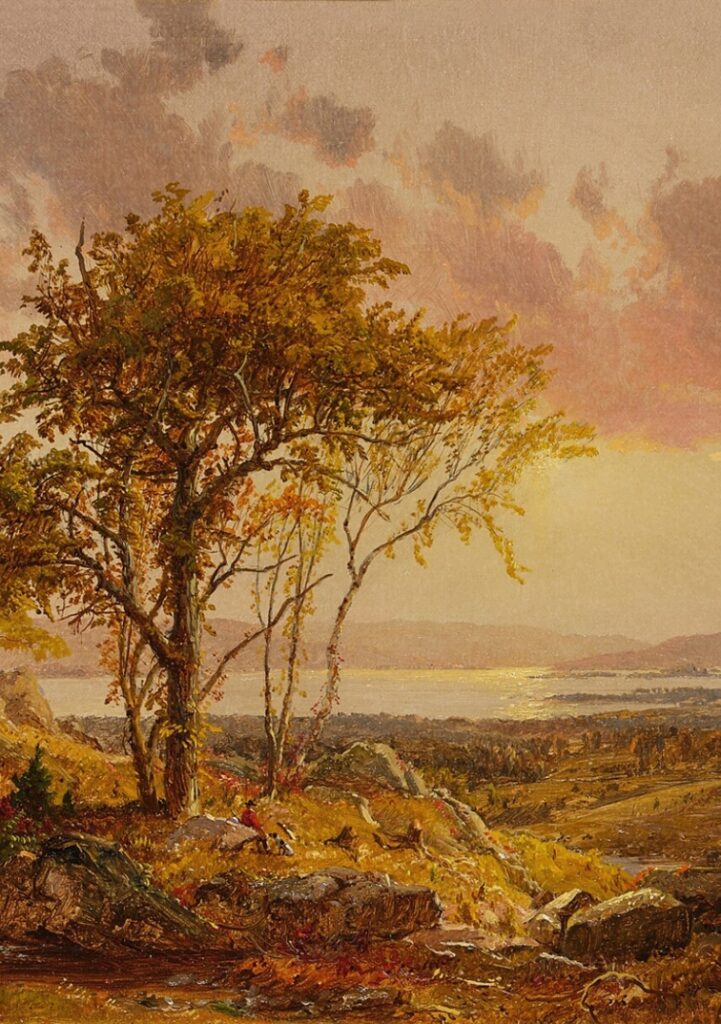
In the literary landscape of contemporary American poetry, few voices manage to balance devastating sincerity with a dry, disarming wit quite like Bob Hicok. Designated as the Missouri Review Poem of the Week for October 26, 2026, Hicok’s piece, "Observations meant to enlighten can also obscure," offers a masterclass in tonal juxtaposition. Set against the rich, melancholic backdrop of Jasper Francis Cropsey’s 1873 Hudson River School painting, A Distant View of the Hudson River in the Fall, the poem serves as a micro-cosmic reflection on modern despair, societal alienation, and the peculiar ways humans attempt to find order in an indifferent universe.
Hicok, whose latest poetry collection Breathe (Copper Canyon Press, 2026) continues to garner critical acclaim, uses this particular work to probe the boundaries of empathy. Moving seamlessly from the surreal imagery of marine biology to the heavy, bureaucratic trenches of crisis intervention and municipal leaf-raking, the poem refuses easy consolations. Instead, it invites readers into an unflinching dialogue about mental health, existential exhaustion, and the quiet resilience found in repetitive, physical labor. This analysis explores the thematic architecture, stylistic innovations, and cultural resonance of a poem that asks us to look past our constructed certainties and confront the raw, unvarnished texture of existence.
Detailed Chronology and Literary Context: The Evolution of Hicok’s Poetic Landscape
To understand the weight of "Observations meant to enlighten can also obscure," one must examine the trajectory of Bob Hicok’s extensive career. Emerging as a distinct voice in the late 20th century, Hicok has consistently championed a conversational yet intricately crafted poetic style that bridges the gap between urban realism and philosophical inquiry. His poetry often reads like a late-night conversation at a diner booth—casual in its vernacular, yet staggering in its sudden turns toward metaphysical depth.
Read Also
The poem unfolds through a series of jarring associative leaps, mirroring the fragmented nature of modern consciousness:
- The Surreal Opening (Lines 1–11): Hicok begins with declarations that defy conventional logic: "No one had to teach moonlight / how to whisper. And sharks / are natural vacuum cleaners." This establishes a surreal baseline where nature operates independently of human instruction or moralizing. The transition to the dissection of a shark in Santa Monica—revealing a wallet, a license plate, an astrolabe, and sheer "loneliness"—brings the cosmic down to the absurdly mundane. The introduction of Saint Monica as a cinematic companion provides a brief, humanizing harbor before the poem plunges into darker emotional waters.
- The Crisis Point (Lines 12–20): The tonal shift arrives abruptly: "I lasted half a day on the suicide hotline." This confessional pivot strips away the whimsical distance of the opening lines. Hicok exposes the paralysis inherent in institutional empathy—the impossibility of offering canned platitudes ("she had so much to live for") to someone drowning in compounded tragedies (cancer, Alzheimer’s, poverty, and isolation). The speaker’s radical, anti-dogmatic honesty ("I wanted to be honest and tell her / she had so much to die for") is not a celebration of death, but a critique of the toxic positivity that often isolates the suffering.
- Grounding in the Physical (Lines 21–29): Seeking refuge from the abstract demands of emotional salvation, the speaker takes a job raking city leaves. Here, Hicok invokes Heraclitus—you never rake the same leaves twice—transforming municipal labor into a meditation on impermanence. The rustle of the leaves mimics the ambient murmur of a bar, offering a communal phantom-presence to a chronically isolated mind.
- The Psychiatric Interlude and Conclusion (Lines 30–44): Returning to institutional surveillance through the memory of a psychiatrist asking about a half-full versus half-empty glass, the speaker delivers one of the poem’s most arresting lines: "the glass / is thirsty and so am I." The poem concludes by merging the opening motif of moonlight with the cosmic void, bringing the speaker full circle to a quiet, terrifying embrace of the infinite.
Supporting Context & Metrics: The Mechanics of Modern Despair
The resonance of Hicok’s poem is amplified when viewed against contemporary metrics surrounding mental health, isolation, and the modern workforce. While poetry operates primarily in the realm of aesthetic and emotional truth, Hicok’s framing of the suicide hotline worker and the municipal laborer touches upon urgent sociological realities of the mid-2020s.
The Burden of Caregiving and Institutional Burnout
The speaker’s brief tenure on the suicide hotline highlights a critical, often-overlooked metric in public health: compassion fatigue and frontline burnout. Studies in psychological journals consistently show that crisis-response workers experience severe attrition rates within their first year of service. Hicok captures the existential friction of this environment—the tension between clinical protocols designed to preserve life and the overwhelming, chaotic gravity of chronic, systemic human suffering.

Manual Labor as Cognitive Restoration
In an era dominated by digital alienation and knowledge-economy burnout, the speaker’s transition to raking leaves reflects a growing cultural interest in somatic, tactile labor as a form of psychological grounding. The physical act of gathering decaying foliage, paired with the pre-Socratic philosophy of Heraclitus (panta rhei—everything flows), serves as a low-stakes anchor for a mind unmoored by trauma.
Critical Reception of Breathe (2026)
"Observations meant to enlighten can also obscure" arrives as a companion piece to the thematic explorations found in Hicok’s latest collection, Breathe. Reviewers have noted that Breathe leans heavily into themes of breath as both a biological necessity and a fragile metaphor for existence in a warming, fractured world. The poem under discussion encapsulates this duality: the breath required to speak on a hotline, the breath held in a psychiatric ward, and the final exhalation into the cosmic night.
Official Statements and Critical Commentary
While individual poems rarely come with corporate or governmental press releases, the literary community’s reception of Hicok’s work provides a clear framework for its significance. Editors at The Missouri Review and contemporary poetry critics have lauded the piece for its unflinching refusal to offer sentimental resolutions.

"Bob Hicok has an uncanny ability to walk the tightrope between humor and heartbreak without ever losing his balance. ‘Observations meant to enlighten can also obscure’ reminds us that language often fails us precisely when we need it most, yet poetry remains the space where we can admit that failure aloud."
— Editorial Commentary, The Missouri Review, October 2026
In interviews discussing his overarching philosophy of composition, Hicok has frequently emphasized that poems should not be puzzles to be solved, but rather environments to be inhabited. The juxtaposition of high philosophy (Heraclitus, astrolabes) with gritty realism (shark stomachs, municipal leaf piles) is a deliberate strategy to dismantle intellectual pretension. By framing observations as potential obscuring veils, the title itself serves as a warning against the very act of poetic interpretation, urging readers to experience the text rather than decode it.
Future Outlook: The Legacy of Hicok’s Poetic Realism
As American literature continues to navigate the complexities of the mid-21st century—marked by technological acceleration, ecological anxiety, and institutional strain—works like Bob Hicok’s "Observations meant to enlighten can also obscure" provide an essential anchor.

The poem’s legacy will likely rest on its democratization of existential despair. By refusing to pathologize the speaker’s dark humor or his retreat into physical labor, Hicok validates the messy, non-linear ways individuals cope with trauma. There is no neat redemption arc: the speaker does not cure the suicidal woman, nor does he achieve permanent peace through leaf-raking. Instead, he arrives at a shared thirst with the universe itself—an acknowledgment that wanting, needing, and fading are fundamental conditions of being alive.
For readers turning to The Missouri Review’s Poem of the Week feature, Hicok’s work serves as both a mirror and a challenge. It asks us to examine our own carefully constructed observations and recognize the blind spots they create. In doing so, it carves out a vital space for honesty in a culture increasingly saturated by performative clarity.





Comments
Facebook App ID not configured. Please add it in the Customizer.