
Executive Overview
In a series of sweeping policy pronouncements delivered via social media while en route to an overseas golf outing, President Donald Trump has issued a high-stakes ultimatum to the Smithsonian Institution. The directives demand a fundamental realignment of how America’s foundational history is curated, presented, and celebrated at the nation’s premier museum network. Centered primarily on the legacy of George Washington, the presidential demands include the immediate installation of an 11-foot statue outside the National Museum of American History, a multi-year exhibition leading up to the nation’s tricentennial, and the radical proposal to replace a historic, mid-century modernist abstract sculpture with a towering, 30-foot monument dedicated to the nation’s first president.
The demands arrive amid an atmosphere of intense ideological contestation over how American history is taught, commemorated, and visualized in the public sphere. For over a year, the Trump administration has been locked in a quiet yet aggressive war of attrition with Smithsonian leadership over institutional ideology, culminating in recent clashes over curatorial framing, decolonization initiatives, and the presentation of early American history.
With the recent retirement announcement of Smithsonian Secretary Lonnie G. Bunch III, the institution finds itself at a historical crossroads. While the Smithsonian operates legally as an independent trust establishment rather than a direct agency of the executive branch, its complex financial reliance on federal appropriations and the composition of its governing Board of Regents—which includes Vice President JD Vance—place it squarely in the crosshairs of executive authority. As the White House increasingly flexes its muscles to reshape federal cultural infrastructure—evidenced by recent sweeping structural alterations in Washington, D.C., and the removal of contemporary art installations—the standoff over the Smithsonian represents a major escalation in the broader American culture war.
Read Also
Detailed Chronology
Friday’s Digital Directive: A Flurry of Truth Social Posts
The latest chapter in the ongoing ideological struggle over public monuments began unfolding late Friday afternoon. Writing from Air Force One while en route to his golf course in Ireland, President Trump took to Truth Social to publish a flurry of posts targeting the Smithsonian Institution.
The initial posts laid out a timeline for a major George Washington exhibition, demanding that the Smithsonian mount a comprehensive tribute to the nation’s first president to run imminently through February 22, 2032—the exact date marking the tercentennial (300th anniversary) of Washington’s birth at Wakefield, Virginia. Furthermore, Trump demanded that an 11-foot statue of Washington, which had recently been featured at the Freedom 250 IndyCar race inside the museum’s Flag Hall, be permanently installed outside the National Museum of American History by September 17, coinciding with Constitution Day.
The Escalation: Replacing Modernism with Monumentalism
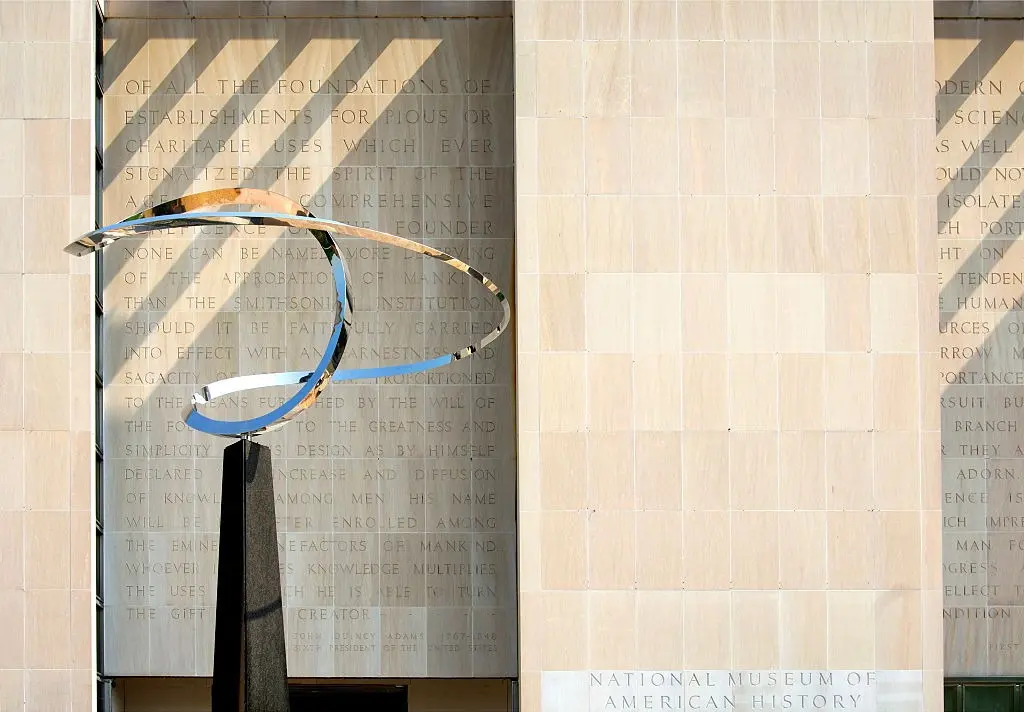
The demands quickly escalated from temporary exhibitions and traveling statues to permanent architectural interventions. Trump specifically targeted Infinity, a celebrated kinetic sculpture created by renowned New York artist José de Rivera and dedicated by the federal government in 1967. Located at the prominent south entrance of the National Museum of American History, the polished stainless steel ribbon sits atop a black granite base and has continuously rotated once every six minutes for nearly six decades.
Trump called for Infinity to be completely dismantled and replaced by a massive, 30-foot statue of George Washington.
"Replace a sculpture that says nothing about America with the man who, more than anyone else, says everything about America," Trump posted, doubling down by calling Washington "easily America’s Greatest Hero. Without him, our Country and our Freedoms wouldn’t exist."
He dismissed Infinity as a relic of out-of-touch artistic elitism, writing: "That strange modernist sculpture tells visitors nothing about America, inspires no one, and honors none of our Great American Heroes."
The Ideological Grievance: The 250th Anniversary and the "Great Unsettling"
In subsequent posts, the president broadened his critique, accusing the Smithsonian of institutional negligence regarding the upcoming 250th anniversary of American independence (the Semiquincentennial). Trump explicitly claimed that Washington’s historic crossing of the Delaware River on December 25, 1776—universally recognized as a pivotal turning point of the Revolutionary War—was entirely omitted from the museum’s core narratives. (Archival records indicate the museum does hold several historic prints, engravings, and currency items related to the event, though they may not feature centrally in the permanent galleries).
The president tied these omissions to a broader ideological critique of recent institutional developments under outgoing Secretary Lonnie G. Bunch III. Trump specifically singled out the Smithsonian’s recently established "Center for Restorative History" and its internal "Decolonization Plan," arguing that these initiatives skewed the museum’s focus toward historical grievance and oppression while erasing stories of triumph.
As a prime example of institutional drift, Trump highlighted a current exhibition text that characterizes the period from 1492 to 1776—encompassing Christopher Columbus’s arrival and subsequent European settlement—as the "Great Unsettling" of the continent.
"That tells you all you need to know about how twisted the thinking is today at the Smithsonian," Trump wrote.
Supporting Context & Metrics
The History and Significance of Infinity
To understand the gravity of Trump’s proposal, one must examine the art-historical significance of José de Rivera’s Infinity. Commissioned in 1967, it was the very first work of modern public art authorized by the United States government under the newly established Art and Architecture Program for the National Mall. De Rivera, a pioneer of American abstract kinetic sculpture whose works grace major public plazas and museum collections worldwide, designed the piece to engage viewers through dynamic spatial movement rather than literal representation.
For nearly 60 years, the sculpture has served as a modernist architectural anchor for the National Museum of American History, bridging the gap between mid-century civic design and public patronage. Its removal would represent a profound symbolic break with the federal government’s historic embrace of abstract and contemporary public art.
The Smithsonian’s Governance Structure and Financial Anatomy
Legally and structurally, the Smithsonian Institution occupies a unique space within the American ecosystem of public-private governance. Established in 1846 through an act of Congress using a bequest from British scientist James Smithson, the institution is technically a trust instrumentality of the United States, operating independently of the executive, legislative, and judicial branches.
However, its administrative and financial realities leave it deeply vulnerable to political pressure:
- Federal Appropriations: Federal funding constitutes a substantial majority of the Smithsonian’s annual operating budget, supporting staff salaries, building maintenance, and core administrative functions.
- The Board of Regents: The institution is governed by a 17-member Board of Regents comprising the Chief Justice of the United States, the Vice President of the United States, three members of the U.S. Senate, three members of the House of Representatives, and nine citizen regents appointed by joint resolution of Congress.
- Executive Leverage: With Vice President JD Vance serving on the Board of Regents, the current administration possesses a direct institutional conduit to spearhead policy shifts, budgetary scrutiny, and administrative restructuring within the museum network.
A Pattern of Executive Interventions in Cultural Spaces
Trump’s demands regarding the Smithsonian do not occur in a vacuum; they are part of a broader, highly aggressive campaign by the administration to reshape the physical and cultural landscape of the nation’s capital.
- The White House Ballroom Project: Bypassing traditional congressional approval pathways, the administration advanced plans for a massive ballroom project slated to replace the historic East Wing. Despite a divided Supreme Court issuing a ruling allowing construction to proceed—with dissenting justices denouncing the move as "likely unlawful"—the project highlights the administration’s willingness to leverage executive power over heritage preservation laws.
- The Kennedy Center Sculpture Removal: In a parallel move, a towering blue, stick-like sculpture created by artist Joel Shapiro—gifted to the Kennedy Center in 2019—was quietly dismantled and removed. While the cultural center offered no official public explanation, the artist’s family expressed deep dismay, noting that the sculptor would have been "alarmed" by the sudden erasure of his work. The piece was subsequently acquired by the center’s former chairman, David Rubenstein.
Official Statements and Institutional Reactions
Lonnie G. Bunch III’s Tenure and Departure
The timing of President Trump’s ultimatums is inextricably linked to leadership transitions at the top of the Smithsonian. The demands were issued mere days after Smithsonian Institution Secretary Lonnie G. Bunch III announced his retirement.
For over a year, Bunch—the founding director of the wildly successful Smithsonian National Museum of African American History and Culture—had been locked in quiet resistance against persistent attacks from the Trump administration. Conservative critics have continually accused the Smithsonian of propagating an "unflattering," revisionist view of American history that prioritizes systemic failures over national achievements.
Throughout his tenure, Bunch stoutly defended the institution’s curatorial independence. He repeatedly maintained that all exhibitions, research initiatives, and programmatic frameworks were grounded in rigorous historical scholarship, peer-reviewed methodology, and objective documentation.
The Vacuum of Leadership
With Bunch stepping down, the Smithsonian enters a period of intense administrative vulnerability. The search for a new secretary will unfold under the shadow of intense political pressure from the White House and the Board of Regents.
To date, official spokespersons for the Smithsonian have declined to issue a direct, point-by-point rebuttal to Trump’s Truth Social demands, instead issuing standard institutional statements emphasizing their commitment to chronicling the comprehensive tapestry of the American experience. However, internal sources within the museum network suggest that curators, conservators, and administrative staff are bracing for an unprecedented institutional crisis over heritage management, artistic freedom, and historical narration.
Future Outlook
Legal Hurdles vs. Political Realities
As the dust settles from the president’s weekend social media pronouncements, constitutional scholars and art-law experts are sharply divided over whether the administration possesses the legal mechanisms to enforce its demands.
Strictly speaking, the executive branch cannot unilaterally order the destruction of a federally owned artwork like Infinity, nor can it dictate specific exhibition labels or curatorial layouts within an independent trust establishment. Removing or altering Infinity would theoretically require approvals from the Commission of Fine Arts (CFA) and the National Capital Planning Commission (NCPC), agencies designed to protect the architectural integrity of the National Mall.
However, legal technicalities may provide cold comfort against hard political power. Through aggressive budgetary oversight, direct appointments to the Board of Regents led by Vice President Vance, and the leverage of federal funding approvals, the Trump administration has demonstrated a unique capacity to bend independent cultural institutions to its will.
The Semiquincentennial Showdown
As the United States barrels toward its 250th anniversary in 2026, the battle over the Smithsonian Institution has become the primary theater for an existential debate: Who owns the narrative of American history?
For the administration, the objective is unambiguous: to purge what it terms "woke revisionism" and restore what it views as a heroic, patriotic teleology centered on the Founding Fathers. For defenders of institutional autonomy and modern museology, yielding to presidential ultimatums threatens the foundational integrity of independent scholarship, setting a dangerous precedent where partisan politics dictate the contents of the nation’s collective attic.
Whether Infinity will fall to make way for a bronze George Washington, and whether the Smithsonian will pivot toward the administration’s curated vision of American triumphalism, remains one of the most volatile cultural questions of the decade. What is certain is that the historic trust established to "increase and diffuse knowledge among men" is facing its most severe ideological test in its nearly 180-year history.




Comments
Facebook App ID not configured. Please add it in the Customizer.