
Executive Overview
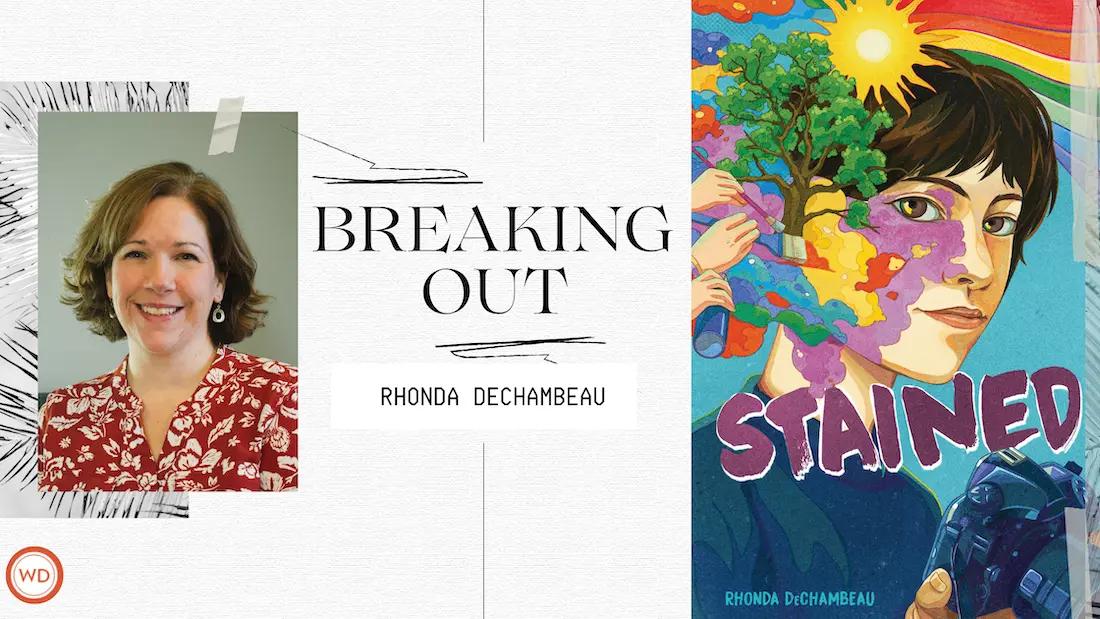
The journey from a debut author to a seasoned publishing professional is rarely a straight line, yet few navigate the turbulent waters of the middle-grade and young adult markets with the grace and self-reflection demonstrated by Rhonda DeChambeau. First introduced to readers in the July/August 2025 edition of Writer’s Digest’s "Breaking In" column during the promotional tour for her debut novel, Top Heavy, DeChambeau has swiftly returned to the literary spotlight. With her sophomore release, Stained, officially hitting shelves via Holiday House, the author is taking stock of an evolving career, a changing creative process, and the unexpected lessons learned from her second trip through the traditional publishing machine.
In this exclusive follow-up Q&A, DeChambeau pulls back the curtain on the sophomore book-writing experience. Securely backed by a two-book deal negotiated at the onset of her publishing career, she discusses the compressed timelines of writing a follow-up manuscript before her debut even debuted. Furthermore, she dives into the editorial surprises that shaped Stained, the nuances of intergenerational friendship dynamics in middle-grade fiction, and why she has completely abandoned rigid writing schedules in favor of a more fluid, joyful approach to storytelling. As she looks ahead to a daring new young adult project involving verse and multiple points of view, DeChambeau’s trajectory serves as an invaluable blueprint for emerging writers striving to build sustainable, long-term literary careers.
Detailed Chronology: From Debut Success to Sophomore Release
The timeline of a novelist’s life is frequently measured not by calendar years, but by drafts, editorial rounds, and publication dates. For DeChambeau, the momentum required to sustain a professional writing career began long before her debut novel reached readers.
Read Also
The Two-Book Deal Advantage
When DeChambeau successfully sold her debut novel, Top Heavy, she achieved a milestone envied by many aspiring writers: a two-book contract. This contractual security fundamentally altered her creative timeline. Rather than experiencing the terrifying vacuum of "debut silence"—the vulnerable period where an author waits to see how their first book performs before daring to write another—DeChambeau was immediately propelled back to the page.
"Because I was fortunate enough to land a two-book deal when I sold Top Heavy, I started writing Stained shortly after we wrapped up edits on the first book," DeChambeau explains. As a result, the foundational draft of her sophomore novel was substantially completed before Top Heavy had even officially arrived on bookshelves.
Summer Drafts and Editorial Rigor
The bulk of Stained took shape during the summer of 2024. For DeChambeau, a portion of this intensive writing period was spent at a July residency at the Highlights Foundation (now operating as Boyds Mills), an environment she describes as "glorious" for deep creative focus.
Once the manuscript left her hands, the collaborative machinery of traditional publishing took over. Throughout 2025, DeChambeau navigated multiple rigorous rounds of revisions. Guiding this process was her editor, Sally Morgridge of Holiday House, whose sharp developmental eye helped steer the manuscript from a strong draft into a polished, market-ready middle-grade novel.
Supporting Context & Metrics: The Publishing Reality Check
Writing a debut novel is often defined by a breathless, frantic urgency—a desperate race to prove oneself to agents, publishers, and the reading public. However, the experience of drafting and releasing a second book invariably shifts an author’s perspective.
Embracing the Waiting Periods
One of the most profound shifts DeChambeau highlights since her debut is her evolving relationship with the publishing timeline. The glacial pace of the industry—the inevitable, yawning gaps between submitting a draft, receiving an editorial letter, reviewing copyedits, and waiting for cover reveals—can paralyze a novice writer. DeChambeau, however, has learned to reframe these dormant phases.
"I think I am more accustomed to how long everything takes," she notes. "I am prepared now for the stretches of time between drafts, waiting for editorial letters or for copy edits. I’ve come to think of those waiting periods like breathing space, a little room for my head to clear."
Rather than viewing these intervals as frustrating delays, she now recognizes them as essential breathing room. These quiet windows provide the psychological safety valve needed to step away from a manuscript, clear the mental palette, and temporarily escape into fresh creative ideas. Ultimately, this acclimation has bred a profound sense of calm: "I guess that means I feel like I’m in less of a hurry than I was with my first book."
The Power of Multi-Project Writing
This change in perspective mirrors a broader evolution in DeChambeau’s operational philosophy. During her early days as a writer, she adhered to a strict, linear methodology: she felt obligated to stick to a single project, forcing herself to complete a start-to-finish draft before ever casting a glance toward a new idea.
However, her experience pursuing an MFA degree challenged that rigid framework, and her journey through professional publishing has fully cemented the lesson. Today, DeChambeau actively advocates for working on multiple projects simultaneously.
"Rather than feeling like working on different things somehow dilutes the work or disrupts the momentum, I’ve come to recognize it can be a good way to keep the writing fresh," she shares. "If I feel like my writing is forced or labored, I sometimes switch to something else that day. I think not being so rigid with a plan for finishing allows me to approach the writing with more freedom and more joy."
Official Statements & Insights from the Author
In our extended Q&A, DeChambeau offers granular insights into the creative mechanics of Stained, detailing the specific narrative choices that define the book and the unexpected directions her editor encouraged her to explore.
The Surprise of Middle-Grade Humor
Every manuscript contains its own hidden challenges, but DeChambeau’s biggest surprise during the preparation of Stained came directly from her editorial partnership with Sally Morgridge.
"I think the biggest surprise might have been Sally’s suggestion to add more humor," DeChambeau reveals. "I thought I’d already included some funny bits in the draft. But it turns out the story had room for even more humor."
For middle-grade fiction, injecting comedic relief is far more than a stylistic preference—it is a critical narrative engine that keeps young readers turning pages while tackling emotionally resonant themes. DeChambeau admits she had not initially made a deliberate, calculated effort to amplify the comedic beats in her early drafts. Striking that balance successfully required a delicate touch, but the resulting revisions elevated the text, making it an even more enticing prospect for the middle-grade demographic.
Crafting Intergenerational Friendships
When asked what she believes she executed most effectively within Stained, DeChambeau points unhesitatingly to the relational architecture of her characters.
The novel centers on a protagonist named Uly, who is entirely new to town and forced to navigate the harrowing social landscape of a brand-new school. While watching Uly forge connections with his peer group forms a natural backbone for the narrative, DeChambeau’s proudest achievement lies elsewhere.
"My favorite part of the story is not only seeing friendships develop between Uly and the kids at his new school, but also watching the friendships that evolve between Uly and the adults in his life," she explains.
Significantly, this multi-tiered dynamic was not mapped out on a meticulous plot outline before she began writing. "I didn’t set out to write a story in which the kid protagonist finds kinship with the adult characters in the story, but it worked out that way. And I think it’s one of the more compelling parts of the story."
Letting Go of Perfectionism
For authors navigating the early stages of their careers, second-guessing creative choices is an occupational hazard. Yet, DeChambeau is actively learning the art of creative detachment—the crucial ability to recognize when a manuscript is finished, trust the collaborative editorial process, and release the work into the world.
When asked if there is anything she would have done differently with Stained, her response is rooted in radical self-compassion and professionalism:
"Oh, gosh. I still feel so new to the world of publishing, but I guess I’m learning not to think too much about this question. I don’t think any novel is absolutely perfect, and at a certain point you just have to let it go. Trust that you did the best you could, that you had other smart and talented people helping you to make it better, and then let it go. So, without overthinking it… I’m going to say, no, I wouldn’t have done anything differently with this book."
Future Outlook: What’s Next for Rhonda DeChambeau
With Stained officially out in the world and finding its audience, DeChambeau is far from resting on her laurels. True to her newly adopted philosophy of multi-project writing, she already has several irons in the fire, with one specific manuscript commanding the lion’s share of her attention.
Venturing Into Young Adult and Verse
Moving beyond the middle-grade space that defined her first two releases, DeChambeau’s next major project is an ambitious young adult novel characterized by a complex, multi-perspective narrative structure.
"The one I’m most focused on is a young adult novel told from multiple points of view," DeChambeau shares. "One point of view is in verse, but the other three are in prose."
Blending prose and poetry within a single narrative is a high-wire literary act, requiring absolute precision of voice and thematic alignment. It is an artistic leap DeChambeau has deliberately bided her time to take. "I’ve had the idea for this story for a long, long time, but I wasn’t sure I was ready to take it on until now."
A Deeply Personal Ghost Story
Beyond its structural experimentation, DeChambeau’s upcoming YA project carries significant emotional weight. The manuscript is, at its core, a ghost story—albeit one infused with personal resonance.
"It’s a bit of a ghost story, one that’s near and dear to my heart," she says. "And I really hope it comes out the way I envision it, with all the narrative threads coming together in a surprising and satisfying way for the reader."
As she weaves together four distinct narrative voices—balancing the lyrical constraints of verse with traditional prose—DeChambeau continues to challenge herself creatively. If her transition from Top Heavy to Stained is any indication, her upcoming young adult venture promises to push the boundaries of her craft even further.
Connecting with the Author
For readers, educators, and aspiring writers eager to follow Rhonda DeChambeau’s literary journey, her latest middle-grade novel, Stained, is available now through major booksellers and independent platforms via Bookshop and Amazon, alongside her debut novel, Top Heavy (Bookshop; Amazon).
You can stay updated on her ongoing writing projects, behind-the-scenes insights, and future publication announcements by connecting with her online:
- Website: RhondaDeChambeau.com
- Instagram: @rhondadechambeau
*(Note: Writer’s Digest uses affiliate links for book recommendations. Purchases made through these links may result in a commission for the publisher.)

Comments
Facebook App ID not configured. Please add it in the Customizer.