
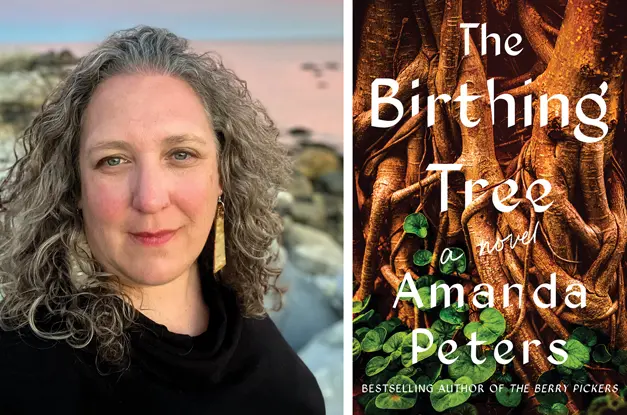
Following the runaway, international success of her 2023 debut, The Berry Pickers, author Amanda Peters returns with her highly anticipated second novel, The Birthing Tree (Catapult). Set for a September release, the novel builds upon Peters’ literary exploration of Indigenous identity, historical grief, and the enduring legacies of systemic assimilation in Canada. Centered on a half-Mi’kmaq woman named Aliet, the narrative spans from the mid-1960s to the close of the 1990s, charting a multi-decade journey through displacement, love, and reconciliation. At the heart of the story stands an ancient tree by the water’s edge—a silent witness to generations of Mi’kmaq births and a defiant symbol of cultural resilience against government suppression.
For Peters, a 49-year-old writer based in Nova Scotia’s Annapolis Valley, the path to literary acclaim has been as unexpected as it is meteoric. Once anticipating that her debut would quietly circulate among a small circle of Canadian readers, Peters instead found herself collecting prestigious accolades, including the Barnes & Noble Discover Prize and the Andrew Carnegie Medal for Excellence in Fiction. Today, The Berry Pickers has been translated into 25 languages.
Yet, this unprecedented global success has birthed a profound creative paradox for the author. Grappling with the immense pressure of a follow-up project, Peters navigated a period of intense self-doubt before stripping away the external noise to rediscover her core storytelling voice. In The Birthing Tree, Peters once again demonstrates her unique ability to weave personal family history, Indigenous oral traditions, and rigorous research into powerful fiction, cementing her status as one of the most compelling new voices in contemporary North American literature.
Read Also
Detailed Chronology: From a Grandmother’s Whisper to Literary Triumph
The Genesis: A Grandmother’s Cryptic Words
The conceptual roots of The Birthing Tree stretch back decades to an afternoon when a 19- or 20-year-old Peters was reading on a couch. Her paternal grandmother, who was suffering from dementia, directed her gaze toward a specific tree by the water at the edge of the family property.
“I wasn’t really sure what she was talking about, so I just said, ‘Yeah, sure,’” Peters recalls.
Her grandmother then delivered a line that would haunt the author for the rest of her life: “That’s where we used to give birth.” She immediately turned back to the window, offering no further context.
Because Peters’ grandmother was Mi’kmaq, the young author attempted to query other relatives regarding the cultural significance of the tree, but received only ambiguous answers. The mystery faded into the background until years later, when Peters interned for the Nova Scotia Department of Health and Wellness. Working closely with Indigenous midwives reignited her curiosity about traditional birthing practices and the cryptic memories shared by her grandmother.
Academic Pursuits and International Exploration
Before turning to fiction full-time, Peters pursued an eclectic and rigorous academic trajectory, ultimately earning four master’s degrees in political science, public administration, information management, and creative writing. Her educational journey was matched by geographic wanderlust; after finishing university in New Brunswick, she lived and taught English in the United Kingdom, Japan, and South Korea.
Despite her global travels, the Annapolis Valley remained her spiritual anchor. She returned permanently to Nova Scotia in 2011, embarking on a career in First Nations administration. It was during this period that she began drafting fiction rooted in the landscape of her youth. However, her entry into the literary world was unconventional. She completed a novel-writing certificate at the University of Toronto, during which her father suggested she write about his family’s summers spent picking berries in Maine.
Skeptical at first, Peters visited Portland with her father, sparking the conceptual framework for The Berry Pickers. By the time she earned her creative writing master’s degree from the University of New Mexico, she had secured an agent—Marilyn Biderman of Transatlantic Agency—and a finalized manuscript.
The Breakthrough of The Berry Pickers
The Berry Pickers debuted in 2023 to extraordinary acclaim. The novel, which explores the devastating fallout of a kidnapped Mi’kmaq girl and her brother’s lifelong grief, resonated globally. Peters had modestly expected her parents to offer a polite nod of approval before the book quietly vanished into obscurity. Instead, the novel captured the Barnes & Noble Discover Prize prior to its official U.S. release, followed months later by the Andrew Carnegie Medal for Excellence in Fiction.
As The Berry Pickers achieved international prominence, Peters faced the daunting task of drafting her second novel under the microscopic lens of a global audience. The psychological toll of maintaining this newfound momentum was, in her words, “horrifying.”
“I spent a lot of time in my head, wondering if people would like this or that part of the new book,” Peters explains. “It stymied the story, and eventually, I had to just say, If The Berry Pickers didn’t exist, how would you write this novel? I’m still terrified that people are going to absolutely hate it. But I’m hoping they don’t.”
Supporting Context & Metrics
Cultural Themes and the Weight of Identity
Across her growing bibliography—which includes The Berry Pickers, the short story collection Waiting for the Long Night Moon, and now The Birthing Tree—Peters continually returns to central themes of identity, assimilation, and historical trauma.
Literary critics and editors note that her work consistently engages with the profound erasures wrought by colonialism. As Peters notes:
“In Indigenous communities, there are a lot of gaps: gaps in our history, gaps in our stories. Colonization has not done well for us. Maybe, in my work, I’m unconsciously reflecting those gaps.”
Rather than merely highlighting these losses, however, Peters’ novels actively engage in the process of cultural reclamation. In The Birthing Tree, this reclamation manifests physically through the titular tree. Though historical research failed to provide Peters with the exact historical designation of the real-world tree her grandmother referenced, the author granted the fictional tree a literal voice. Most chapters in the novel open with brief observations from the tree’s perspective, framing it as an ancient caretaker that stores the stories of its people within its annular rings.
Biographical Parallels
While Peters insists that “the setting is me, but the characters are not me,” distinct biographical echoes ripple through her fiction. Like Aliet, the protagonist of The Birthing Tree, Peters grew up in the Annapolis Valley and spent years away from home before returning as an adult. In the novel, a teenage Aliet flees her grandmother’s home for Halifax following a devastating loss, spending two and a half decades away before returning in her 40s to reconnect with her roots.
Peters’ upbringing was shaped by a vast, interconnected family network. Born to teenage parents who remained amicable after separating and remarrying, Peters spent her weekdays with her mother and weekends with her father. Between both sides of her family, she accumulated 18 aunts and uncles, growing up surrounded by a multitude of cousins.
Her relationship with literature, conversely, began with hurdles. Peters struggled significantly with reading until the sixth grade, when her peers’ fascination with Kristy’s Big Day from The Baby-Sitters Club series motivated her to master literacy to participate in social conversations. From there, she quickly moved through Nancy Drew, the thriller novels of Sidney Sheldon and John Saul, and finally found her definitive literary calling through John Steinbeck’s Of Mice and Men.
Metrics of Success
- Literary Output: Two novels (The Berry Pickers, The Birthing Tree); one short story collection (Waiting for the Long Night Moon).
- Academic Credentials: Four master’s degrees (Political Science, Public Administration, Information Management, Creative Writing).
- Global Reach: The Berry Pickers translated into 25 languages worldwide.
- Major Accolades: Barnes & Noble Discover Prize; Andrew Carnegie Medal for Excellence in Fiction.
Official Statements & Authorial Insights
Discussing her creative process via Zoom from her Nova Scotia home—where she resides alongside a dog named Holly and a cat named Pooks—Peters maintains a self-effacing humor regarding her status as an internationally celebrated author.
“My favorite title is auntie, and then maybe dog mom,” Peters jokes. “Author comes last.”
Reflecting on how she manages an intensive writing career without the traditional domestic interruptions faced by many parents, Peters acknowledges her unique position:
“Everyone’s like, How did you do all that? And I tell them, I don’t have kids. I see my sister driving kids to soccer and horseback riding and part-time jobs, and I don’t know that I could do this if I had to do that.”
On the mechanics of inspiration, Peters rejects overly clinical explanations for artistic creation, expressing a fascination with theoretical physics and astronomy. While joking that she only comprehends roughly 10 percent of the scientific literature she consumes, she subscribes to the philosophical notion that creative ideas are distributed via a universal consciousness—functioning much like raindrops descending upon individuals for reasons beyond human comprehension.
Future Outlook
With the September publication of The Birthing Tree by Catapult, the literary world will be watching closely to see if Peters can replicate the lightning-in-a-bottle success of her debut. Early indicators suggest that her sophomore effort offers the same emotional depth, lyrical prose, and sharp historical awareness that won over critics worldwide.
As Aliet’s journey in the novel closes with her building a protective fence around the ancient birthing tree—defying the bureaucratic indifference of the townspeople and affirming her connection to an ancestral past—Peters similarly stakes her claim within the literary landscape. Despite her lingering anxieties regarding public reception, Amanda Peters has firmly established herself as a vital chronicler of Indigenous resilience, capable of transforming generational whispers into enduring literature.





Comments
Facebook App ID not configured. Please add it in the Customizer.