
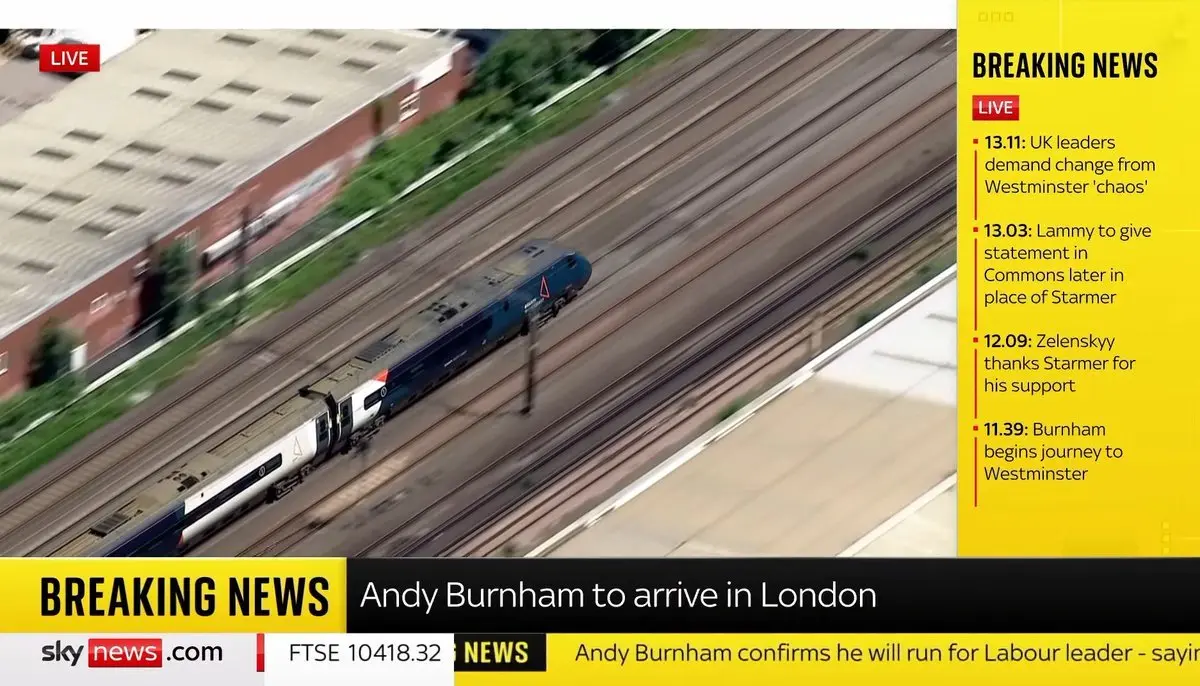
The convergence of high-stakes international football and seismic domestic political shifts often serves as a revealing diagnostic of the British national psyche. In a single, balmy mid-summer week, the United Kingdom found itself suspended between two competing versions of its own future: a high-tension World Cup semifinal clash against Argentina and the abrupt, chaotic transition of executive power from Prime Minister Keir Starmer to incoming Labour leader Andy Burnham.
This chronicle examines how the public mood—alternating between defensive cynicism and a newly imported rhetoric of "hope"—manifests across both the terraces of North London pubs and the halls of Westminster. Through the lens of a pivotal 90 minutes of football and the perennial churn of post-Thatcherite governance, this report unpacks Britain’s chronic institutional weariness, the slippery definitions of optimism versus active hope, and the inescapable domestic pathology that binds national sporting glory to political despair.
Detailed Chronology: The Semifinal and the Seven-Day Cycle
Wednesday Evening: The Pub and the Pitch
The atmosphere inside The Winchester on Archway Road was suffocatingly dense well before kickoff. Outside, a sudden, perfect dip in temperature had granted London a rare, balmy summer evening, contrasting sharply with the bleak political and meteorological vibes that had defined the preceding decade. Inside, the pub was standing-room-only.
Read Also
The author’s heavily pregnant partner had initially declined the invitation, finding the prospect of sitting marooned with a non-alcoholic Guinness while patrons tossed out monotonous inquiries—"How are you feeling?"—to be deeply dispiriting. Yet, as the World Cup semifinal against Argentina loomed, the gravitational pull of the fixture proved irresistible, even amidst predictions of national humiliation.
As patrons crammed around flickering screens, celebrity sightings—Mick Jagger, David and Victoria Beckham, and various pop icons—served as surreal validations of collective self-delusion. Why else would the cultural machinery assemble if not for an inevitable English triumph?
On the pitch, however, the first half proved to be an exercise in attrition. The opening forty-five minutes yielded nineteen fouls, a nervy, physical stalemate characterized by mutual hesitation. John Stones managed a header wide in the 33rd minute, while Argentina’s Lionel Messi and Enzo Fernández probed an unyielding English backline. The half closed at 0–0, sending patrons back to the bar in restless, bored chatter.
The Second-Half Surge and Collapse
The second half injected immediate life into the fixture. Following an intricate sequence involving Harry Kane, Declan Rice, and Morgan Rogers, Anthony Gordon met a low cross at the forty-five-degree angle, driving the ball past the Argentine keeper and sending The Winchester into a rapturous eruption of flying pint glasses and concussive table-pounding.
The elation was short-lived. Following a brilliant defensive tackle by Djed Spence, England retreated into a defensive shell, conceding possession to a relentless Argentine side. In the 85th minute, Enzo Fernández converted a Messi corner into the far side of the net. Deep into stoppage time, Lautaro Martínez headed home the winner, sealing a devastating exit.
The immediate aftermath was characterized by the familiar, sickening atemporality unique to English football supporters: a 24-to-48-hour infection of the mundane world with a heavy sense of pointlessness, exacerbated by opposition fans parading LAS MALVINAS SON ARGENTINAS banners.
Saturday Night: The Absurdist Epilogue
By Saturday, the psychological landscape had shifted entirely for the third-place playoff against France. Stripped of the highwire tension of the semifinal, the fixture devolved into pure, unadulterated absurdity.
Filling up with late-arriving patrons, the pub bore witness to a chaotic ten-goal thriller. After racing to a 4–0 lead by halftime through a strike by Declan Rice, England endured a chaotic French resurgence. Kylian Mbappé traded smiles with opponents, Bukayo Saka completed a hat-trick via a penalty, and Jude Bellingham sealed a 6–4 victory with a virtuosic stoppage-time solo run. It was a match that defied solemnity, offering a release valve for a nation unaccustomed to uncomplicated joy.
Supporting Context & Metrics: The Political Machinery of Hope
While the nation was transfixed by the World Cup, the machinery of British governance was undergoing its seventh leadership transition in a decade.
The Fall of Starmer and the Rise of Burnham
Just days prior, the Labour Party concluded nominations for its new leader following the resignation of Sir Keir Starmer. Plagued by subterranean approval ratings, continuous in-fighting, and accusations of soul-less administrative managerialism, Starmer’s tenure collapsed under the weight of political friction and poor communication.
Out of 403 Labour MPs, former Manchester Mayor Andy Burnham secured 379 nominations, triggering his ascension to the premiership—the seventh prime minister in ten years. Burnham’s political packaging relied heavily on his northern identity, positioning him safely outside the traditional Westminster bubble despite his decades-long parliamentary tenure.
The Quantifiable Rhetoric of "Hope"
A striking element of Burnham’s early public addresses was the heavy, almost desperate invocation of a single word previously alien to British political discourse: hope.
Following a strategic by-election victory in Makerfield—orchestrated by outgoing MP Josh Simons to clear a path to parliament—Burnham declared that his constituents had "voted for hope." Ten days later, at his formal leadership launch at the Manchester People’s History Museum, the word appeared repeatedly across his address:
- "possibility and hope flowing around the country"
- "I hope people can begin to feel the excitement"
- "that ability to hope"
- "a sense of hope"
- "people need hope"
- "imagine good growth in every postcode and hope in every heart" (repeated twice).
Optimism vs. Hope: A Philosophical Distinction
Cultural critics and philosophers—drawing on thinkers like Terry Eagleton—draw a sharp dividing line between optimism and hope. Optimism is described as a "bovine" primordial stance toward the world, an assumption that things will work out without deep reflection, easily curdling into self-delusion and the disappointment-industrial complex (exemplified by Shepard Fairey’s iconic Obama "HOPE" posters, which preceded years of executive militarism and administrative compromises).
Hope, conversely, is an active, reasoned commitment to the open possibilities of the future—described as "the enemy of idle utopianism as well as of despair." In football, predictions are falsifiable; in politics, promises are abstract. The British electorate’s embrace of Burnham’s rhetoric reflects an acute starvation for this virtue, earned through fifty years of post-imperial decline, deindustrialization, and the punishing austerity measures introduced following the 2008 financial crash.
Official Statements & Public Discourse
The collision between national sport and executive politics generated intense public commentary regarding Britain’s post-war identity.
"This endless pathology of fucking decline. This bottomless narcissistic obsession. England didn’t win the World Cup, and it’s not the king of the world. So what? That’s fine! England’s tortured relationship with its football team, with football ‘coming home’—it’s just boring unresolved trauma about Britain’s diminished postwar status. This country needs therapy."
— Anonymized Partner’s Diagnostic on the "British Disease"
This sentiment cuts to the heart of the national malaise. For decades, electoral cycles have functioned as a repeated choice between "stick and twist"—a desperate ballot-box rejection of whichever political incumbent currently personifies national stagnation. Whether voting for Brexit in 2016 or cycling through Conservative and Labour administrations, the underlying engine remains a pervasive numbness and detachment from worldly efficacy.
In his inaugural address to the Trades Union Congress, Prime Minister Andy Burnham directly addressed the structural foundations of this exhaustion:
"Four decades of the neoliberalism that began in the 1980s have not been kind to the places that built our Party. Political power was centralised and economic power was privatised… We are united and we put the power that comes from that unity at the service of people and places who have been waiting too long for politics to let them hope again."
— Prime Minister Andy Burnham, Leadership Address
Yet, beneath the rhetorical flourish lies the enduring skepticism of an electorate conditioned to treat political promises as ephemeral. As Burnham himself rhetorically asked during his campaign launch: "What hope can we have that it will be different this time?"
Future Outlook: The Horizon of 2030
As the dust settles on both the World Cup tournament and the coronation of Britain’s seventh premier in ten years, the structural realities of the United Kingdom remain unaltered.
The Starmer administration, despite its unceremonious exit, did leave behind tangible legislative markers: the renationalization of the railways, the removal of hereditary peers, and significant updates to worker and renter protections through the Employment Rights and Renters’ Rights Acts. Yet, these structural victories were overshadowed by a fundamental failure of public resonance and vibral management.
For Burnham’s administration, the challenge lies in translating the weaponized rhetoric of hope into durable material improvements across every postcode, moving beyond mere procedural competence to challenge fifty years of diminishing returns.
On a domestic and familial scale, these grand political and athletic narratives converge on micro-level realities. As the author notes regarding the impending arrival of a new generation:
"By the next World Cup in 2030, our kid, whoever they are, and with the permission of circumstance, will be four. Old enough to be both fascinated and disappointed by England—and maybe just old enough to begin to will for it something better."
Ultimately, whether through the cyclic heartbreak of the international football calendar or the perpetual churn of Westminster leadership, the British public continues its resolute, stubborn march forward—equipped not with the blind certainty of optimism, but with the fragile, persistent labor of active hope.



Comments
Facebook App ID not configured. Please add it in the Customizer.