Television thrives on convention, but few franchises bend—and occasionally break—structural norms quite like Paramount+’s flagship sci-fi property, Star Trek: Strange New Worlds. As the fourth season winds through its narrative paces, Episode 8 has arrived to spark fierce debate across digital fandoms, alienating casual viewers while rewarding the patient with profound emotional payoff.
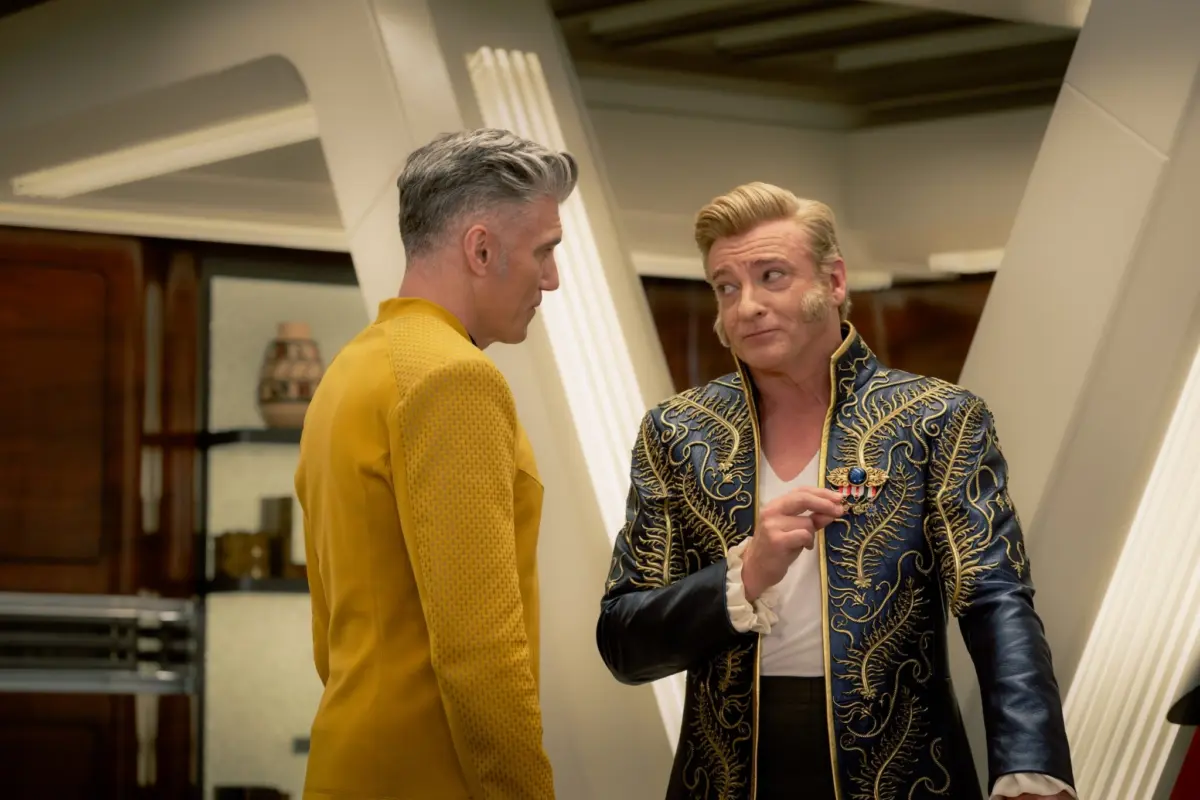
At first glance, the episode appears to be yet another high-concept "gimmick" entry in a season already heavily laden with formal experiments. Featuring the return of Rhys Darby as the omnipotent, reality-bending trickster figure analogous to The Original Series’ Trelane (and deeply intertwined with the cosmic legacy of the Q Continuum), the episode traps the USS Enterprise inside a literal soap opera. Complete with absurd amnesia plots, melodramatic medical crises, sudden evil twins, and bizarre family revelations, the narrative initially plays as disposable, campy farce.
However, beneath the heavy layers of meta-irony and soapy overacting lies a masterclass in psychological character deconstruction. Led by an astonishing, heartbreaking performance from Anson Mount as Captain Christopher Pike, the episode transitions from a throwaway parody into a harrowing exploration of unresolved grief. For viewers willing to look past the initial silliness, Episode 8 stands as a vital, character-defining chapter that deepens the emotional mythology of the series.
Detailed Chronology: From Soap Opera Satire to Cathartic Grief
Act I: The Arrival of the Absurd
The episode opens without preamble, plunging the USS Enterprise into a paradigm shift that defies scientific logic. Rhys Darby’s enigmatic entity—never explicitly named as a member of the Q Continuum, though heavily implied through thematic callbacks and costume design nods—has chosen humanity as the subject of an academic presentation. To study them, he transforms the ship’s daily operations into a melodramatic, serialized soap opera.
Instantly, the ship’s crew undergoes radical, uncharacteristic transformations:
Dr. M’Benga (Babs Olusanmokun) is struck down by "Space Madness," resulting in wildly chaotic medical procedures alongside Nurse Chapel (Jess Bush).
Spock faces an absurd, life-threatening crisis requiring a dramatic heart transplant.
The ship’s structural reality warps, forcing characters into recycled tropes of hidden lineage and sudden betrayals—highlighted by Ethan Peck’s scenery-chewing, delightfully unhinged turn as an alternative, roguish version of Sybok.
Amidst this cascading madness, Captain Christopher Pike emerges as a curious anomaly. Suffering from an unexplained head injury, Pike retains his baseline sanity. While the rest of the crew marches lockstep through the writer’s room tropes of a daytime drama, Pike recognizes the artificiality of his environment. He spends the early acts attempting to negotiate with Darby, only to find himself walled off by the simulation’s self-sustaining momentum. When he tries to escape his quarters to avoid a melodramatic confrontation with Lieutenant Uhura (Celia Rose Gooding)—who has suddenly been written as his secret biological daughter—the narrative violently forces him back inside.
Act II: The Clues Within the Chaos
As the episode progresses, the humor begins to fray around the edges, replaced by subtle narrative dissonance. Uhura presents Pike with a family recipe book containing instructions for coq au vin, a dish tied to a biological father she never knew. To Pike, who is acutely aware of the absurdity of the simulation, the book appears entirely blank.
The turning point arrives when Pike surrenders to the emotional logic of the simulation. Agreeing to cook the coq au vin with Uhura in his quarters, she hands him the book once more. This time, the pages yield text, but the revelation shatters the constructed reality: the recipe is earmarked not for Uhura’s birthday, but for Juliet’s.
Darby’s entity, watching from the sidelines, registers immediate confusion. Juliet is not part of his scripted soap opera.
Act III: Confronting the Ghost of Juliet
Pike immediately seeks out the ship’s counselor, Dr. Jeffers (portrayed by television icon Deirdre Hall). While some traditionalists online have raised pedantic objections regarding the presence of a shipboard counselor on a mid-23rd-century Constitution-class starship, narrative logic—and basic organizational realism for a vessel housing 430 souls on multi-year deep-space assignments—firmly justifies the inclusion.
Dr. Jeffers acts as the narrative anchor that steers the episode toward its true purpose. "Juliet" is the daughter Pike and Captain Marie Batel shared in the simulated utopian life granted to Pike in the third-season episode "New Life and New Civilizations," before Batel ascended to a higher plane of existence.
While Pike found closure regarding Batel’s departure in the Season 3 finale, he had never processed the grief of losing Juliet—a child who, biologically speaking, never existed outside of a constructed reality. Yet, within the architecture of human memory and emotion, the loss was absolute.
Returning to his quarters, Pike finds not Uhura, but Juliet (reprised by Anna Mirodin). Stripped of the melodramatic satire, the scene plays out with agonizing naturalism. Mirodin portrays the phantom daughter with a grounded, everyday warmth that makes Pike’s internal suffering palpable.
Supporting Context & Metrics: Analyzing the "Gimmick" Fatigue
While the emotional climax of Episode 8 has earned widespread critical acclaim, it arrives against a backdrop of growing fan weariness regarding structural experimentation.
Season-to-Date Narrative Metrics
Total Episodes in Current Run: 10
Proportion of "Gimmick" Episodes: 60% (Including musical episodes, noir pastiches, body-swap scenarios, and reality-bending simulations).
Fan Satisfaction Index: Split sharply between viewers craving serialized canon development and those embracing the anthological, high-concept flexibility modeled after The Original Series.
The collective exhaustion among viewers is understandable. Coming directly on the heels of "Off-Hour"—a tightly constructed, deeply intimate, and refreshingly gimmick-free masterpiece—Episode 8’s initial twenty minutes risk alienating audiences fatigued by high-concept premises.
However, looking at the macro-structure of Strange New Worlds, these formal detours serve a vital purpose. They lower the audience’s guard, utilizing broad comedy and stylistic pastiche as a Trojan horse for heavy psychological excavation.
Official Statements and Creator Intent
Speaking on the creative philosophy behind the season’s structural risks, showrunner Akiva Goldsman has consistently emphasized the necessity of tonal breadth.
"Star Trek has always possessed a unique elasticity," Goldsman noted in a recent production roundtable. "You can tell a hard science-fiction survival story one week, and an existential comedy or a theatrical tragedy the next. The trick—and the challenge—is ensuring that every narrative detour ultimately serves the internal emotional life of our core characters. If the ship turns into a soap opera, it has to matter to the person standing in the middle of it."
Anson Mount, whose portrayal of Captain Pike anchors the entire franchise enterprise, reflected on the heavy emotional demands of the character’s trajectory:
"Pike lives under the shadow of a known, immutable fate," Mount explained in an interview discussing the character’s processing of loss. "He carries tomorrow’s grief into today’s mission. When you introduce simulated lives, alternate futures, and phantom families—as we did with Batel and Juliet—you are testing the boundaries of what a human psyche can endure. Playing those scenes isn’t about science fiction; it’s about the very real, very messy ways we process things that were taken from us before they even began."
Future Outlook: The Legacy of Christopher Pike
As Strange New Worlds marches toward the back half of its current broadcast block, Episode 8 sets a high-water mark for character-driven storytelling. By using a seemingly throwaway romp with an omnipotent trickster as a vehicle for profound grief work, the creative team has reinforced why Christopher Pike remains one of the most compelling captains in franchise history.
The episode proves that the show does not need to sideline its lead to explore its ensemble, nor does it need to avoid levity to achieve dramatic weight. Instead, it successfully marries the two, demonstrating that even within the silliest corners of the galaxy, the human heart remains unbroken, scarred, and infinitely worth exploring.
For the audience, the takeaway is clear: in the universe of Strange New Worlds, patience is more than a virtue—it is the prerequisite for transcendence.







Comments
Facebook App ID not configured. Please add it in the Customizer.