
Executive Overview
For decades, the foundational anatomy of a compelling character arc has relied on a singular, magnetic concept: The Lie the Character Believes. Popularized in instructional writing guides—most notably K.M. Weiland’s seminal resource Creating Character Arcs—this paradigm has long taught authors that a protagonist must harbor a specific, flawed premise. This "Lie" serves as a psychological barrier, preventing the individual from embracing a broader, thematic "Truth" until external plot events force a reckoning.
In a positive change arc, the character overcomes this fallacy to achieve expansive personal growth. In a negative change arc, their refusal to confront it causes their worldview to warp further.

However, a radical evolution is underway in narrative theory. A deeper examination of transformational fiction suggests that the "Lie" is rarely a fabrication in the traditional sense. Instead, it often begins as an absolute, functional truth that worked brilliantly for the protagonist until it outlived its utility.
Read Also
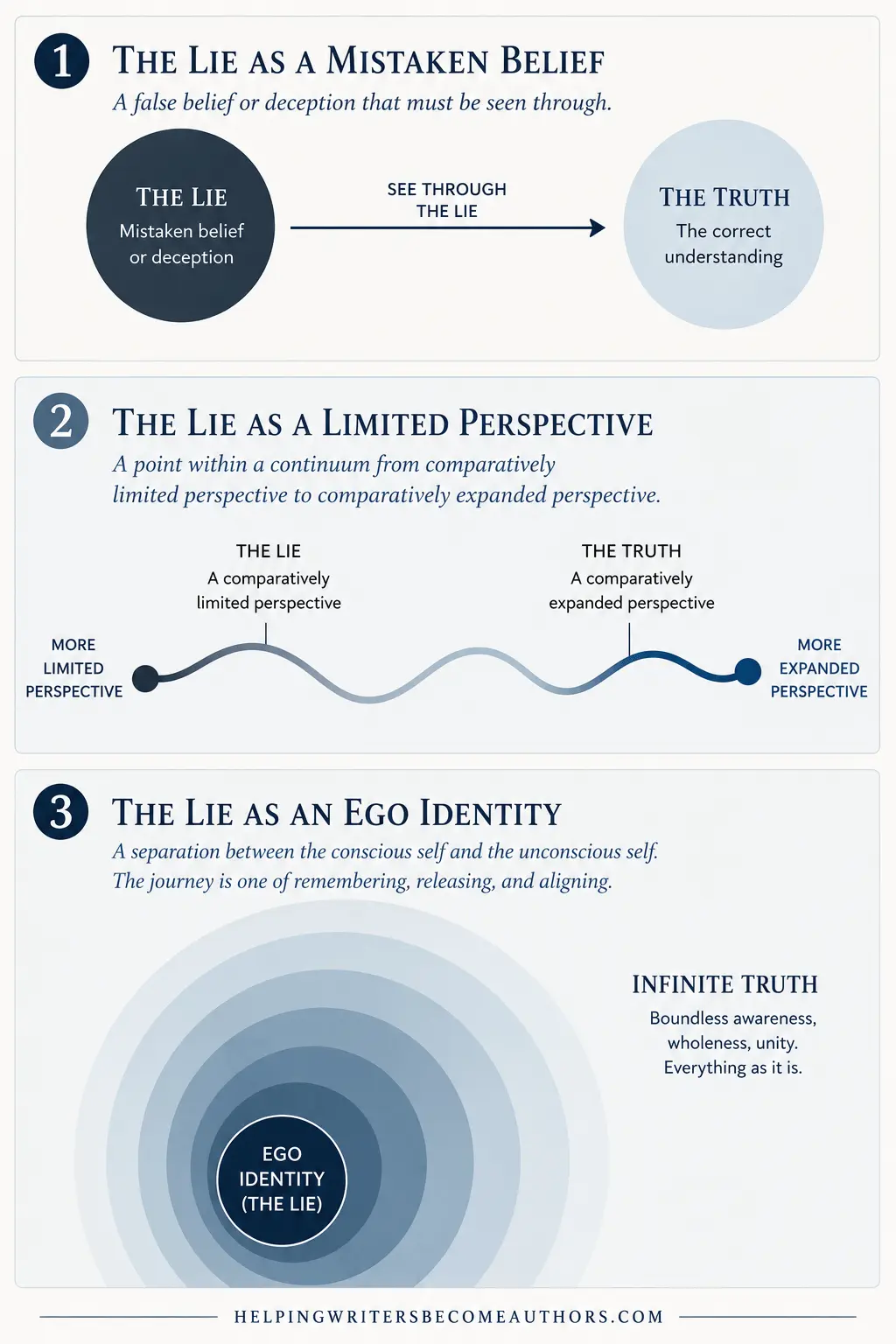
By analyzing narrative arcs through three progressive models—ranging from a simple mistaken belief to an expansive continuum of perspective, and ultimately to an ego-driven separation of consciousness—writers can unlock a more profound tier of psychological realism. Character development, under this refined lens, is no longer merely about "transformation" or correcting a falsehood; it is an act of alignment, a stripping away of the ego to unite the conscious mind with the deeper, unconscious self.

Detailed Chronology: The Evolution of Character Arc Theory
To understand where narrative psychology stands today, it is essential to trace how storytelling pedagogy has matured over time.
Phase 1: The Mechanical Paradigm (The Mistaken Belief)
In the early days of structural screenwriting and novel-writing guides, the Lie was treated as a black-and-white error. A protagonist held an explicitly incorrect assumption about themselves or the world—such as "I am unlovable" or "Power is everything." The narrative functioned as a laboratory designed to systematically disprove this hypothesis, forcing the character to swap out a bad belief for a good one by the climax.

Phase 2: The Relational Continuum (Perspective over Falsehood)
As writers wrestled with the nuance of long-form series and complex characters (such as Feyre in Sarah J. Maas’s A Court of Thorns and Roses series), the binary definition began to fracture. It became clear that survival skills that kept a protagonist alive in Book 1 could transform into limiting psychological anchors by Book 2.
The Lie was recontextualized not as an inherent evil, but as a comparatively limited perspective existing on a sliding scale with a comparatively expanded Truth. Yesterday’s hard-won wisdom naturally evolves into tomorrow’s restrictive boundary as the horizon of life expands.

Phase 3: The Metacognitive Shift (Ego Identity and Separation)
The current frontier of narrative philosophy—drawing heavily from Jungian psychology, sociological consensus theory, and somatic research—views the Lie as a structural fissure in human consciousness. Here, the Lie is recognized as an ego identity. It is a protective coping mechanism forged in backstory (the "Ghost") that eventually isolates the conscious self from the totality of the psyche. Character arcs are no longer viewed as artificial makeovers, but as organic processes of individuation.
Supporting Context & Metrics: The Three Models of the Lie
To effectively apply this advanced psychological framework to fiction, authors must master the three distinct tiers through which a limiting belief can be understood.

[Level 1: Mistaken Belief]  --->  [Level 2: Limited Perspective]  --->  [Level 3: Ego Identity & Separation]
(Direct deception to be disproven)   (A point on a continuum of growth)    (Coping mechanism & ego defense)
1. The Lie as a Mistaken Belief
At its most basic, this model serves high-stakes plots, thrillers, and tightly paced genre fiction. The character has swallowed a specific deception—often fed to them by an antagonist or a corrupt society (as seen in The Matrix or The Truman Show)—and must uncover objective reality to survive.
2. The Lie as a Limited Perspective
Moving up the scale, both the Lie and the Truth lose their rigid moral binaries. They become coordinates on a continuous map of human awareness. In Pride and Prejudice, Elizabeth Bennet’s initial prejudice is not a cartoonish evil; it is a viewpoint shaped by her environment that she must gradually expand to see Darcy’s true character. The narrative does not label her early worldview as "evil," simply "too small."

3. The Lie as an Ego Identity and Separation
At its deepest psychological tier, the Lie is an emotional armor. Drawing on Carl Jung’s definitions of the ego versus the Self, this model posits that characters (and human beings) conflate their true nature with temporary roles, trauma responses, and social uniforms (such as profession, status, or victimhood).
When society itself acts as a collective ego—reinforcing cultural constructs and status quos—the protagonist’s internal Lie mirrors external social reality. Breaking free from this dynamic requires stepping away from the "tyrant-ogre Holdfast" (as Joseph Campbell described the keeper of the status quo) and initiating the painful, liberating process of individuation.

Official Insights: Bridging Psychology and Storytelling
Prominent literary and psychological frameworks validate this shift from artificial transformation to alignment.
- The Biology of Coping Mechanisms: Referencing Loretta Graziano Breuning’s research in Habits of a Happy Brain, early neurological wiring driven by dopamine, serotonin, and cortisol builds our personalities. A limiting belief or a backstory "Ghost" is fundamentally a neurological coping mechanism. Just as a coping mechanism is never questioned until it creates more pain than safety, a character’s Lie remains unquestioned until reality demands a broader adaptive response.
- The Illusion of Suffering: In The Gene Keys, Richard Rudd notes that psychological suffering is largely an illusion maintained by the frantic ego when faced with the unknown. Transformation occurs not by fighting the darkness, but through the "willingness to feel the pain, and the miracle begins."
- The Role of the Unconscious: Jungian scholar Marie-Louise von Franz emphasized in Man and His Symbols that the ego was never meant to govern the psyche in isolation. Its true purpose is to illuminate the unconscious totality. True character growth is achieved when the ego surrenders its rigid wishful aims, allowing conscious awareness to merge with the deeper unconscious self.
Future Outlook: The Rise of Soul-Driven Narrative Design
As the publishing landscape matures, readers increasingly crave narratives that transcend predictable, mechanics-first plotting. They demand stories that resonate on a mythic, archetypal frequency.

This conceptual pivot—moving away from character arcs as forced transformations and toward arcs as acts of alignment and the stripping away of falsehoods—offers writers an unprecedented competitive edge. By treating the Lie not as a simple math error to be corrected, but as a deeply human ego defense or societal construct, authors can craft characters whose inner conflicts mirror the profound, universal journey of human individuation.
Whether writing epic fantasy, intimate contemporary drama, or speculative fiction, integrating these three tiered models of the Lie allows creators to build layered subtext, resonant thematic arguments, and transformative emotional payoffs that linger long after the final page is turned.




Comments
Facebook App ID not configured. Please add it in the Customizer.