
Executive Overview
In the rapidly evolving landscape of digital reading, hardware capability often dictates the boundary of user experience. While e-readers have long mastered the delivery of monochrome text and, more recently, color illustrations, the integration of multi-media ecosystems has historically been fragmented. Major industry players have frequently siloed their features—permitting e-books while ignoring audiobooks, or supporting library integration with severe format restrictions.
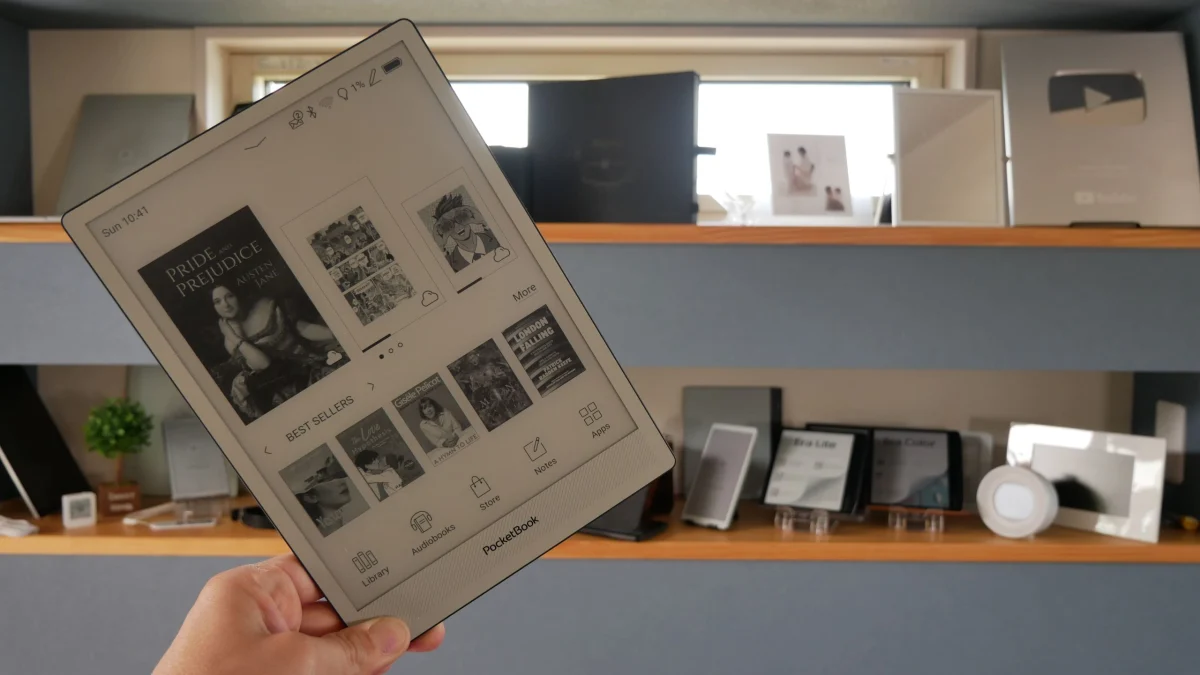
PocketBook, a prominent innovator in the e-reader market, has fundamentally disrupted this paradigm. With the rollout of its comprehensive firmware update, version 6.11.1437, PocketBook has solidified its position as an industry frontrunner. This new software release introduces full native support for digital magazines via the Libby app, bridges advanced artificial intelligence directly into the device’s Notepad application, refines automatic Bluetooth audio handling, and addresses critical quality-of-life bugs.
By unifying e-books, audiobooks, and now digital periodicals into a single hardware ecosystem—accessible directly via a library card and PIN without the need for a tethered computer—PocketBook is redefining what a modern e-reader can achieve. This executive overview explores the profound implications of firmware update 6.11.1437, detailing how these new capabilities position PocketBook uniquely against fierce market competition from tech giants like Amazon Kindle and Kobo.
Read Also
Detailed Chronology of the 6.11.1437 Firmware Update
The journey toward this monumental update has been incremental, built upon a foundation of robust native integrations. Previously, PocketBook devices gained widespread acclaim for implementing native Libby support, allowing users of both legacy and contemporary devices to seamlessly browse public libraries, borrow e-books and audiobooks, and consume them natively. However, the periodical market—specifically digital magazines boasting rich layouts, high-resolution photography, and dynamic typography—remained an elusive frontier for most dedicated E Ink devices.
Firmware update 6.11.1437 changes this dynamic completely. According to PocketBook’s official software release notes, the update introduces comprehensive magazine compatibility through Libby-supported libraries.
The New Libby Magazine Integration
The mechanics of the new magazine feature are designed with user experience at the forefront. The official changelog highlights the following workflow:
- Discovery and Search: Users can effortlessly discover magazines directly within their library catalog and execute targeted searches for specific titles or genres.
- Streamlined Borrowing: Individual issues can be checked out instantaneously with a single tap.
- Dedicated Management: A specialized, dedicated magazine page displays high-resolution covers, comprehensive issue details, and real-time availability status at a glance. Furthermore, users can meticulously track previously checked-out issues without cluttering their standard e-book shelves.
Hardware Compatibility Spectrum
PocketBook has ensured that this transformative update is not restricted to a solitary flagship model. The 6.11.1437 update is rolling out across a wide array of popular devices spanning their current and recent product lineups. Supported hardware includes:
- PocketBook Era and Era Color
- PocketBook Verse Pro and Verse Pro Color
- PocketBook InkPad 4 and legacy variants such as the InkPad One
Advanced AI and Productivity Enhancements in the Notepad Application
Beyond library integration, PocketBook has substantially upgraded the productivity toolset within its Notepad application, transforming its devices from passive consumption tools into active creation hubs.
- Send-to-Email Functionality: Users can now transmit notes directly from their e-reader to one or multiple recipient email addresses. Notes can be bundled as file attachments or embedded directly within the email body, with robust export options for standard PDF and TXT formats.
- AI Selection: By leveraging embedded artificial intelligence, the software allows users to simply draw a circle around handwritten text. This action instantly triggers sophisticated handwriting recognition (OCR), converting analog scribbles into searchable, editable digital text.
- Magic Shapes: Translating rough hand-drawn concepts into professional diagrams is now automated. The Magic Shapes function instantly recognizes poorly drawn circles, rectangles, arrows, and geometric figures, cleanly snapping them into pristine, mathematically precise shapes.
Audio Optimization and Bluetooth Automation
Audiobook enthusiasts and listeners of spoken-word content will find significant quality-of-life improvements in this update:
- Automatic Bluetooth Reconnection: The e-reader now intelligently detects previously paired audio peripherals (such as wireless headphones or external speakers). It automatically establishes a connection upon availability, playback initiation, or when Bluetooth is toggled on, eliminating manual pairing steps.
- Smart Pause and Resume: If a Bluetooth connection drops mid-playback, the device automatically pauses audio. Upon successful re-establishment of the connection, playback resumes automatically, governed by a controlled number of retry attempts to preserve battery life.
- Hardware Volume Synchronisation: Bug fixes directly address previous anomalies, ensuring that adjustments made via physical or headphone volume controls correctly scale music and audiobook output without unexpected audio spikes.
Supporting Context & Metrics: The E-Reader Ecosystem Landscape
To fully appreciate the significance of PocketBook’s latest update, it is crucial to analyze how competing ecosystems handle public library borrowing and digital media consumption. The e-reader market is largely dominated by three distinct paradigms:
| Brand / Ecosystem | E-Books | Audiobooks | Digital Magazines | Ecosystem Friction |
|---|---|---|---|---|
| Amazon Kindle | Yes (via Send to Kindle / OverDrive) | Yes (Audible ecosystem) | Limited (Kindle Unlimited) | Requires US-centric web workflows; closed ecosystem. |
| Kobo E-Readers | Yes (Native OverDrive integration) | Yes (Hardware player exists) | No | Native e-book integration, but complete lockout of library audiobooks on device. |
| PocketBook | Yes (Native Libby integration) | Yes (Native Libby integration) | Yes (New via 6.11.1437) | Zero friction; direct on-device browsing, borrowing, and listening. |
The Amazon Kindle Model
In the United States, Kindle users seeking public library books must navigate a multi-step external workflow. Readers typically visit their local branch’s digital website, check out a title via OverDrive/Libby, and select the "Send to Kindle" option to deliver the e-book via Amazon’s servers. While functional, this system is heavily constrained by regional availability, requires an active Amazon account, and completely segregates library audiobooks, which must be consumed through the separate Audible or Amazon Music apps on a smartphone or tablet rather than the e-reader itself.
The Kobo Model
Kobo e-readers feature deeply integrated OverDrive support, allowing users to log in with their local library card directly on the device. While this offers a streamlined e-book browsing experience, Kobo’s architecture contains a glaring limitation: despite housing built-in audiobook players and Bluetooth connectivity for listening, Kobo e-readers do not support borrowing audiobooks from public libraries. Users are restricted strictly to purchasing audiobooks through the Kobo store, leaving library patrons unable to check out spoken-word titles natively.

The PocketBook Advantage
PocketBook has systematically dismantled these artificial barriers. By supporting native Libby integration across e-books, audiobooks, and now digital magazines, PocketBook stands alone as the definitive universal library reader.
The user journey on a PocketBook device is remarkably streamlined:
- Navigate to the library section on the device.
- Link your local library card and input your four-digit PIN directly into the e-reader interface.
- Browse, search, check out, and download e-books, audiobooks, and magazines directly to the hardware.
No personal computer, no USB tethering, and no cumbersome web-browser workarounds are required. This level of autonomy represents the gold standard of digital library integration.
Official Statements and Industry Insights
The release of firmware update 6.11.1437 has generated considerable commentary across the publishing technology sector, underscoring PocketBook’s commitment to user-centric engineering. Industry experts and corporate communications emphasize that hardware longevity and software adaptability are paramount in maintaining consumer loyalty.
Michael Kozlowski, Editor-in-Chief at Good e-Reader and a leading authority on electronic reading technology with over fifteen years of industry observation, notes the profound shift represented by this release:
"Some e-readers let you borrow e-books from the public library… Now that many PocketBook e-reader software platforms are mature enough, they are the only brand that supports e-books, audiobooks, and now digital magazines. Borrowing on a PocketBook is easy: simply attach your library card and four-digit PIN, and you can browse your local branch’s entire digital collection, borrow, and do everything on the e-reader without a computer or USB connection."
PocketBook’s engineering teams have similarly emphasized that the integration of AI-driven tools like Magic Shapes and AI Selection in the Notepad application reflects a broader corporate strategy: bridging the gap between passive reading and active, professional document interaction. By turning E Ink displays into responsive canvases capable of instant handwriting recognition and geometric cleanup, PocketBook is aggressively courting academic, professional, and student demographics who previously relied exclusively on LCD-based tablets for note-taking.
Future Outlook: What Firmware 6.11.1437 Means for the Industry
The rollout of update 6.11.1437 establishes a formidable benchmark that competing manufacturers will struggle to ignore. As consumers increasingly demand hardware versatility—expecting a single device to handle literature, periodicals, audio, and handwritten notes without compromise—traditional single-purpose e-readers are facing obsolescence.
Implications for Competitors
The inclusion of digital magazines via Libby on E Ink screens exposes a glaring feature gap for competitors like Kobo and Amazon. Magazines have historically been difficult to render on electronic paper due to complex page layouts, multi-column text, and heavy reliance on color photography. However, with the proliferation of advanced color E Ink technologies (such as Kaleido 3 found in PocketBook’s Era Color and Verse Pro Color models), reading magazines on E Ink is no longer a compromised experience. As library patrons increasingly migrate toward digital periodical subscriptions to save costs and reduce paper waste, the lack of native magazine borrowing on rival platforms will likely influence consumer purchasing decisions.
The Trajectory of On-Device AI
Furthermore, the integration of on-device artificial intelligence—specifically handwriting-to-text conversion and geometric shape smoothing—signals the future direction of E Ink productivity. As processors become more efficient and machine-learning algorithms are optimized for low-power ARM architectures, users can anticipate even deeper AI integrations. Future iterations may see context-aware summarization of borrowed non-fiction books, intelligent voice-to-text transcription for audio notes, and predictive translation tools operating entirely offline.
Conclusion
PocketBook’s software update 6.11.1437 is much more than a routine collection of bug fixes and minor tweaks; it is a comprehensive manifesto for what a modern digital reading ecosystem should be. By uniting public library e-books, audiobooks, and magazines under a single roof, supported by state-of-the-art AI note-taking and frictionless Bluetooth automation, PocketBook has set a towering standard. For avid readers, researchers, and library patrons alike, the message is clear: the future of portable, versatile, and independent reading has arrived.



Comments
Facebook App ID not configured. Please add it in the Customizer.