If a picture is truly worth a thousand words, the newly minted Lucas Museum of Narrative Art in Los Angeles has decided it is not worth writing a single one.
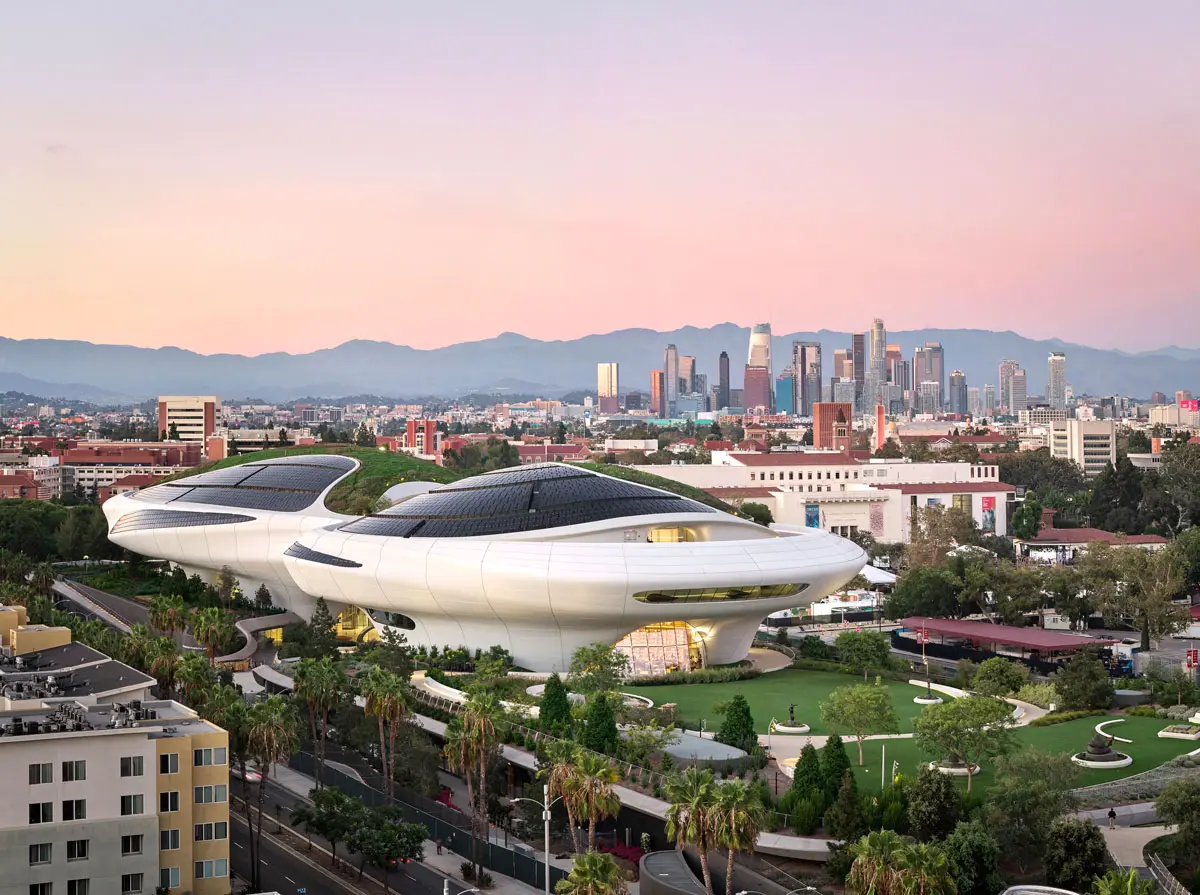
Nearly two decades in the making and staggering past a $1 billion price tag, the long-awaited temple to visual storytelling is finally ready to make its public debut on September 22, following exclusive preview windows. Yet, beneath the gleaming architecture of its futuristic, cloud-inspired campus in South Los Angeles lies a profound institutional contradiction. Founded by cinematic visionary George Lucas and his wife, enterprise executive Mellody Hobson, the museum intends to champion illustrators, comic artists, and figurative painters who have long been marginalized by the rigid hierarchies of the mainstream art world.
Yet, as visitors ascend to the primary galleries on the fourth floor, they are met with a startling omission: the near-total absence of didactics, contextual wall texts, and interpretive labels. By prioritizing pure, unmediated looking while stripping away the educational scaffolding that contextualizes complex historical and cultural works, the Lucas Museum has inadvertently abdicated its role as a producer of knowledge. Rather than acting as a rigorous public institution, the billion-dollar vanity project often reads as a private billionaire’s curated cabinet of curiosities—a cinematic mood board writ large that occasionally falters in its solemn duty to history, community, and scholarship.
Detailed Chronology: A Two-Decade Odyssey
The path to the Los Angeles opening has been fraught with geographic detours, bureaucratic friction, and immense capital expenditure, turning the museum into one of the most anticipated and scrutinized cultural infrastructure projects of the twenty-first century.
The Early Concept (Mid-2000s to 2014): George Lucas, leveraging decades of amassed personal wealth generated from his pioneering cinematic empire, began seriously formalizing plans to establish a permanent public home for his vast collections of illustration, fine art, comic art, and cinematic memorabilia.
The Chicago Rebuff (2014–2016): Initially, the museum targeted Chicago as its destination, selecting a lakefront site near McCormick Place. However, the proposal met fierce resistance from local open-space advocacy groups, sparking lengthy legal battles that ultimately drove the founders to abandon the Midwest entirely.
The San Francisco Detour (2016–2017): Brief consideration was given to San Francisco’s Treasure Island, but structural and logistical hurdles prompted a swift pivot to Southern California.
Breaking Ground in Los Angeles (2018–2024): Settling in Exposition Park within South Los Angeles—a historically Black neighborhood—construction commenced on a colossal, fluid architectural marvel designed to anchor 160 acres of newly integrated green space. The building process, spanning over eight years, was repeatedly pushed back by global supply chain disruptions and complex engineering demands.
Internal Turmoil (May 2025): Just over a year before its grand opening, the institution quietly executed layoffs, cutting 15 full-time and seven part-time employees. The reductions disproportionately targeted the Learning & Engagement and Museum Services teams, sowing early seeds of doubt regarding the institution’s commitment to public programming despite official assertions that education remained a "central pillar."
The Premiere (September 2026): Founding member previews launch ahead of the September 22 public opening, welcoming ticket holders to a sprawling campus that includes a free research library, extensive parklands, and the much-debated collection galleries.
Supporting Context & Metrics: Architecture, Collections, and Curatorial Gaps
To understand the Lucas Museum is to grapple with its immense physical footprint and its jarring curatorial oversights. Spanning thousands of square feet, the institution houses roughly 1,300 objects on view, yet the distribution and framing of these works reveal acute blind spots.
The Problem of the Missing Context
The most glaring critique of the museum’s design is its ideological crusade against wall texts. Visitors encounter artworks labeled strictly with the artist’s name, title (translated into Spanish), date, and medium. Curatorial heavy-hitters and masterpieces are left entirely unmoored from their historical zeitgeist.
For instance, Norman Rockwell’s 1963–64 masterwork The Problem We All Live With—a powerful depiction of six-year-old Ruby Bridges being escorted by U.S. Marshals into a desegregated New Orleans elementary school—hangs without a single explanatory label. Without context, young visitors, particularly Black children in South Los Angeles encountering the prominent display of racial slurs scrawled on the gallery wall within the painting, are left entirely unguided. The museum steps away from difficult conversations precisely where civic engagement is most urgent.
Demographic Imbalances and Medium Bias
A rigorous audit of the collection on view exposes heavy reliance on mid-century white male artists, tempered by late additions meant to diversify the roster.
Gender Disparity: Women artists are severely underrepresented. While Jessie Willcox Smith receives a dedicated single-artist room, sports-themed sections feature only a single representation of a female athlete among 20 artworks.
Racial and Cultural Representation: Black artists enjoy prominent placement—highlighted by works from Charles White, Kadir Nelson, and Jacob Lawrence—and Latinx creators are represented via figures like Carmen Lomas Garza and Judith F. Baca. However, Asian artistic experiences are largely quarantined to a "Manga" subsection, and Native American narratives are flattened into traditional "cowboys and Indians" tropes within the American West gallery. Notably, queer narratives and non-Christian religious perspectives are virtually nonexistent.
Medium Biases: Despite its cinematic pedigree, the museum displays zero video work in its main galleries. Sculpture is sparsely represented—apart from Yinka Shonibare’s Boy on Globe—and is awkwardly interspersed with gaudy commissioned bronzes and film costumes from franchises like Batman and Indiana Jones. Photography is restricted to a single gallery where Gordon Parks’s searing images of the segregated South sit uncomfortably close to celebrity pin-ups of James Dean and publicity shots of the Beatles.
Official Statements & Institutional Defense
Museum leadership has consistently defended the design choices and structural philosophy of the Lucas institution, framing the lack of traditional didactics not as an oversight, but as an intentional design choice.
During press previews, cofounder Mellody Hobson articulated her husband’s foundational ethos:
"George wanted to celebrate the illustrators who have often been underappreciated for their contributions, those who have narrated our lives in pictures, often using a single frame to tell a story."
When pressed directly on the complete absence of explanatory wall texts throughout the fourth-floor galleries, Chief Executive Tracey Bates deflected accountability to the checkout counter, directing inquiries to a two-volume, 200-dollar publication produced by Taschen.
"Few of us can travel the world to see all these objects in person," Bates noted regarding the ground-floor digital and sculptural reproductions of global masterworks like the Sistine Chapel and the Aztec Sun Stone, "but here in the ground floor gallery, they’ve been brought together for a journey everyone can take to the fundamental myths of narrative art."
This reliance on reproductions rather than authentic, contextualized artifacts underscores a fundamental identity crisis: Is the Lucas a museum dedicated to authentic scholarship, or is it an immersive, high-end entertainment experience designed to turn a profit at $25 a ticket?
Future Outlook: Can the Billion-Dollar Vision Mature?
As the Lucas Museum of Narrative Art flings open its doors to the public, it stands at a critical historical crossroads. Financially and logistically, the institution is guaranteed to pull massive box office numbers; its futuristic architecture, integrated green spaces, and free research library provide genuine, tangible civic value to an underserved pocket of Los Angeles.
Yet, as an art museum, its current trajectory invites sharp censure. The institution has conflated the democratization of looking with the abandonment of education. By stripping away historical frameworks, sidestepping uncomfortable societal truths, and reducing curatorial curation to a billionaire’s personal mood board, the Lucas Museum has failed to earn its lofty title.
History shows that collector-founded institutions—from the Metropolitan Museum of Art to Crystal Bridges—can eventually mature into world-class beacons of rigorous scholarship. For the Lucas Museum to fulfill its ambitious promises, it must eventually hand over the curatorial keys to professional historians and educators willing to write the words that give those powerful pictures their true voice. Until that day arrives, the Museum of Narrative Art remains a breathtaking, billion-dollar spectacle that fundamentally forgets how to tell its own story.




Comments
Facebook App ID not configured. Please add it in the Customizer.