In the hyper-competitive landscape of contemporary publishing, authors face a formidable mandate: capture a literary agent, publisher, or reader within a minuscule sixty-second window. Successfully pitching a novel demands an intricate synthesis of mystery, market potential, plot mechanics, thematic depth, and tonal consistency. Yet, when writers sit down to distill an 80,000-word manuscript into a punchy query letter or back-cover summary, they frequently hit a brick wall. The technical plot points that anchor the narrative mechanics are rarely compatible with the emotional, magnetic elements that draw an audience in—at least, not within the confines of a brief pitch.
The root of this creative friction lies in a foundational misunderstanding: a story’s hook and a story’s heart are not the same thing.
While the hook serves as the initial lure designed to spark curiosity and compel a reader to pick up the book, the heart represents the deeper thematic essence that validates that engagement, ensuring the story matters long after the final page is turned. Recognizing this dichotomy does more than streamline the querying process; it fundamentally transforms macro-level structural choices across every single page of a manuscript. By defining both elements early in the development cycle, authors can construct resilient narratives capable of weathering the rigorous demands of the modern literary marketplace.
Detailed Chronology: The Evolution of the Pitch and the Anatomy of Story Architecture
The traditional publishing pipeline has long placed immense pressure on the initial point of contact—the query letter, the synopsis, and the elevator pitch. Historically, writers relied on exhaustive plot synopses that detailed every twist, turn, and character arc. However, as the literary market expanded exponentially over the past few decades, the volume of submissions overwhelmed literary agencies and publishing houses. The operational standard shifted radically from comprehensive plot summarization to high-concept market positioning.
Phase 1: The Recognition of the Disconnect
In the early days of creative writing instruction, pedagogy often treated a story as a singular, monolithic entity. Writers were taught to summarize their plots linearly. However, as industry gatekeepers demanded higher efficiency in pitches, authors realized that linear plot summaries often sounded identical. Two coming-of-age novels or two dystopian thrillers could have radically different artistic merits, yet reduce to the exact same formulaic plot beats on paper. This systemic realization forced a critical separation in structural theory: identifying the mechanics of what happens (the plot) versus why it matters (the theme/heart) and what makes it unique (the hook).
Phase 2: Decoupling Heart from Mechanics
Industry veterans began advising writers to look past the technical mechanics of their manuscripts. The "heart" emerged as the North Star of manuscript development. It represents the soul of the work—the core emotional or philosophical inquiry that drove the author to the keyboard in the first place.
To isolate a story’s heart, writers must move past superficial genre definitions (e.g., "it’s a romance" or "it’s a political sci-fi drama") and confront deeper thematic inquiries:
Why write this specific story?
What is the underlying human truth being explored?
For instance, Paul Volponi’s young adult novel Rikers High reduces its complex narrative architecture down to a singular, beating heart: a teenager incarcerated on Rikers Island who discovers the transformative power of education. While numerous subplots, secondary characters, and institutional hurdles populate the book, this primary thrust forms the narrative’s emotional anchor.
Phase 3: The Rise of the High-Concept Hook
Once the heart is established, the structural evolution turns outward toward the market. The hook developed as the industry’s screening mechanism—a sharp, unique selling proposition designed to puncture the noise of overcrowded slush piles.
As literary agent Elizabeth Winick Rubinstein noted in industry guides, authors must obsess over what makes their novel stand out from every other manuscript in an inbox. The hook answers a fundamental consumer question: Why haven’t I seen this version before? By marrying a high-concept hook with a resonant heart, authors create a complete narrative engine capable of captivating both a literary agent and, eventually, the end reader.
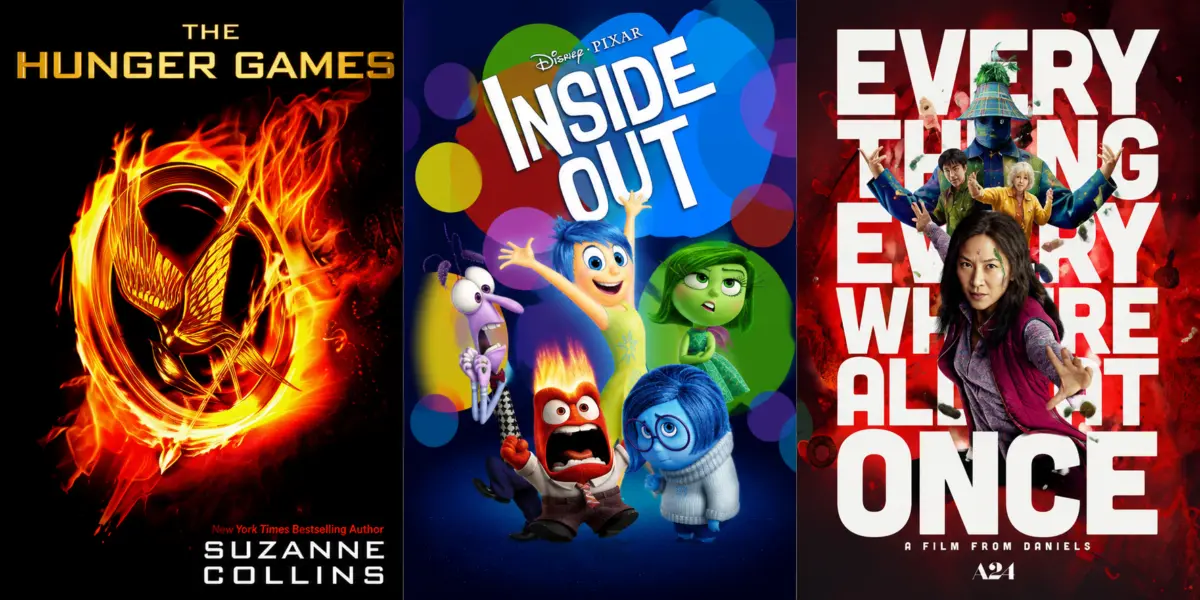
To fully understand the interplay between hook and heart, we must examine how critically acclaimed literature and cinema execute this duality.
Title & Medium
The Hook (The Curiosity Engine)
The Heart (The Deeper Meaning)
Reflex by Steven Gould
A man possesses the rare ability to teleport instantly to anywhere in the world.
A targeted outsider must navigate systemic persecution and learn to save himself.
The Hunger Games by Suzanne Collins
Children are forced into a televised gladiatorial arena by a corrupt government.
A young woman fights to preserve her fundamental humanity amidst systematic dehumanization.
Inside Out (Pixar)
The narrative takes place inside a human mind, where anthropomorphized emotions run the show.
A young girl must accept that sadness is a vital, necessary component of emotional maturity.
Everything Everywhere All at Once
An exhausted laundromat owner accesses infinite alternate selves across a fracturing multiverse.
An estranged mother and daughter must bridge an emotional chasm across realities.
Dissecting the Mechanics
In each of these examples, the hook functions as an unconventional premise that immediately sparks a cognitive itch in the audience’s mind. Teleportation is not a new concept, but Reflex subverts superhero tropes by framing the power not as a tool for global salvation, but as a curse that makes the protagonist a hunted, tortured fugitive. Similarly, Everything Everywhere All at Once utilizes the chaotic, absurd canvas of a multiverse (hot dog fingers, talking rocks) to ground a deeply intimate story about generational trauma and familial reconciliation.
Crucially, none of these streamlined descriptions rely on subplots or tertiary plot twists. When crafting a pitch, extraneous narrative trappings must be stripped away to reveal the pure architecture beneath.
Official Statements and Industry Insights
Literary professionals and developmental editors consistently emphasize that the failure of a novel pitch rarely stems from poor writing style; rather, it originates from a structural misunderstanding of what gatekeepers are looking for.
"Really think about your novel’s hook. What makes it stand out? How is it different from all the other novels in my inbox?"
— Elizabeth Winick Rubinstein, Literary Agent
Industry consensus dictates a strict hierarchy for structuring a pitch or query letter: The hook always comes first.
Audience investment cannot be assumed. Readers and agents do not inherently care about a manuscript simply because an author poured months of labor into it. Therefore, the most interesting, unique, and conceptually striking element of the book must be brought to the forefront immediately.
Lead with the Hook: Deliver the high-concept spark of curiosity right out of the gate. If the hook fails to capture attention within the opening sentences, the pitch is dead on arrival.
Anchor with the Heart: Once the hook has secured the audience’s attention, ground the pitch in the narrative’s emotional core. Pithy execution is paramount here; frame the heart of the story with the same magnetic precision applied to the hook.
Industry veterans also advocate for solving the hook-and-heart equation before drafting the manuscript. Far from being merely a marketing exercise, defining these two elements during the conceptualization phase provides a strict structural compass. It ensures that every chapter, scene, and subplot serves the dual purpose of satisfying the reader’s intellectual curiosity (the hook) and delivering profound emotional resonance (the heart).
Future Outlook: The Intersection of Craft and Marketability
As the publishing ecosystem continues to evolve through digital disruption, algorithmic discovery, and shifting consumer reading habits, the margin for error in narrative positioning narrows further. Writers operating in genres ranging from speculative fiction to literary drama must master the delicate balance between high-concept marketability and deep-seated artistic purpose.
Platforms like the upcoming WorldShift Summit for Speculative Fiction Writers highlight a growing industry hunger for advanced structural instruction. Events bringing together dozens of authors, editors, and publishing professionals underscore a vital trend: modern authors must view themselves not only as artists, but as architects of meaning. Classes focusing on the hidden architecture of fiction—such as building thematic resonance, managing complex character arcs, and optimizing narrative weight—demonstrate that long-term career sustainability requires a mastery of both micro-level prose and macro-level concept design.
Ultimately, the distinction between a story’s hook and its heart is the dividing line between a manuscript that languishes in obscurity and one that breaks through the noise. By deliberately crafting a hook that sparks insatiable curiosity and anchoring it to a heart that demands emotional investment, writers equip themselves with a professional-grade toolkit. Whether facing down a literary agent across a conference table or drafting the opening lines of a debut novel, the author who clearly understands their hook and heart writes with absolute authority—transforming a fleeting pitch into an enduring literary achievement.





Comments
Facebook App ID not configured. Please add it in the Customizer.