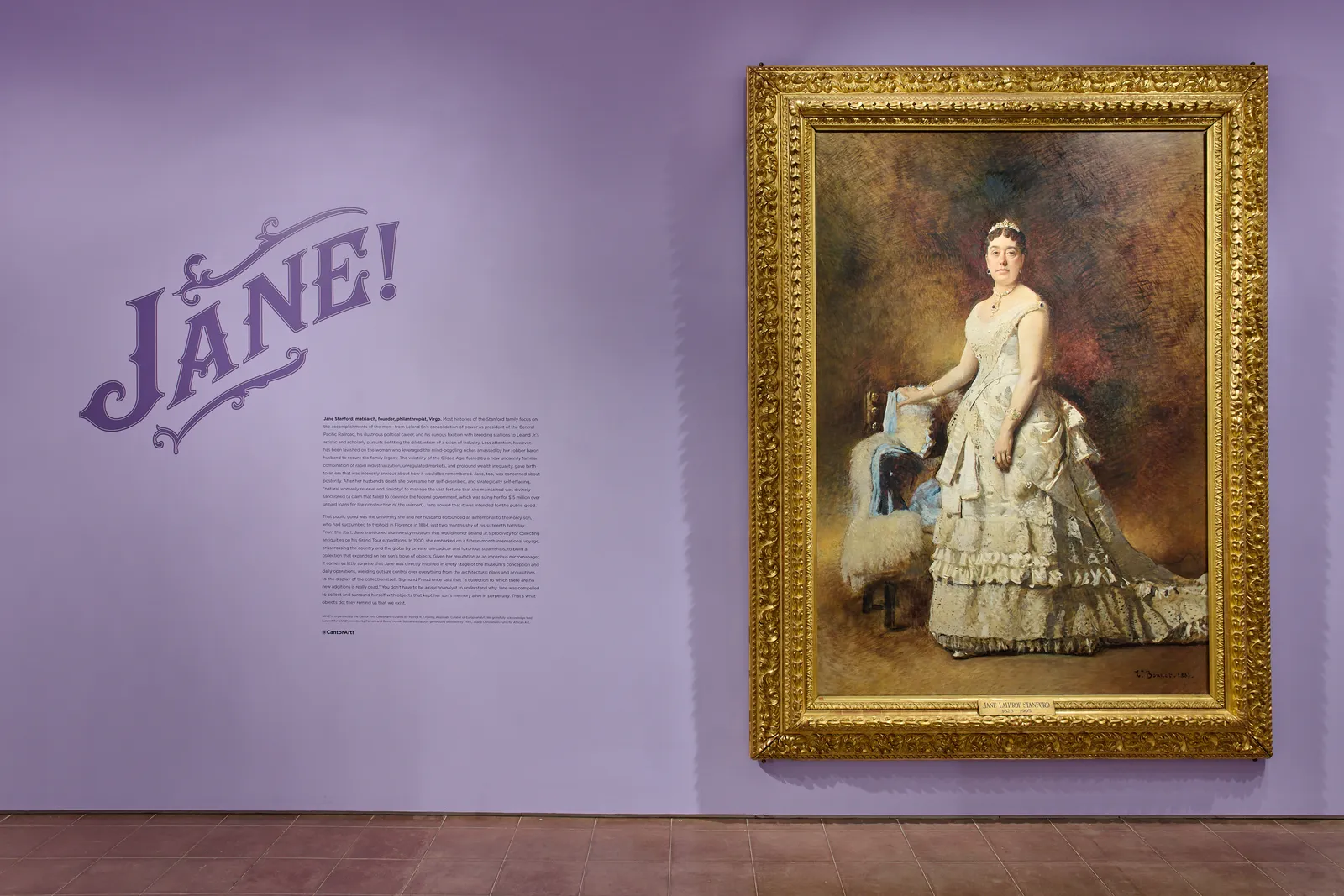
For over a century, the monumental sandstone arches and sprawling palm-lined quadrangles of Stanford University have stood as a testament to the Gilded Age ambition of Leland and Jane Stanford. While history has often spotlighted Leland Stanford—the railroad baron, governor, and United States senator whose political and economic machinations laid the bedrock of the institution—the true architect of the university’s enduring survival was its founding matriarch, Jane Lathrop Stanford.
Now, a sweeping, paradigm-shifting exhibition titled "Jane!" at the university’s Cantor Arts Center seeks to reclaim Jane from the footnotes of history. Running through May 18, 2028, the exhibition presents a deeply intimate, unvarnished portrait of a woman defined as much by staggering resilience and visionary philanthropy as by profound personal tragedy and a still-unresolved murder.
Curated by Patrick R. Crowley and supported by registrar Isabelle Rogers, university archaeologist Laura Jones, and historical scholarship, "Jane!" brings to light artifacts that have never before been publicly displayed. These range from high-art masterpieces and peculiar family heirlooms to the chilling material culture surrounding Jane’s 1905 assassination via strychnine poisoning. Far from presenting a sanitized hagiography, the exhibition exposes Jane Stanford in all her complexity: formidable, eccentric, deeply human, and fiercely dedicated to transforming personal grief into a legacy that would shape the intellectual landscape of the American West.
Detailed Chronology: From Gilded Age Opulence to Tragedy and Murder
1. Origins and the Rise of a Dynasty (1828–1884)
Jane Lathrop was born in Albany, New York, in 1828 into a large, middle-class family. In 1850, she married Leland Stanford, an ambitious lawyer who would soon migrate west during the California Gold Rush. Through relentless enterprise, Leland amassed a staggering fortune in the railroad industry, eventually presiding over the Central Pacific Railroad. On May 10, 1869, at Promontory, Utah, Leland famously drove the ceremonial gold spike that completed the nation’s first transcontinental railroad—cementing the family’s place in the pantheon of American titans.
The couple welcomed their only child, Leland Stanford Jr., in 1868. Raised in unimaginable wealth, the young Leland was the center of his parents’ universe.
2. The Catalyst of Grief and the Birth of a University (1884–1893)
The trajectory of the Stanford family—and by extension, the history of California higher education—altered irrevocably in the winter of 1884. While the family was touring Europe, 15-year-old Leland Jr. contracted typhoid fever in Athens, Greece, and died.
The devastation fractured his parents. However, rather than succumbing entirely to despair, Jane and Leland chose to channel their inconsolable grief into an act of monumental public philanthropy. As Isabelle Rogers of the Cantor Arts Center notes, "They didn’t have a child anymore, and so she thought that all of California could be her children."
In 1885, the couple executed the Founding Grant, establishing the Leland Stanford Junior University in memory of their son. Classes commenced in 1891. To honor Leland Jr.’s youthful fascination with antiquities and architecture—sparked during that fateful trip to Greece—the family established a museum (now the Cantor Arts Center), designed deliberately to mirror the facade of the National Archaeological Museum in Athens.
3. The Solo Matriarch and Institutional Survival (1893–1905)
When Leland Stanford died suddenly in 1893, Jane was left to shoulder the immense financial, administrative, and legal burdens of the fledgling university alone. At a time when women were virtually excluded from the corridors of higher education leadership, Jane assumed total control.
Operating against a backdrop of severe economic depressions and legal battles over the Stanford estate, Jane repeatedly liquidated her private assets—including her priceless jewelry collection—to keep the university’s doors open. She acted not merely as a figurehead, but as an active, hands-on chief executive who made critical campus appointments, oversaw architectural expansions, and fiercely protected the institution’s co-educational, tuition-free ethos.
4. The Poisoning, Cover-Up, and Historical Reckoning (1905–Present)
Jane Stanford’s life ended under deeply suspicious and violent circumstances on February 28, 1905, at the Moana Hotel in Honolulu, Hawaii. Weeks earlier, on January 14, 1905, at her San Francisco mansion, she had survived an initial attempt on her life when her mineral water was laced with strychnine—a potent rat poison. Fearing for her safety, she fled to Hawaii, where she was administered a fatal dose disguised as a digestive aid.
While autopsies confirmed acute strychnine poisoning, the university’s then-president, David Starr Jordan—who had repeatedly clashed with Jane over the governance and pedagogical direction of Stanford—swiftly moved to suppress the truth. Jordan traveled to Hawaii, dismissed the coroner’s findings, and publicly attributed her death to heart failure. This narrative of natural death endured for nearly a century.
It was not until the early 2000s, through rigorous medical and historical investigations by scholars such as Robert W.P. Cutler, W.B. Carnochan, and historian Richard White (author of Who Killed Jane Stanford?), that the institutional cover-up was exposed. Historians now point primarily to two suspects: Bertha Berner, Jane’s personal secretary and the only individual present during both poisonings, who may have been motivated by financial gain; and President David Starr Jordan, who allegedly acted as an accessory after the fact to protect the university’s reputation and secure his own administrative dominance.
Supporting Context & Metrics: Inside the "Jane!" Exhibition
The "Jane!" exhibition at the Cantor Arts Center breaks new curatorial ground by juxtaposing high art with unsettling, deeply personal artifacts. Key components of the showcase include:
Unseen Heirlooms: The exhibition features items never before shown to the public, offering visitors a glimpse into the idiosyncratic private world of the Gilded Age elite.
The Last Meal Ceramics: Among the more striking contemporary and historical pieces are ceramic artworks depicting Leland Jr.’s final meal in Athens—bacon, eggs, and toast—rendering a tragic historical moment in tactile, domestic terms.
Death Masks and Plaster Casts: The exhibition displays the death masks of both Jane and young Leland, alongside a set of plaster hands initially misattributed to Jane but later identified as belonging to President David Starr Jordan—a subtle nod to the entanglement of power, suspicion, and legacy.
The Jewel Collection Painting: An 1898 canvas by Astley D.M. Cooper immortalizes Jane’s legendary diamond and gemstone collection, which she would later sell to fund faculty salaries during the university’s darkest financial hours.
The Bertha Berner Mosaic: A long-forgotten mosaic portrait of Jane’s enigmatic secretary and primary murder suspect, discovered gathering dust in an attic near campus, now hangs as a silent witness to the dark intrigues of early Stanford history.
Official Statements and Scholarly Perspectives
The curatorial and academic voices behind the exhibition emphasize the necessity of looking past the marble monuments to confront the complex, flesh-and-blood reality of Stanford’s founders.
"She’s huge as a philanthropist, and she doesn’t really get recognized for that," explains Laura Jones, director of Stanford’s heritage services and official university archaeologist. "People talk all the time now at Stanford about ‘founders.’ All our students want to found something or build something. And she really is our prototype."
Exhibition curator Patrick R. Crowley notes that the breadth of the artifacts illustrates a personality far more intricate than standard historical retellings suggest. In a statement released by the university, Crowley describes Jane as a figure "so formidable, peculiar and unexpectedly human."
Assistant registrar Isabelle Rogers highlights how Jane utilized alternative belief systems to process her endless grief, noting that after her son’s death, Jane embraced Spiritualism—a popular 19th-century movement centered on communicating with the dead—as a vital coping mechanism. Rogers emphasizes that the exhibition aims to show visitors that "there are still a lot of wonderful things in life, even when you’re in mourning."
Future Outlook
The "Jane!" exhibition will remain on view at the Cantor Arts Center through May 18, 2028, providing a multi-year window for students, scholars, and the public to re-evaluate the foundational myths of Silicon Valley’s intellectual cradle.
As Stanford University continues to grapple with its complex institutional past—from the labor exploitation inherent in Gilded Age railroad fortunes to the murky details of its matriarch’s assassination—this exhibition marks a vital step toward historical transparency. By shifting the lens from Leland’s boardroom dominance to Jane’s resilient, grieving, yet iron-willed stewardship, the Cantor Arts Center has ensured that the true pioneer of Stanford University finally steps out of the shadows.

/https://tf-cmsv2-smithsonianmag-media.s3.amazonaws.com/filer_public/cb/f5/cbf53a8f-ab25-4f04-9809-58da970031e4/2026-07_jane_gc-4-web.jpg)
/https://tf-cmsv2-smithsonianmag-media.s3.amazonaws.com/accounts/headshot/IMG_7600-edit-v2.png)
:focal(1500x1000:1501x1001)/https://tf-cmsv2-smithsonianmag-media.s3.amazonaws.com/filer_public/cb/f5/cbf53a8f-ab25-4f04-9809-58da970031e4/2026-07_jane_gc-4-web.jpg)
/https://tf-cmsv2-smithsonianmag-media.s3.amazonaws.com/filer_public/04/9d/049d1eb9-1c67-4577-a6ff-562c1f7bc7e4/mosaic.png)
/https://tf-cmsv2-smithsonianmag-media.s3.amazonaws.com/filer_public/c5/92/c5920bad-a7a1-405a-998e-8eb181e8a40b/jls14897_cdp-pub_angel.jpg)
/https://tf-cmsv2-smithsonianmag-media.s3.amazonaws.com/filer_public/91/19/911943c8-65db-4727-8472-c9a7c4d406a0/jls18217_cdp-pub_portrait.jpg)
/https://tf-cmsv2-smithsonianmag-media.s3.amazonaws.com/filer_public/37/65/3765fd26-99f1-41ce-adf4-f98e9202dd97/leland.jpg)
/https://tf-cmsv2-smithsonianmag-media.s3.amazonaws.com/filer_public/41/6e/416e4309-595b-4fe7-9232-bd9aa2cbb6ba/199153_gilhooly_breakfast-2.jpg)
/https://tf-cmsv2-smithsonianmag-media.s3.amazonaws.com/filer_public/02/5e/025e7bc9-d982-4807-883e-68ec359fb6a1/jls16294_cooper_jewels.jpg)



Comments
Facebook App ID not configured. Please add it in the Customizer.