
Executive Overview
On August 23, 1944, a catastrophic aviation accident unfolded in the quiet English village of Freckleton, Lancashire. A United States Army Air Forces (USAAF) B-24H Liberator bomber, on a routine test flight from a nearby base, lost control amid a severe summer storm and plummeted directly into the Holy Trinity School and a neighboring snack bar. The resulting explosion and inferno claimed the lives of 61 people, including 38 children between the ages of four and six, two teachers, local civilians, U.S. service members, and all three airmen on board the aircraft.
Standing as the single greatest civilian air disaster suffered by Allied forces during World War II, the Freckleton tragedy devastated a community of roughly 1,000 residents, wiping out an entire generation of the village’s youngest children. Yet, despite its staggering loss of life, the event remains largely absent from mainstream historical consciousness in both the United Kingdom and the United States. Overshadowed by the vast global scale of World War II, the liberation of Paris dominating contemporary news cycles, and subsequent British tragedies like the Aberfan mining disaster, the event faded from public view. This in-depth investigation examines the chronology of the crash, the strategic military context of “Little America” in Lancashire, the contested theories surrounding the accident’s cause, and the enduring mission of survivors to ensure the victims are never forgotten.
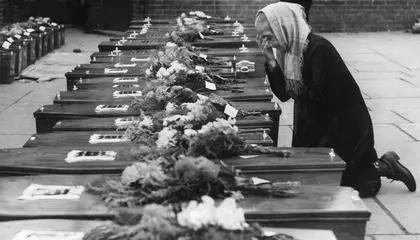
/https://tf-cmsv2-smithsonianmag-media.s3.amazonaws.com/filer_public/bc/67/bc67e7cd-5e2c-4ce2-89ef-dbe16c632594/freckleton-coffins.png)
Detailed Chronology: The Events of August 23, 1944
The morning of Wednesday, August 23, 1944, began deceptively mildly across England’s western coast. At the Holy Trinity School, 176 students had returned for only the second day of the school year. Inside the infants’ wing, teacher Louisa Hulme—nearing her planned retirement the following week—gathered her youngest students, ages four to six, alongside Jennie Hall, a young local teacher in her first week on the job.
Read Also
The Narrow Escapes and the Fateful Moment
Minutes before disaster struck, 13-year-old student Jacky Nichol was dispatched by the headmaster to check coatroom windows against the approaching storm. Chastised by a teacher for failing to knock on a door, Nichol paused before entering the infants’ wing. That minor reprimand delayed him just enough to keep him out of the direct blast zone.
/https://tf-cmsv2-smithsonianmag-media.s3.amazonaws.com/accounts/headshot/meilan_headshot2.png)
At 10:47 a.m., as torrential rains and winds reaching 60 miles per hour battered Freckleton, the B-24H Liberator nicknamed Classy Chassis II—weighing 25 tons and carrying nearly 2,800 gallons of aviation fuel—screeched low over the village. Piloted by 27-year-old First Lieutenant John Bloemendal alongside co-pilot Jimmie Parr and flight engineer Gordon Kinney, the bomber had taken off from Base Air Depot 2 (BAD2) in neighboring Warton less than 20 minutes prior.
The Impact and the Inferno
Caught in a sudden, violent microburst or severe weather downdraft, the aircraft clipped a building, shearing off its right wing tip. Its main wheel and tail turret violently struck the Sad Sack Snack Bar—a popular café frequented by service members—while its nose turret and heavy engines smashed straight into the Holy Trinity School’s infants’ wing.
:focal(750x500:751x501)/https://tf-cmsv2-smithsonianmag-media.s3.amazonaws.com/filer_public/bc/67/bc67e7cd-5e2c-4ce2-89ef-dbe16c632594/freckleton-coffins.png)
The impact triggered an immediate, devastating explosion. Fuel ignited instantly, turning the center of the village into a raging furnace. Out of the 41 children inside the infants’ wing at that exact moment, 38 were killed instantly or succumbed to their injuries. Only three young students—Ruby Currell, David Madden, and George Carey—survived the initial blast and subsequent fire.
Local civilians, RAF personnel, and U.S. servicemen from BAD2 rushed immediately to the scene, digging through burning rubble with bare hands and utilizing makeshift bucket brigades and trailer pumps when the wreckage blocked the local water mains. Despite heroic rescue efforts, the final death toll reached 52 immediately, rising to 61 as severely burned victims succumbed to their wounds in the days that followed.
/https://tf-cmsv2-smithsonianmag-media.s3.amazonaws.com/filer_public/82/0e/820ee920-d5e6-4ab0-b138-14a183ca3591/fre_011566.jpg)
Supporting Context & Metrics: "Little America" and Wartime Operations
To understand how such a catastrophe occurred, historians examine the massive industrial and military footprint established in Lancashire during the European theater operations.
Base Air Depot 2 (BAD2) and the Eighth Air Force
Situated just miles from Freckleton, Warton’s BAD2 served as a vital maintenance hub for the U.S. Eighth Air Force. The depot was responsible for repairing, overhauling, and testing thousands of combat aircraft. In the months leading up to the disaster, more than 10,400 American personnel were stationed at the facility.
/https://tf-cmsv2-smithsonianmag-media.s3.amazonaws.com/filer_public/da/ae/daae3ba5-c3a4-4c36-9186-6723e4353095/rescuers_searching_through_demolished_school_after_aberfan_disaster.jpg)
The presence of thousands of U.S. troops deeply transformed the rural Lancashire region, which quickly earned the moniker "Little America." Friendships flourished over pints in local pubs, and American servicemen regularly shared rations, chocolate, and chewing gum with local children. Yet, this intense wartime mobilization came with severe risks. The USAAF suffered staggering fatality numbers during the war—surpassing the total losses of the U.S. Marine Corps—driven not only by combat missions over Nazi-occupied Europe but also by high training and testing attrition rates on the home front and allied soil.
The Contrast of Global Headlines
The suppression of widespread public awareness regarding the Freckleton disaster was largely tactical and chronological. On August 24, 1944, front pages across the United Kingdom and the United States were dominated by monumental geopolitical milestones: the advancing Allied sweep toward Paris and the rapid liberation of France. Military commanders and civilian censors alike were cautious about publicizing devastating domestic accidents that could fracture fragile Allied morale or strain Anglo-American relations at the zenith of wartime cooperation.
/https://tf-cmsv2-smithsonianmag-media.s3.amazonaws.com/filer_public/1f/7b/1f7b09de-c439-4bc8-b4bc-1938bd1f3425/media-13622.jpeg)
Official Statements and Investigation Findings
In the wake of the tragedy, military and civilian authorities moved quickly to investigate the root causes while maintaining diplomatic solidarity.
The USAAF Investigation Report
The official USAAF accident investigation placed primary responsibility on pilot error, concluding that the crash "resulted from pilot’s error in the judgment of the violence of the storm." Investigators noted that Bloemendal, facing rapidly deteriorating meteorological conditions, attempted to turn north to follow a fellow test pilot out of the hazard zone. However, the unexpected severity of the British weather system—drastically different from the conditions American pilots were typically trained to navigate—proved insurmountable.
/https://tf-cmsv2-smithsonianmag-media.s3.amazonaws.com/filer_public/08/9c/089c435b-016a-4d93-8de5-52b7d6f6ac24/media-40683.jpeg)
Independent Historical Analysis
Subsequent historical studies, notably by researcher James R. Hedtke, suggest a more complex picture. Hedtke’s analysis points out that Flight Control Operations at BAD2 held shared responsibility, as base personnel possessed updated regional weather tracking data indicating the ferocity of the approaching squall line long before the bombers reached cruising altitude. Furthermore, alternate eyewitness testimonies suggested that a sudden lightning strike could have disabled the aircraft’s control surfaces, rendering corrective pilot action impossible. Given the total destruction of the aircraft and the paucity of surviving flight data, the precise catalyst remains a subject of historical debate.
Diplomatic Resolutions
Despite the devastation, both British and American officials worked to ensure the tragedy did not erode bilateral goodwill. General Carl A. Spaatz dispatched an official message expressing deep sorrow on behalf of the American Air Forces to the Crown’s representative in Lancashire. Local authorities graciously accepted these condolences, prioritizing mutual solidarity over recrimination.
/https://tf-cmsv2-smithsonianmag-media.s3.amazonaws.com/filer_public/9b/d1/9bd1e639-5c8f-4d45-9216-741526848edf/2jxw16g.jpg)
Future Outlook: Memorialization and Historical Memory
For decades, the Freckleton air disaster remained an unhealed wound—a localized tragedy preserved primarily through oral histories, family grief, and the tireless dedication of survivors.
The Mission of the Survivors
Ruby Currell, who spent years recovering from full-body burns and enduring multiple reconstructive surgeries, dedicated her adult life to ensuring her fallen classmates were never forgotten. Rejecting bitterness toward the pilot or the U.S. military, Currell maintained that the disaster was a tragic hazard of war. "The storm brought him down, and unfortunately, we were in the line of fire. An accident: That’s all it was," she noted in later interviews.
/https://tf-cmsv2-smithsonianmag-media.s3.amazonaws.com/filer_public/81/41/81411415-ed29-45c8-9f7e-dccbe6b71beb/2jxw0hw.jpg)
Modern Commemoration
While a mass funeral was held on August 26, 1944—funded by the U.S. military, with American servicemen serving as pallbearers for the children—it took many decades for a prominent public memorial to emerge. An initial playground was gifted by American airmen in August 1945, followed by a council-erected monument near the communal T-shaped grave. However, it wasn’t until 2007, following a BBC documentary, that a dedicated plaque was installed directly at the crash site.
Today, historians and curators at institutions like the American Air Museum in Britain continue efforts to bring the Freckleton air disaster out of obscurity. By preserving the stories of educators like Louisa Hulme and Jennie Hall, who tried to shield their pupils until the final moment, contemporary research ensures that the victims of World War II’s worst civilian aviation accident finally receive the historical recognition they were denied for over three-quarters of a century.



Comments
Facebook App ID not configured. Please add it in the Customizer.