
Executive Overview
At St. Mikhail Church, located just a short, reflective walk from the bustling center of Kyiv, the raw human cost of the ongoing war is laid bare daily. A grieving mother presses her tear-stained face into the crucified Christ depicted on her fallen son’s burial shroud, seeking solace in centuries-old iconography. Just beneath the shroud, a blue-and-yellow Ukrainian flag drapes the foot of the casket, a stark reminder of the nation for which he gave his life. Since the full-scale Russian invasion of 2022, this sanctuary has echoed with continuous prayers for the Ukrainian armed forces, the preservation of the nation’s territorial integrity, and the endurance of its suffering civilian population.
Yet, to the offices of President Volodymyr Zelenskyy, this very church and its umbrella institution—the Ukrainian Orthodox Church (UOC)—are viewed through a lens of profound suspicion, often categorized as a fifth column or a branch of the "Russian hydra."
An on-the-ground investigation in Kyiv reveals a complex, deeply painful reality: a religious community fiercely dedicated to the physical and territorial defense of Ukraine, yet utterly trapped in a historical, cultural, and political tug-of-war. As the Ukrainian state accelerates its nationwide decolonization campaign—eradicating centuries of Russian imperial influence from its streets, textbooks, and cultural institutions—the UOC finds itself caught in the crosshairs. Despite declaring formal independence from Moscow following the 2022 invasion, condemning the war as a "fratricidal sin," and enduring the same wartime destruction, blackouts, and rocket fire as the rest of the country, the UOC faces state-sanctioned property seizures, sweeping legislative bans, and the mass alienation of its clergy.
Read Also
This investigative report explores the geopolitical fault lines running through Kyiv’s ancient sanctuaries, examining how a nation fighting for its survival is simultaneously wrestling with the weaponization of faith.
Detailed Chronology
To understand the current institutional crisis surrounding Ukrainian Orthodoxy, one must trace the timeline of political shifts, ecclesiastical schisms, and wartime escalations that have defined the post-Soviet era.
- 2018–2019: The Birth of the OCU and the Ecumenical Schism
Driven by then-President Petro Poroshenko under the rallying cry of "Army, Language, Faith," the Ukrainian government engineered the creation of the Orthodox Church of Ukraine (OCU). Designed to sever centuries of ecclesiastical dependence on Moscow, the OCU received a Tomos (decree) of autocephaly from Bartholomew, the Ecumenical Patriarch of Constantinople. This historic recognition triggered an ongoing, bitter schism between Constantinople and the Moscow Patriarchate, while laying the groundwork for a bifurcated religious landscape in Ukraine. - February 2022: The Invasion and UOC Condemnation
As Russian tanks rolled across the border, UOC head Metropolitan Onufriy Berezovsky immediately condemned the invasion, labeling it a "sin of Cain" and a fratricidal war. Shortly thereafter, the UOC formally declared its administrative and institutional independence from the Moscow Patriarchate, seeking to distance itself entirely from Patriarch Kirill, who vocally supported Vladimir Putin’s military campaign. - November 2022: The Kyiv Pechersk Lavra Incident
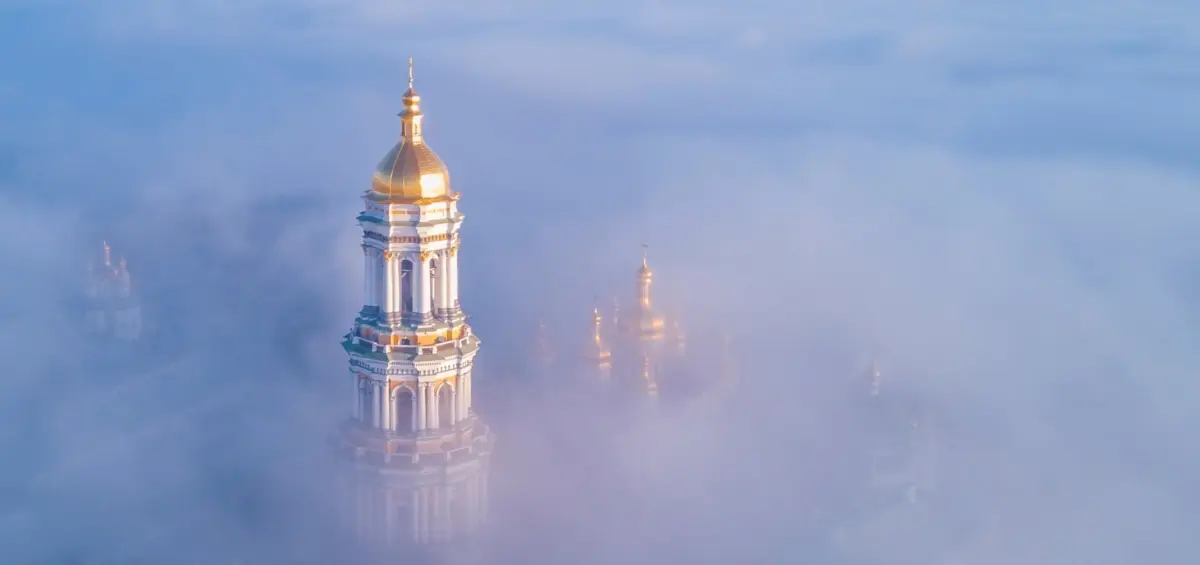
Tensions reached a boiling point at the historic Kyiv Pechersk Lavra—the cradle of East Slavic Christianity—when monks were caught on video singing pro-Russian hymns during a service, and Metropolitan Pavlo openly rejoiced over the temporary Russian occupation of Kherson. The incident provided the Ukrainian government with the catalyst for a systemic crackdown. - March–July 2023: Evictions and State Seizures
The Ukrainian Ministry of Culture terminated the UOC’s indefinite lease on the lower monastic complex of the Kyiv Pechersk Lavra. Following legal battles, state authorities forcefully evicted the UOC monks, dividing the sprawling sacred premises between the OCU and a state historical museum, leaving the evicted congregation with only three small chapels. - August 2024: The Sweeping Legislative Ban
President Zelenskyy signed legislation effectively banning religious organizations affiliated with Russian centers of influence, targeting the UOC despite its stated independence. The law provided a legal framework for local authorities and the state to shutter remaining parishes, seize assets, and accelerate the absorption or closure of UOC structures. - 2024–Present: Widespread Prosecutions and Citizenship Revocations
The Ukrainian state opened over two hundred criminal cases against UOC clergy, resulting in prolonged pre-trial detentions for some priests. In a dramatic escalation, reports surfaced that the government had revoked the Ukrainian citizenship of Metropolitan Onufriy, signaling an all-out institutional offensive against the church’s hierarchy.
Supporting Context & Metrics
The friction between the Ukrainian state and the UOC is not merely a modern security dispute; it is tied to the profound etymological and civilizational identity of the region. The word Ukraine itself derives from ukraina, historically translating to "borderland" or "frontier." As political scientist Samuel Huntington famously observed in The Clash of Civilizations and the Remaking of World Order, "We know who we are only when we know who we are not and often only when we know whom we are against."
In forging a distinct European identity amid a brutal war of attrition, Ukrainian authorities have sought to define that identity primarily by purging remnants of Russian civilization. The decolonization sweep has been comprehensive:
- Toponymy: Lev Tolstoy Square in central Kyiv was swiftly renamed the Square of Ukrainian Heroes.
- Arts and Academia: Pyotr Tchaikovsky’s name was formally expunged from the title of the National Music Academy of Ukraine, while the literary works of Dostoevsky, Pushkin, and Tolstoy were systematically pulled from public school curricula and library shelves.
Financially and structurally, the pressure on non-compliant or legacy institutions has been relentless. St. Mikhail’s church, stripped of its state protections as a recognized religious organization, has been forced to pay 200,000 Ukrainian hryvnias (approximately $4,500 USD) monthly to the state treasury just to maintain its functional existence.
Furthermore, the personnel toll within the UOC is immense. Despite being officially barred from serving as formal military chaplains—a restriction that has left the Ukrainian Armed Forces’ chaplaincy operating at less than half its required capacity—UOC priests and their families have bled for the country. Parishioners and local clergy point to numerous instances where UOC priests have been drafted into frontline infantry units. Deprived of the right to serve in pastoral military roles, many operate as de facto spiritual guides or emergency medical responders, enduring the same high mortality rates as ordinary soldiers.
Official Statements and Divergent Perspectives
The ideological chasm dividing the Ukrainian government, the OCU, the UOC, and international observers is vast, characterized by competing narratives of national security, religious freedom, and historical justice.
The Ukrainian Government and the Orthodox Church of Ukraine (OCU)
State authorities maintain that the UOC remains an insidious, fifth-column security risk. Government officials argue that decades of institutional integration with Moscow cannot be erased overnight by mere declarations of independence, particularly when historical ties, property deeds, and certain rogue clergy members have displayed sympathies toward the Russian aggressor.
Defending the state’s legislative ban, an OCU representative asserted: "This law in no way restricts the right to freedom of religion or prevents religious communities from carrying out their activities."
Similarly, Bishop Vitalii Kryvytskyi of the Roman Catholic Diocese of Kyiv-Zhytomyr defends the broad trajectory of the state, noting that Ukraine sits on a volatile "ideological, cultural, and political tectonic plate" where "society has its head in the direction of Europe." However, Bishop Kryvytskyi parts ways with the state on executive overreach, criticizing the heavy-handed seizure of the Lavra and historical church properties as reminiscent of historical imperial persecutions.
The Ukrainian Orthodox Church (UOC)
Conversely, members of the UOC vehemently reject the label of Russian agents. None of the dozens of UOC clergy and laypeople interviewed expressed anything other than outright condemnation for Vladimir Putin’s regime.
Metropolitan Onufriy’s pre-war and wartime declarations have consistently emphasized territorial integrity: "The Ukrainian Orthodox Church has consistently supported and continues to support the territorial integrity of Ukraine."
Monks and priests caught in the middle argue that they are being punished for the geopolitical sins of the Moscow Patriarchate—a patriarchate that has proven just as eager to persecute UOC clergy within Russian-occupied territories for refusing to submit to Kirill’s war-blessing apparatus. Nikodim, a monk forcibly evicted from the Kyiv Pechersk Lavra, acknowledged that the contested eastern provinces of Donetsk and Luhansk are unequivocally Ukrainian territory, while condemning Moscow’s theological justifications for bloodshed as "obviously not Christian."
International Response
The domestic crackdown has not gone unnoticed abroad. High-profile traditional supporters of Kyiv’s war effort have raised alarms over religious freedom violations. Pope Francis publicly condemned Ukraine’s legislative ban on the UOC, while officials within the Biden administration expressed deep concern regarding the erosion of minority religious rights during wartime. Conversely, domestic interfaith solidarity remains complex; the Ukrainian Council of Religious Organizations notably issued a unanimous endorsement of state efforts to secure the nation’s spiritual independence, illustrating that even among religious bodies, the alignment with state security is far from uniform.
Future Outlook
As the war grinds on through its third devastating year, the religious landscape of Ukraine remains an open, bleeding wound. The cultural tug-of-war shows no signs of abating.
On one hand, the Ukrainian state views cultural and ecclesiastical purification as an existential prerequisite for sovereignty. To Kyiv’s policymakers, allowing a church with historical roots in Moscow to operate unhindered within the capital is akin to leaving the gates unbolted during a siege. The ongoing shuttering of parishes, the criminal prosecution of select clergy, and the complete reorganization of sacred sites like the Kyiv Pechersk Lavra under the OCU and state auspices are viewed as measures of wartime self-defense.
On the other hand, this strategy risks alienating millions of Ukrainian citizens—including soldiers fighting and dying on the frontlines—whose faith remains tied to the UOC. When elderly mothers mourn beneath icons in UOC sanctuaries, and when UOC priests serve in frontline trenches as medics and infantrymen, the government’s broad-brush designation of the church as "pro-Moscow" creates deep internal fractures.
Ultimately, the tragedy of the UOC highlights the agonizing paradox of a nation at war: in its desperate, necessary quest to sever all ties with an imperial aggressor that seeks its total annihilation, Ukraine is forced to navigate the messy, intertwined histories of families, faiths, and cultures that cannot be neatly untangled by decree. Whether a sustainable pluralism can be forged from these ashes, or whether the campaign of ecclesiastical decolonization will leave permanent scars on the nation’s spiritual fabric, remains one of the defining questions of modern Ukraine.

Comments
Facebook App ID not configured. Please add it in the Customizer.