The first-season finale of HBO Max’s critically acclaimed superhero drama Lanterns, titled "Dirt and Stars," delivers a masterclass in narrative subversion, emotional resonance, and high-stakes character deconstruction. Eschewing the traditional sci-fi trope of a universe-shattering, CGI-heavy cosmic war, the episode turns inward, anchoring its climax in the deeply fractured, dusty heart of Rushville.
At its core, the finale resolves the central mystery of Hal Jordan’s murder while completely redefining the mythology of the Green Lantern Corps. By introducing a decentralized, independent power system fueled not by rigid discipline or the nebulous construct of "willpower," but by the complex, pragmatic utilization of fear, protagonist John Stewart charts a revolutionary path forward. As corporate uncertainties loom on the horizon regarding the future of the DC Universe media landscape, "Dirt and Stars" stands as a poignant, structurally immaculate capstone to a television season that dared to ask what happens when the protectors of the universe are forced to confront their own localized demons.
Detailed Chronology: From the Ashes of Rushville to a New Oath
1. The Fallout of 2016 and the 2026 Prison Release
The narrative weaves seamlessly across timelines, anchoring itself initially in the decimated landscape of 2016 Rushville. John Stewart engages in a tense dialogue with Lianna, while Kerry searches for Hal among the motel’s smoldering rubble. Hal wryly notes the Guardians’ impending retribution, acknowledging Kerry’s unheeded warnings.
Fast-forwarding a decade to 2026, Kerry waits outside prison gates, armed with beer and concealed flowers, to witness Hal’s release. Their reintegration into Rushville’s social fabric is immediately hostile. Dining at a local establishment, they face open vitriol, underscored by a crude slur spray-painted across Hal’s lawn. In a defining character moment, Kerry stands up to the restaurant patrons, acknowledging their hatred while firmly establishing that while Hal may not be owed immediate forgiveness, he unequivocally deserves peace—and that he is under her protection.
2. The Firebombing and the Revelation of Noah Macon
Following an intimate evening, Hal invites Kerry to a soft launch of their relationship at her son Noah’s upcoming football game. However, domestic tranquility is violently shattered when Hal’s home is firebombed. While attempting to rescue Earl, Hal falls through a compromised staircase, awakening in Zoe’s former medical facility.
Here, a staggering truth is revealed: Noah has utilized advanced technology to regenerate Hal’s skin. More alarmingly, Noah is a Manhunter, demanding Hal’s absolute silence to protect his secret from Kerry.
3. Interrogating Sinestro and the Forged Lantern
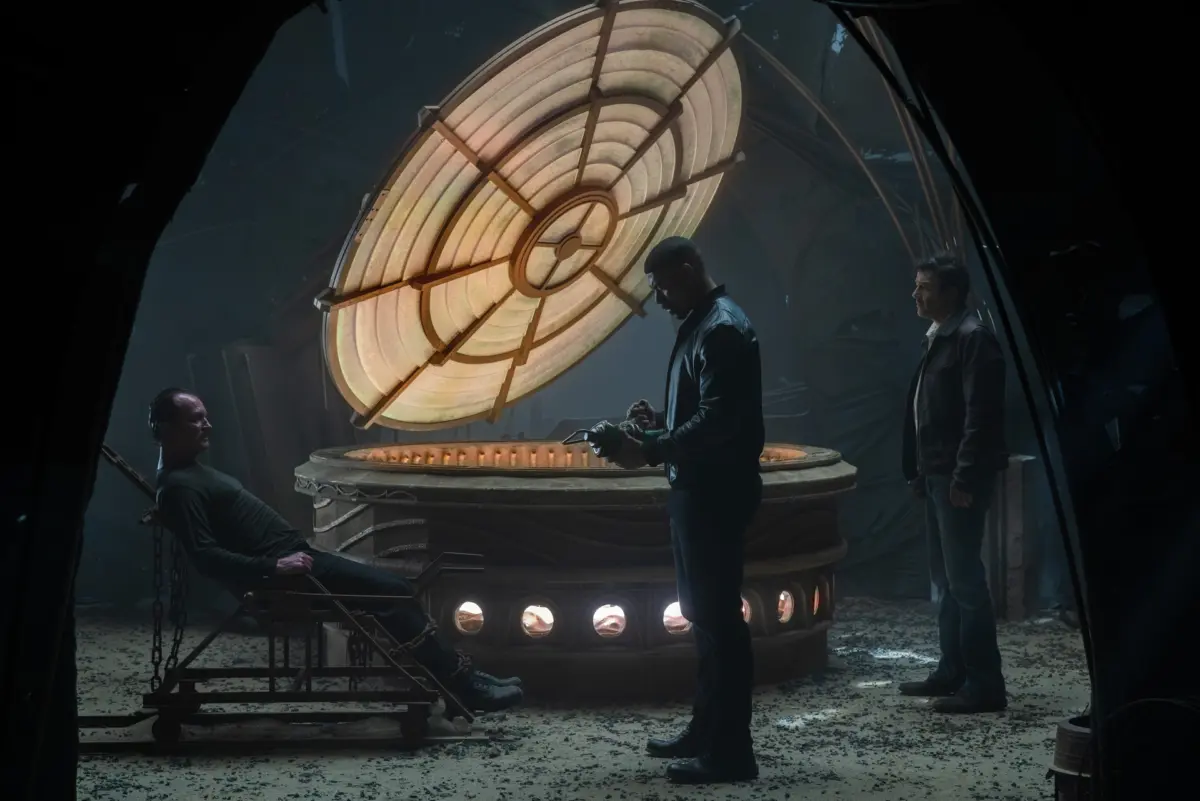
In a parallel 2026 thread, John interrogates Sinestro, who was broken out of prison by Noah Macon out of a desire for vengeance against the Guardian killer. Submerging Sinestro in laced water, John extracts a confession: Sinestro forged a custom lantern for Noah.
This lantern proves uniquely volatile, capable of charging a ring while simultaneously radiating the distilled fear of the local world. The Halogram warns John against utilizing it, suspecting a trap, while Sinestro manipulates Hal to beg for his ring back to restore his corporeal form. When Hal refuses, Sinestro exposes Hal’s selflessness, noting that charging the ring with this specific energy will cause Hal’s holographic consciousness to fizzle out of existence entirely.
4. The Confrontation at the Crossroads and the Football Field
John confronts Noah at the slaughterhouse, where Noah steals the ring and demands a ride to his football game. During the car ride, Noah wrestles with his programming, questioning whether he can overcome the dark impulses planted by his lineage. Arriving at the game, Noah leaves the ring on the dashboard, asking John for a mercy kill akin to Zoe’s fate before walking out to play.
John approaches Kerry in the stands. Through careful probing, the devastating truth emerges: Kerry is Hal’s killer. Having learned of Noah’s true nature and fearing the legacy of her father’s genes following an inexplicable pregnancy engineered by Zoe, Kerry panicked when Hal insisted they flee together. Driven by a desperate maternal instinct to protect her son and the world from what Noah might become, she shot Hal in the head. Yet, she summoned John not to evade justice, but to answer a singular, agonizing question: Is her son truly a monster? John offers a nuanced verdict—Noah may be capable of goodness, but he requires vigilant oversight.
Supporting Context & Metrics: Deconstructing Fear and Legacy
Thematic resonance in "Dirt and Stars" relies heavily on a sophisticated re-examination of the emotional electromagnetic spectrum traditionally established in DC Comics lore.
Character
Primary Emotional Driver
Manifestation in Narrative Arc
John Stewart
Pragmatic Fear / Acceptance
Rejects the Guardians’ centralized authority; redefines his oath to embrace fear as an instructional guide rather than a paralyzing liability.
Hal Jordan
Protective Regret / Selflessness
Sacrifices his holographic existence to ensure John’s survival, ultimately solving his own murder posthumously.
Kerry Kane
Maternal Fear / Protection
Commits patricide out of terror regarding ancestral trauma and the preservation of her son’s humanity.
Noah Macon
Existential Dread / Programming
Wrestles between an innate desire for a normal life and the overwhelming temptation of absolute cosmic power.
The Architecture of Rebellion
By positioning John Stewart—an architect by trade—outside the traditional Guardian hierarchy, the series taps into contemporary socio-political disillusionment with entrenched power structures. Rather than embracing hollow nihilism ("burning it all down" without a blueprint), John constructs a parallel, independent system of protection. He secures Sector Earth on his own terms, issuing an authoritative ultimatum to Guy Gardner and the Guardians: Guy gets the stars; John gets the dirt.
Official Statements & Creative Insights
While the television industry navigates a volatile landscape marked by massive corporate restructuring—specifically the rumored Paramount-Warner Bros. Discovery media mergers—the creative team behind Lanterns has offered profound insights into the season’s thematic architecture.
Showrunners and writers deliberately chose to dismantle the traditional Green Lantern mythos to make the characters feel profoundly human. As highlighted in post-finale commentaries, the integration of fear as a foundational component of John’s new ring challenges the rigid, unyielding dogma of the Guardians of the Universe:
"Fear can ruin a person, certainly… But fear can be a guide as well. John’s fears led him to a better destiny—and now his lantern is a testament to it. The trick is in not allowing it to rule you and how well you learn to interpret its signals."
Furthermore, the emotional climax of the series—anchored by Hal’s final confession of love to John just before his holographic dissolution—was intentionally designed to subvert expectations of stoic machismo in superhero narratives. By rewriting the iconic Green Lantern oath to incorporate vulnerability, the series establishes a new standard for modern comic book adaptations:
“In brightest day, in darkest night / I’ll embrace my fear, I’ll do what’s right / I choose this ring, I choose this fight / In service to this lantern’s light.”
Future Outlook: Uncertainty and Potential
As the dust settles on Rushville, the future of Lanterns remains precariously poised. Fans and critics alike have lauded the eight-episode season as a high-water mark for the modern DC Universe, praising its intimate character studies, stellar performances, and willingness to interrogate the darker psychological underpinnings of heroism and family legacy.
However, industry analysts note that broader corporate consolidations cast a long shadow over potential renewal orders. If "Dirt and Stars" ultimately serves as a complete series finale rather than a springboard for a second season, it nevertheless achieves something vanishingly rare in modern television: a fully realized, structurally circular narrative arc that honors its characters’ flaws, resolves its core mysteries, and leaves its protagonist soaring toward an unwritten, fiercely independent horizon. Whether John Stewart’s newly forged path will ever be explored on screen again, Rushville’s guardian has irrevocably changed the landscape of the stars.





Comments
Facebook App ID not configured. Please add it in the Customizer.