
Executive Overview
In a significant technological leap for the spoken-word entertainment industry, Audible has officially announced the rollout of a suite of next-generation, AI-powered features designed to fundamentally redefine how listeners engage with audiobooks. Over the coming months, the audiobook giant—an Amazon company—will introduce three distinct capabilities: Character Guide, Interactive Stories, and Visual Explorer.
These groundbreaking tools are being deployed alongside a curated selection of upcoming multi-cast productions and high-profile Audible Originals. Notable titles slated for this interactive treatment include timeless literary classics such as Bram Stoker’s Dracula and George Orwell’s dystopian masterpiece 1984, alongside cutting-edge sci-fi projects like the original audio drama Exoplanet, produced by renowned author Andy Weir and written by Benjamin Percy.
By bridging the gap between passive listening and active participation, Audible is addressing long-standing listener pain points, such as keeping track of complex character rosters, while catering to an increasingly media-fluent younger demographic. Currently rolling out in a limited beta phase for users in the United States and the United Kingdom, these features signal a major philosophical shift for the platform: moving beyond traditional narration to embrace dynamic, personalized, and multimedia-rich audio experiences.
Read Also
Detailed Chronology & Feature Breakdown
The integration of artificial intelligence into long-form audio marks a watershed moment for digital publishing. Rather than treating AI as a replacement for human talent, Audible’s newly launched tools are designed to complement, contextualize, and expand upon the foundational work of voice actors, sound designers, and authors.
The feature rollout is structured across three core pillars, each targeting a unique dimension of the listening experience:
1. Character Guide: Solving the Multi-Cast Confusion
For decades, one of the primary critiques of sprawling audio dramas or dense multi-cast audiobooks has been the occasional difficulty of tracking who is speaking, particularly when multiple voice actors share similar vocal registers or when a narrative features a massive ensemble cast.
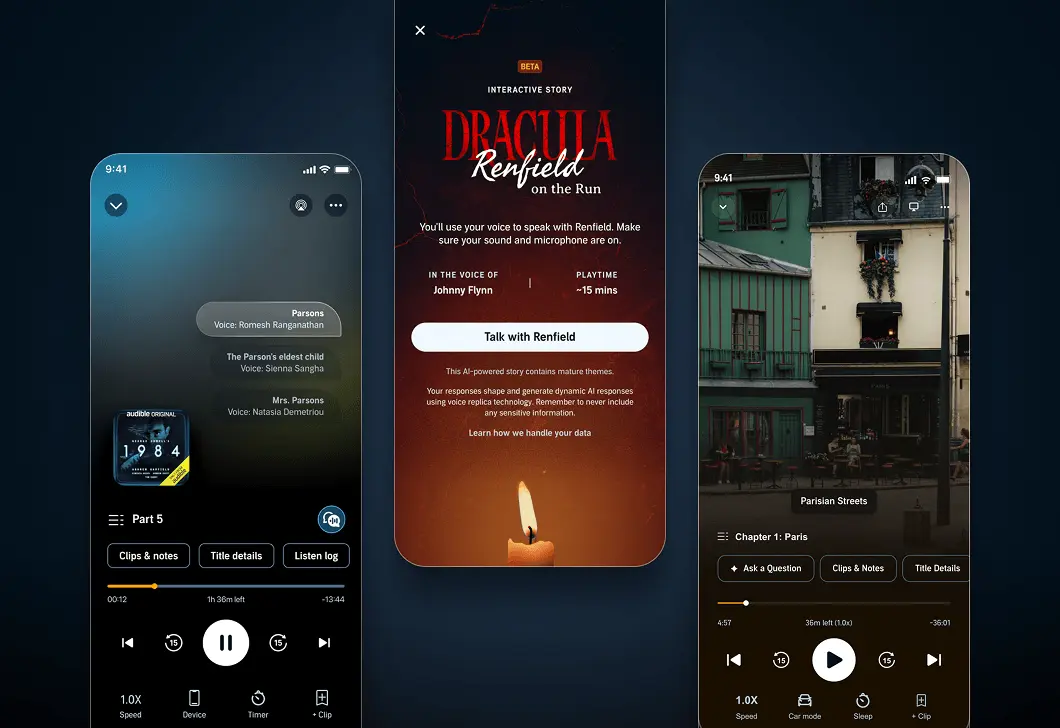
The Character Guide solves this friction point directly. Now live and integrated into select Audible Originals, the tool dynamically displays real-time identification of the speaker currently active in the scene. Furthermore, the player interface has been overhauled to include dedicated narrator and character headshots alongside comprehensive biographical bios. This bridges the disconnect between the listener and the artistic personnel bringing the text to life, fostering a deeper appreciation for the vocal performances without pulling the audience out of the narrative flow.
2. Interactive Stories: Stepping Inside the Narrative
Perhaps the most ambitious feature in Audible’s new arsenal is Interactive Stories, which merges generative AI, conversational design, and cinematic sound production to allow listeners to converse directly with characters in real time.
The initiative debuted with a specialized adaptation of Dracula. In this mode, listeners are assigned a specific role and a narrative mission. As the story unfolds, characters spontaneously initiate dialogue, prompting the user to respond in their own words. The AI-driven characters react dynamically on the spot, creating a branch-like conversational loop that heightens the dramatic stakes and transforms a traditional horror classic into a personalized role-playing experience.
Building on the momentum of Dracula, Audible has locked in November 5 for the release of its next Interactive Story. This upcoming experience will transport listeners into the cosmos of the Audible Original Exoplanet, crafted in close collaboration with sci-fi heavyweight Benjamin Percy.
3. Visual Explorer: Bringing Spatial and Contextual Depth to Audio
While audio is inherently an "eyes-free" medium, modern consumption habits—particularly among younger cohorts—frequently involve multi-tasking or a desire for visual anchors. To satisfy this appetite for multi-sensory engagement, Audible has developed the Visual Explorer.

This feature populates the playback interface with relevant visual context precisely when it matters most in the story. Depending on the narrative, this can include geographical maps tracking the journey of characters, historical artwork, or architectural diagrams.
The Visual Explorer is currently being showcased in The Cultural Tutor’s Grand Tour: The Story of Europe in Six Cities. As listeners journey through the audio guide, they can examine curated imagery and supplementary educational content detailing significant European landmarks, historical figures, and cultural touchstones, effectively merging the educational rigor of a documentary with the intimacy of an audiobook.
Supporting Context & Metrics: The Shift Toward Immersive Media
Audible’s pivot toward interactive, AI-enhanced audio is not happening in a vacuum. The global digital audio market has experienced explosive growth over the past decade, but user expectations are evolving rapidly. Industry analysts point to several driving forces behind this strategic evolution:
- The Rise of Interactivity: Modern consumers—particularly Millennials and Generation Z—have grown up with video games, branching narrative platforms, and hyper-personalized streaming feeds. Passive consumption is increasingly sharing space with interactive entertainment.
- The Multi-Tasking Listener: The vast majority of audiobook consumption occurs while listeners are engaged in secondary activities, such as commuting, exercising, or doing household chores. Tools that provide quick context, like the Character Guide, reduce the cognitive load required to catch up on complex plots during distracted listening sessions.
- The Maturation of Generative AI: Early experiments with synthetic media faced severe backlash from creators and consumers alike. Audible’s strategy highlights a crucial pivot: rather than using AI to cheapen production by replacing human narrators, the company is leveraging machine learning to build around premium human-crafted audio productions (such as multi-cast performances and professional sound design).
By confining these initial deployments to high-profile beta tests in the U.S. and U.K. markets, Audible is taking a calculated approach to data collection. The company will monitor engagement metrics, completion rates, and user feedback carefully before determining how and when to scale these technologies globally.
Official Statements
In announcing the new features, Audible leadership emphasized that the core mission remains rooted in respecting the creative intent of authors while unlocking new avenues for engagement.
"AI is allowing us to create new interactive experiences that today’s listeners, especially younger audiences, are craving," stated Andy Tsao, Chief Product and Analytics Officer at Audible.
"We are opening up entry points into stories that are still part of the authors’ vision, but that make our customers’ experiences more personal and unique."
Tsao’s remarks underscore a delicate balancing act for tech-forward publishing platforms: innovating aggressively to capture shifting consumer attention spans while preserving the sanctity of literary storytelling. By partnering with established creators like Benjamin Percy and leaning into canonical literary properties like Dracula and 1984, Audible is positioning these AI tools as enhancement layers rather than gimmicky distractions.
Future Outlook
As the initial beta rollout progresses across the United States and the United Kingdom, the audiobook industry will be watching closely. Success or failure in these markets will likely dictate the trajectory of digital publishing for the next decade.
Several key questions remain for the future of Audible’s AI initiatives:
- Creator Adoption: Will independent authors and traditional publishing houses embrace these tools for their own catalogs, or will Interactive Stories and Visual Explorers remain exclusive to high-budget Audible Originals?
- Technological Refinement: How will conversational AI models handle unexpected or abstract user inputs during real-time dialogue sequences in complex narratives?
- Global Expansion: Beyond the initial English-language beta markets, how quickly can these tools be adapted for localized, multi-language literary markets?
What is clear, however, is that the boundary between audiobooks, video games, and interactive media is officially blurring. If Audible’s beta test proves successful, the way humanity experiences stories in the auditory space will never be the same again.




Comments
Facebook App ID not configured. Please add it in the Customizer.