
Executive Overview
Eighty-one years after the atomic bombings of Hiroshima and Nagasaki in August 1945—cataclysms that fundamentally altered the geopolitical and ecological fabric of the twentieth century—the international literary landscape is witnessing a vital new intervention. Renowned Japanese author, manga artist, and visual creator Erika Kobayashi has inaugurated arbaro books, an independent Tokyo-based publishing venture established in 2025.
Timed deliberately to coincide with the eightieth anniversary of the dawn of the nuclear age, arbaro books seeks to bridge a persistent linguistic divide. Its primary mission is to translate and disseminate Japanese novels, graphic stories, poetry, and art books centered on the realities of radiation, historical trauma, and the nuclear era to English-speaking readers and global audiences. Guided by the slogan, “The End of Nuclear Literature. Recall the Past, Resist Now,” the press derives its name from arbaro, the Esperanto word for forest. Just as individual trees converge to create an interconnected woodland, Kobayashi’s venture aims to cultivate books that traverse borders, root themselves in new cultural soils, and foster international solidarity against the backdrop of resurging geopolitical conflicts.
In this exclusive, wide-ranging interview conducted by Sohini Basak and translated from the Japanese by Brian Bergstrom, Kobayashi reflects on the profound challenges of independent publishing, her latest editorial projects—including a dual-language release of Kyoko Hayashi’s powerful survivorship literature—and how contemporary literature can function as a bridge across historical amnesia and societal fracture.
Read Also
Detailed Chronology: From the Ashes of 1945 to the Birth of arbaro books
To understand the urgency driving arbaro books, one must trace a historical continuum that stretches from the atomic detonations of World War II to contemporary global anxieties over atomic energy and modern warfare.
- August 1945: The United States drops atomic bombs on Hiroshima (August 6) and Nagasaki (August 9), instantaneously killing tens of thousands of civilians and exposing generations of survivors, known as hibakusha, to long-term radiation poisoning and systemic stigma.
- Post-War Decades: A distinct literary genre emerges in Japan known as Genbaku bungaku (atomic bomb literature). Pioneers like Yoko Ota (Shikabane no Machi / City of Corpses, 1948) begin documenting the horror of the blasts, though women writers frequently face systemic marginalization within a male-dominated literary establishment.
- 1975: Kyoko Hayashi, a Nagasaki survivor who was fourteen years old at the time of the bombing, wins the prestigious Akutagawa Prize for Matsuri no Ba (Ritual of Death), cementing her lifelong dedication to bearing witness for every life altered or ended by August 9th.
- March 2011: The Great East Japan Earthquake triggers a massive tsunami, resulting in the accident at the Tokyo Electric Power Company’s (TEPCO) Fukushima Daiichi Nuclear Power Plant. The disaster unleashes radioactive contamination and plunges Japanese society into debates regarding public safety, state accountability, and the viability of nuclear energy.
- 2013: Erika Kobayashi publishes her pioneering graphic novel Hikari no Kodomo (Seeing the Light) with Little More, exploring the historical arc of radiation across time and geographies.
- 2024: Bungeishunju publishes Kobayashi’s critically acclaimed novel Onnanokotachi fūsen bakudan o tsukuru (Girls, Making Paper Balloon Bombs), which explores the wartime mobilization of schoolgirls to manufacture incendiary balloon weapons. The work receives the 78th Mainichi Publishing Culture Award. Concurrently, a major revival of Yoko Ota’s writings takes place in Japan via Takanashi Shobō.
- 2025:
- Kobayashi officially establishes arbaro books in Tokyo on the eightieth anniversary of the development and deployment of atomic weaponry.
- The press debuts with Seeing the Light, translated by Winifred Bird and designed by Brennan Kelly.
- Kobayashi participates in international contemporary art exhibitions, including the 13th Berlin Biennale (passing the fugitive on at the KW Institute for Contemporary Art) and New Utopia: The Ecosystems We Create at the Hirosaki Museum of Contemporary Art in Aomori.
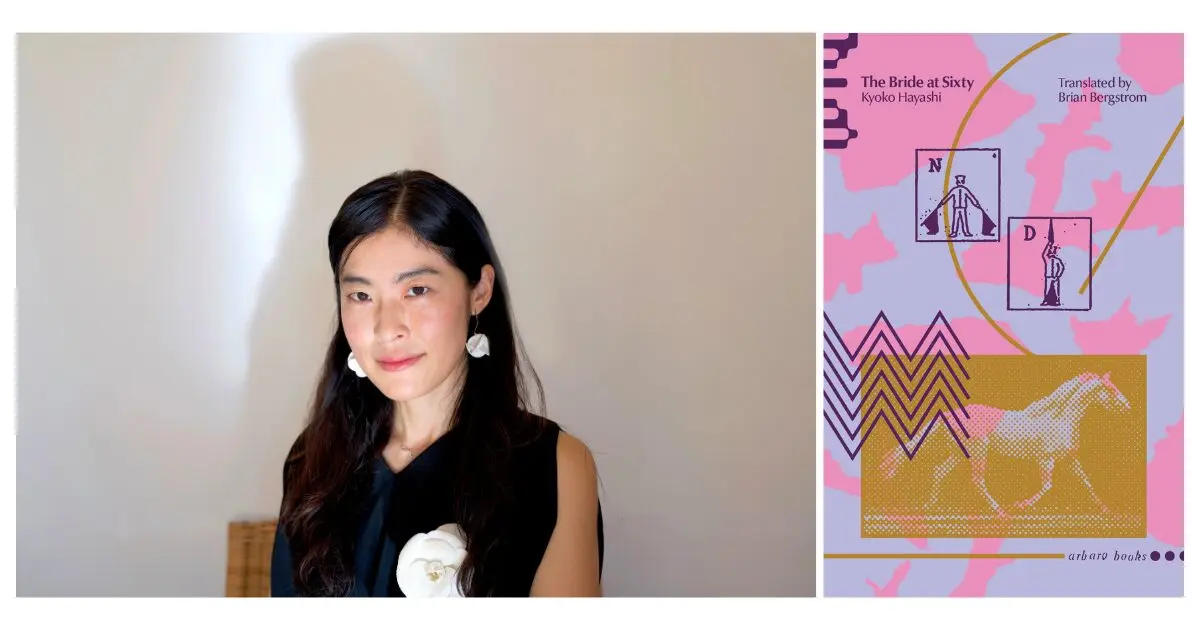
- 2026: arbaro books publishes its second major a simultaneous Japanese and English dual-volume release of Kyoko Hayashi’s classic short story The Bride at Sixty, paired with original conceptual art and drawings by Kobayashi.
Supporting Context & Metrics: The Mechanics of Genbaku bungaku and Independent Publishing
The corpus of Genbaku bungaku is vast, encompassing poetry, historical memoirs, contemporary manga, and avant-garde art. However, structural inequities have historically shaped what reaches the public square.
Gender Disparities in Nuclear Literature
Reflecting on the selection criteria for arbaro books, Kobayashi highlights a critical historical imbalance: the underrepresentation of female voices within atomic literature. During the mid-twentieth century, limited access to higher education for women, combined with a patriarchal literary infrastructure, suppressed the narratives of female survivors and writers.
"Within ‘atomic bomb literature,’ it was wonderful to see that a significant new movement reviving the writings of Yoko Ota took place in 2024, with a new edition of her work… being republished," Kobayashi notes.
By deliberately championing authors like Kyoko Hayashi and excavating the hidden labor of young women in wartime industries—such as the student laborers who constructed paper balloon bombs inside the Tokyo Takarazuka Theater—arbaro books works to correct historical omissions.
The Transnational Translation Ecosystem
Translation is framed by Kobayashi not merely as a mechanical transposing of words, but as an act of archival resurrection. Likening translation to a "séance," she notes how working closely with translators—such as Brian Bergstrom, Winifred Bird, and Yuki Tejima—brings historical subjects back to life in foreign tongues.
This collaborative network extends into design and visual arts. Working with book designer Brennan Kelly and musicians like Saho Terao, Kobayashi constructs multi-media ecosystems where literature intersects with installation art, music, and performance, ensuring that the legacy of radiation and societal conflict resonates across multiple sensory platforms.
Official Dialogue: In Conversation with Erika Kobayashi
Establishing arbaro books in the Shadow of the Nuclear Age
Sohini Basak (SB): Erika, you’ve been involved with the world of books for decades as a writer and a manga artist. What made you establish arbaro books and become a publisher?
Erika Kobayashi (EK): I established arbaro books in Tokyo in 2025, the eightieth anniversary of the development and dropping of atomic bombs and the start of the nuclear age. It is an independent publisher dedicated to bringing Japanese novels, stories, comics, and art books related to this cultural reality to readers of English and other languages.
From the bombings of Hiroshima and Nagasaki to the accident at the Tokyo Electric Power Company’s Fukushima Daiichi Nuclear Power Plant in 2011, many books and stories have been written in Japanese touching on this issue. For a long time, my wish has been to share this writing with the people of the world who speak other languages, and since 2025, this wish has started to come true. Our project’s slogan is: The End of Nuclear Literature. Recall the Past, Resist Now.
“Arbaro” is the Esperanto word for forest. Just as individual trees come together to form a forest, I named it with the hope that, with the help of many people, our books will cross borders, root themselves in new soil, and create a new world.
SB: And was it challenging to bring this dream into reality? Do you have a team to do the various kinds of work required—editing, designing, production, distribution, marketing, etc.?
EK: Yes, it is very hard! My admiration for everyone who has ever made one of my books, or sold one, has only deepened. arbaro books began in a very small, independent form. Our first publication was a translation of the first volume of my own graphic novel Seeing the Light (originally published as Hikari no Kodomo by Little More in 2013), which traces the history of radiation through time, and not just in Japan. Winifred Bird, with whom I had long wanted to work, produced a beautiful translation. The wonderful design was done by Brennan Kelly, with whom I’d previously worked as part of HaeAhn Paul Kwon Kajander’s Wandering Calendar, an art project in Canada.
Even now, we are only just beginning, and rely on the support of people who believe in this project and lend a hand. Luckily, I have made many friends and collaborated with people connected to the independent bookstore and publishing scene, and I’ve been able to receive all kinds of tips and advice.
Honoring the Legacy of Kyoko Hayashi
SB: Please tell us about arbaro books’s newest title, publishing this month.
EK: For arbaro books’s second title, the work I most wanted to publish was something by Kyoko Hayashi. Hayashi was fourteen years old when she survived the atomic bombing of Nagasaki. Years later, after marrying and giving birth, she began to write about that experience and made her debut. I was never able to meet her in person, but her novels mean a great deal to me—they have been a guide in my own creative work.
Matsuri no Ba (Ritual of Death), which won the Akutagawa Prize in 1975 and drew on her experience of the bombing, and its companion Giyaman bīdoro (Cut Glass, Blown Glass), are truly powerful works. What is extraordinary about her is that she carried August 9th with her throughout her entire life—continuing, for each individual death, each individual life, each individual soul who lived through that day with her, to bear witness, to think about the atomic bomb and the larger concept of the nuclear. Trinity kara Trinity e (From Trinity to Trinity), which she wrote after visiting the Trinity Site in New Mexico—where the world’s first atomic bomb test was conducted—and Futatabi Rui e (To Rui, Once Again), written in epistolary form after the TEPCO Fukushima Daiichi accident, are also extraordinary.
The book that we’re publishing, The Bride at Sixty, is a quiet, powerful work—one in which the author and her friends and fellow survivors (termed “hibakusha” in Japanese) are approaching their sixtieth year, a milestone known in Japanese as “kanreki.” When I received permission from Hayashi-san’s family to publish the story in Japanese and in English translation, simultaneously, as two separate volumes through arbaro books, I knew at once that I wanted Brian Bergstrom to translate it. Brian has worked on all my own books dealing with nuclear and atomic energy-related themes—Trinity, Trinity, Trinity (which received the 2022–23 Japan-U.S. Friendship Commission Prize for the Translation of Japanese Literature) and SUNRISE: Radiant Stories.
Because The Bride at Sixty is a short story, I was thinking about what form its publication might take. I consulted again with Brennan Kelly, who designed our first book, and we talked about combining it with my own drawings and publishing it as an art book. These are new drawings, made specifically for this book, drawn in response to and inspired by the story itself. That is what it became.
Navigating Collective Memory and Present-Day Anxieties
SB: While preparing for this interview, I learnt that there are three generations of “Genbaku bungaku,” the genre of literature that emerged as a response to the atomic bombings of Hiroshima and Nagasaki. How far-ranging are the works—for example, is there contemporary poetry and manga, too?
EK: There is an enormous amount—poems, manga, works of art. In recent manga, Fumiyo Kōno’s Kono Sekai no Katasumi ni (In This Corner of the World), which was also made into a film, is extraordinary. Many hibakusha continue to write and speak about their experiences, but we also have to think about how the next generation, and the generation after that, will carry forward those experiences and all they hold within them.
There is also, I feel, the increasingly urgent question of how we can speak about the atomic bomb while also reckoning with the violence perpetrated by our own military—Japan’s history of invasion and colonization.
SB: In the context of contemporary global tensions and renewed fears of nuclear conflict, could you also tell us a little bit about your own book Seeing the Light that was published by arbaro books in 2025?
EK: Seeing the Light is something I wrote in the aftermath of the 2011 accident at the Tokyo Electric Power Company’s Fukushima Daiichi Nuclear Power Plant. I found myself standing in a supermarket in Tokyo, picking up a single mushroom, checking whether it had been tested for radioactive contamination or not. At the same time, I found it was difficult—socially, personally—to discuss the issue openly. Anyone who has lived through the COVID-19 pandemic will recognize the way a society can feel like it’s fracturing over how to respond to a crisis: over vaccines for example, or over the larger question of what is and is not safe.
In the immediate aftermath of the accident, people were debating about how dangerous radiation really is, and about whether to be for or against the existence of nuclear power plants. Of course, these questions matter enormously. But the nuclear accident and the issue of radiation are not merely present-tense problems—they will reach one hundred years, one thousand years into the future. Yet no one seemed to want to look back at the hundred-odd years of history behind us, to ask what choices human beings made that brought us to this moment. That’s what I decided to draw—in the form of a graphic novel.
Today, as conflicts and wars continue, some countries are considering developing nuclear power more, and some have nuclear weapons or are reaching toward creating them. Before making that choice, I hope people will read this book—and then ask themselves, truly, whether it is what they want.
Archival Excavation and Women’s Wartime Labor
SB: Your fiction and conceptual art practice focus heavily on radiation and societal conflict. Do these themes continue in your forthcoming works as well?
EK: My most recent work is Onnanokotachi fūsen bakudan o tsukuru (Girls, Making Paper Balloon Bombs)—a novel based on the historical fact that, during the Second World War, schoolgirls in Japan were mobilized as student laborers to make balloon bombs out of washi paper and konnyaku paste. The English translation is by Yuki Tejima, and it is forthcoming from New Directions in the US and Fitzcarraldo Editions in the UK.
When I was researching the history of atomic bombs, I learned that a paper balloon bomb had flown near the Hanford Site in Washington state—the plant that had produced the plutonium core for the atomic bomb dropped on Nagasaki—and this is said to have delayed the bomb’s production by three days. I also learned that five children and one pregnant woman were actually killed by a balloon bomb in Bly, Oregon. When I discovered that these balloon bombs had been made by teenage schoolgirls in Tokyo—inside the Tokyo Takarazuka Theater, a popular all-female revue that is composed exclusively of unmarried women, then as now—and that a nun at the Catholic school I attended had once told my mother she had made them as a high school student, these threads came together and I decided to write this book.
During the research and writing process, I felt deeply how profoundly the voices of women have been dismissed in the recording of “History,” how much has been left out of the record. And yet, at the same time, I was handed document after document—small memoirs and collections that women had written and compiled themselves, passed into my hands by family members, friends, and teachers. It was only because I received them that I was able to write this book at all. That experience made me want to pass along the words and stories I believe in—to the wider world, and to the future. That’s one of the other reasons I started arbaro books.
I keep thinking about how to stop the wars that continue even now. When I trace the history of radiation and war, I keep running into feelings that cannot be sorted into simple categories like good and evil. Like, the fact that Marie Curie called radioactive radium “fairy light” and kept a piece of it on her bedside. Beauty and danger can exist together. I believe literature and art are what can hold that wholeness intact.
Future Outlook: The Horizon of arbaro books and Creative Synthesis
As arbaro books enters its second year of operation, Erika Kobayashi remains steadfast in her vision. Despite navigating a turbulent political climate in Japan and across the globe, she views literature as an enduring vessel capable of transcending national borders and language barriers.
Her creative practice continues to expand across mediums. In addition to editing forthcoming translations, Kobayashi is actively engaged in installation art and performance collaborations. Following her joint performance piece Onnanokotachi tsumugu to oru (Girls, Spinning and Weaving) with musician Saho Terao and vocal artist Ichiko Aoba, Kobayashi is pairing her literary texts with musical and visual performances, probing the spaces where language ends and visceral artistic expression begins.
Ultimately, arbaro books stands as a testament to the power of grassroots cultural intervention. By turning personal reverence for translated literature into an institutional reality, Kobayashi ensures that the ghosts of the nuclear age—and the resilient, overlooked voices of those who endured it—are neither forgotten nor silenced.
"The world is in a terrible state—my own country’s political situation included—and there are many days when I feel depressed," Kobayashi reflects. "Pero quiero creer que el amor por los libros, por la literatura, por el arte, puede cruzar idiomas y fronteras. I want to be able to speak to all future readers of what we put out through arbaro books."
Questions copyright © 2026 by Sohini Basak. Translation of Erika Kobayashi’s answers copyright © 2026 by Brian Bergstrom. All rights reserved.


Comments
Facebook App ID not configured. Please add it in the Customizer.