
Executive Overview
In the literary calendar, August stands as a crucial focal point for international literature through the annual celebration of Women in Translation Month (WIT Month). Founded in 2014 by literary blogger Meytal Radzinski, this global initiative seeks to address a persistent gender and geographic imbalance in the publishing industry: historically, the vast majority of translated works published in the English-speaking world were written by men. WIT Month champions women writers from across the globe, bringing visibility to diverse linguistic landscapes, overlooked narratives, and boundary-pushing translated fiction, non-fiction, and poetry.
In honor of Women in Translation Month, the editorial and administrative staff of Words Without Borders—a premier organization dedicated to promoting international literature and fostering cultural understanding through translation—have curated a diverse and compelling slate of book recommendations. Spanning six distinct titles translated from Arabic, Albanian, Spanish, German, and Danish, these staff picks showcase the breathtaking range of contemporary global literature.

From dreamlike novellas exploring displacement and identity in Palestine to piercing poetic examinations of systemic injustice, experimental biographies, and sun-drenched European psychological dramas, this year’s curation reflects a deep commitment to literary innovation. This comprehensive report explores the highlighted titles, dissecting their thematic resonance, the linguistic artistry of their translators, and the broader cultural implications of championing women’s voices in translation today.
Read Also
Detailed Chronology: The Evolution and Impact of Women in Translation Month
To fully appreciate the significance of the Words Without Borders staff picks, it is essential to contextualize the movement that gave rise to them.

The Birth of a Global Movement (2014)
For decades, the publishing industry operated under what translation advocates termed the "Three Percent Problem"—the statistic that roughly only three percent of all books published annually in the United States were works in translation. Within that meager slice, works authored by women constituted an even smaller fraction. Recognizing this systemic disparity, literary critic Meytal Radzinski launched Women in Translation Month in August 2014. Her call to action was simple yet revolutionary: read, review, and promote books written by women in translation throughout the month of August.
Momentum and Institutional Recognition (2015–2020)
In the years following its inception, WIT Month evolved from a grassroots blogging campaign into an international phenomenon embraced by independent bookstores, major publishing houses, literary prizes, and cultural institutions. Translators, editors, and readers utilized social media platforms to share reading lists, host read-alongs, and spotlight independent presses specializing in international literature (such as Archipelago Books, Two Lines Press, and Restless Books). During this period, organizations like Words Without Borders became instrumental in sustaining the momentum, regularly featuring translated works by women and providing platforms for international writers.

The Contemporary Landscape (2021–Present)
Today, WIT Month intersects with a growing appetite for global literature in the English-speaking market, buoyed by high-profile acknowledgments such as the International Booker Prize. However, systemic challenges remain. Translators continue to fight for fair compensation, contractual visibility (such as having their names featured on book covers), and institutional support. Curation efforts by literary organizations like Words Without Borders serve not only as reading guides for enthusiasts, but as vital interventions that direct commercial and critical attention toward voices that might otherwise remain sidelined.
Supporting Context & Metrics: The 2026 Staff Selections Analyzed
The six titles selected by the Words Without Borders staff for Women in Translation Month offer a microcosm of contemporary global letters. Below is a detailed breakdown of each recommended work, its creators, and the critical perspective offered by the Words Without Borders team.

1. The Sleep Thief by Ibtisam Azem (Translated from Arabic by Sinan Antoon)
- Recommended by: Sohini Basak, Poetry Editor
- Thematic Focus: Displacement, identity, and the surreal rhythms of daily life in Palestine.
- Critical Analysis: The Sleep Thief marks the debut novel of Palestinian author Ibtisam Azem. The narrative centers on a Palestinian man named Gharib—whose Arabic name fittingly translates to "the stranger"—over the course of a few pivotal days. Poetry Editor Sohini Basak highlights the novel’s "lyrical and gently experimental" structure, praising its slim, dreamlike quality. The translation is handled by acclaimed Iraqi-American poet and novelist Sinan Antoon, whose poetic sensibilities bridge the linguistic gap between Arabic and English, preserving the text’s haunting musicality.
2. She Who Remains by Rene Karabash (Translated from Albanian by Izidora Angel)
- Recommended by: Susan Harris, Editorial Director
- Thematic Focus: Ancient ritual, patriarchy, queer identity, and the tradition of Albanian "sworn virgins."
- Critical Analysis: Set in an isolated Albanian mountain village governed by strict customary laws, She Who Remains tells the harrowing story of Bekija. Trapped between an unwanted arranged marriage and a forbidden romance with a female friend, Bekija makes a radical choice: she elects to become a sworn virgin, renouncing her femininity to live and move through society as a man. Editorial Director Susan Harris notes that Rene Karabash employs a poetic stream of consciousness that, paired with Izidora Angel’s "dazzling translation," captures complex themes of bodily autonomy and queer survival. Published in February, the novel quickly earned a spot on the International Booker Prize shortlist, positioning it as a major contender for US translation awards.
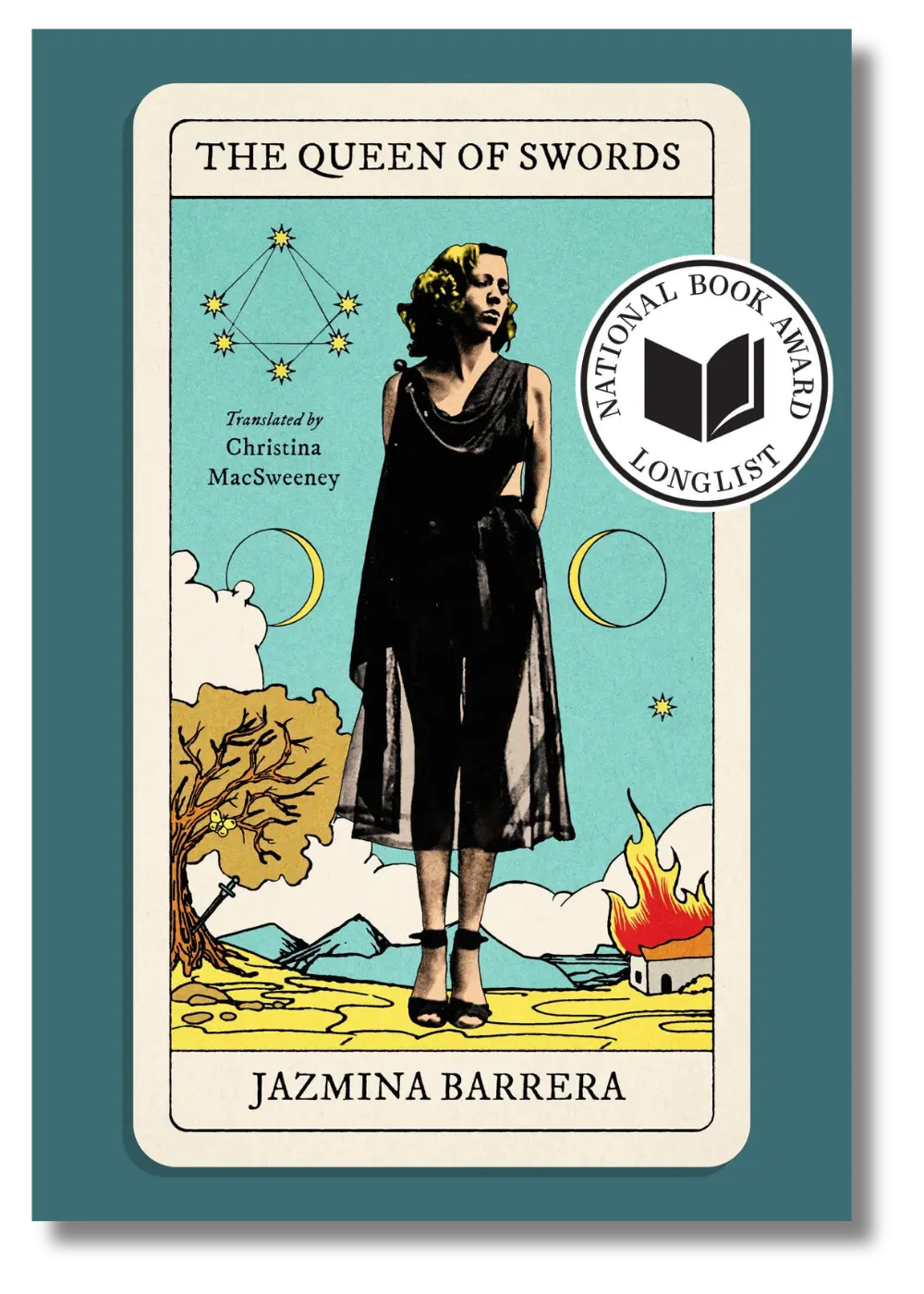
3. The Queen of Swords by Jazmina Barrera (Translated from Spanish by Christina MacSweeney)
- Recommended by: Alicia Lim, Finance and Operations Manager
- Thematic Focus: Experimental biography, memoir, literary ghosts, and the life of Mexican writer Elena Garro.
- Critical Analysis: Blurring the boundaries between biography and personal essay, Jazmina Barrera’s The Queen of Swords constructs an intimate, cross-temporal dialogue between the author and pioneering Mexican writer Elena Garro. Finance and Operations Manager Alicia Lim describes devouring the book, emphasizing how Barrera deliberately stitches together fragments of Garro’s life while leaving structural gaps and loose threads exposed. Translated by Christina MacSweeney, the book invites readers to sit with the mysteries, contradictions, and ghostly resonances of a literary forebear rather than settling for linear certainty.
4. Exophony: Voyages Outside the Mother Tongue by Yoko Tawada (Translated from Japanese and German by Lisa Hofmann-Kuroda)
- Recommended by: Nina Perrotta, Senior Editor and Development Manager
- Thematic Focus: Multilingualism, literary migration, and the psychological space between languages.
- Critical Analysis: Yoko Tawada, a celebrated author who writes in both Japanese and German, explores the slippery, transformative experience of living and creating outside one’s native tongue in her essay collection Exophony. Senior Editor and Development Manager Nina Perrotta highlights Tawada’s wit and intellectual agility, drawing attention to evocative essay titles such as "On Mistranslating the Moon" and "Los Angeles: The Poetic Ravine between Languages." Translated with precision by Lisa Hofmann-Kuroda, the collection serves as an essential meditation for anyone interested in how language shapes human consciousness.
5. Enter World by Dalia Taha (Translated from Arabic by Sara Elkamel)
- Recommended by: Alex Tan, Editorial Fellow
- Thematic Focus: Endurance, daily life amidst occupation, and the architecture of survival in Palestine.
- Critical Analysis: Dalia Taha’s poetry collection Enter World is characterized by Editorial Fellow Alex Tan as a "distilled, elemental collection that stages, with every poem, a life lived—thriving, attentive, defiant, tender—amid the ruins, in Palestine." The collection employs a recurring theatrical device, with every poem’s title beginning with the word "Enter" (e.g., enter wrist pain, enter apartheid, enter girl with books). Skilfully translated by Sara Elkamel, Taha juxtaposes the quotidian with the catastrophic—pairing olive trees and morning dew with checkpoints and military occupation—drawing comparisons to the sparse, oracular precision of Adania Shibli and Etel Adnan.
6. Seeing Further by Esther Kinsky (Translated from German by Caroline Schmidt)
- Recommended by: Maggie Vlietstra, Education Program Manager
- Thematic Focus: Community spaces, cinematic nostalgia, stubborn technological transitions, and rural restoration.
- Critical Analysis: Esther Kinsky’s Seeing Further follows a woman who stumbles upon a dilapidated movie theater in rural Hungary and embarks on the grueling, quixotic task of restoring it. Education Program Manager Maggie Vlietstra champions the book as a love letter to cinephiles and those who believe in the irreplaceable magic of collective film-watching. Translated from German by Caroline Schmidt, the novel offers a reflective exploration of preservation, community infrastructure, and shared cultural experiences.
7. Waist Deep by Linea Maja Ernst (Translated from Danish by Sherilyn Nicolette Hellberg)
- Recommended by: Anna Claire Weber, Marketing & Communications Manager
- Thematic Focus: Millennial angst, relationship dynamics, summer reunions, and social satire.
- Critical Analysis: Rounding out the summer season, Linea Maja Ernst’s debut novel Waist Deep transports readers to a Danish lake house where a group of college friends reunite. Marketing & Communications Manager Anna Claire Weber praises the novel’s lush prose, luxurious pacing, and structural echoes of Shakespeare’s A Midsummer Night’s Dream. Alongside its steamy psychological drama, the novel playfully satirizes millennial anxieties, making it one of the sharpest contemporary encapsulations of aging, longing, and social pretense in the twenty-first century.
Official Statements and Editorial Insights
The curation process behind the Words Without Borders staff picks highlights a broader institutional philosophy regarding international translation. In internal statements shared across the publication’s platform, editors emphasized the dual responsibility of literary translation: honoring the formal integrity of the original text while ensuring it resonates with English-language readers.
- On Linguistic Risk: Editorial leadership noted that this year’s selections display an unusually high degree of formal experimentation. Whether through Dalia Taha’s theatrical poetic refrains, Jazmina Barrera’s fragmented biographical collages, or Yoko Tawada’s cross-linguistic essays, these authors refuse to conform to traditional narrative expectations.
- On Geographic Representation: By featuring works originating from Palestine, Albania, Mexico, Japan, Germany, Denmark, and Hungary, the staff selection underscores the borderless nature of women’s literature. Translation functions not merely as a mechanical conversion of words, but as an act of political and cultural solidarity.
- On Translator Visibility: The inclusion of prominent translators such as Sinan Antoon, Izidora Angel, Christina MacSweeney, Lisa Hofmann-Kuroda, Sara Elkamel, Caroline Schmidt, and Sherilyn Nicolette Hellberg reinforces the vital role that translators play as co-creators of literary art.
Future Outlook: The Horizon of Translated Literature
As Women in Translation Month continues to expand its cultural footprint, the outlook for translated literature authored by women appears both promising and challenging.

On one hand, institutional milestones—such as Rene Karabash’s shortlisting for the International Booker Prize and the increasing presence of translated titles on major bestseller lists—indicate a growing commercial and critical appetite for global narratives. Readers are increasingly seeking out perspectives that transcend Western-centric literary canons.
On the other hand, economic pressures on independent presses, fluctuating grant funding for translation projects, and ongoing debates surrounding artificial intelligence in translation pose significant hurdles. Organizations like Words Without Borders remain on the front lines, advocating for human translation, championing underrepresented languages, and ensuring that women writers from every corner of the globe find an engaged, global audience.

For readers looking to deepen their engagement this August and beyond, the 2026 Words Without Borders staff picks provide an indispensable roadmap into the vibrant, urgent, and transformative world of women in translation.





Comments
Facebook App ID not configured. Please add it in the Customizer.